Saint Cyprian
Birth unknown - September 14, 258
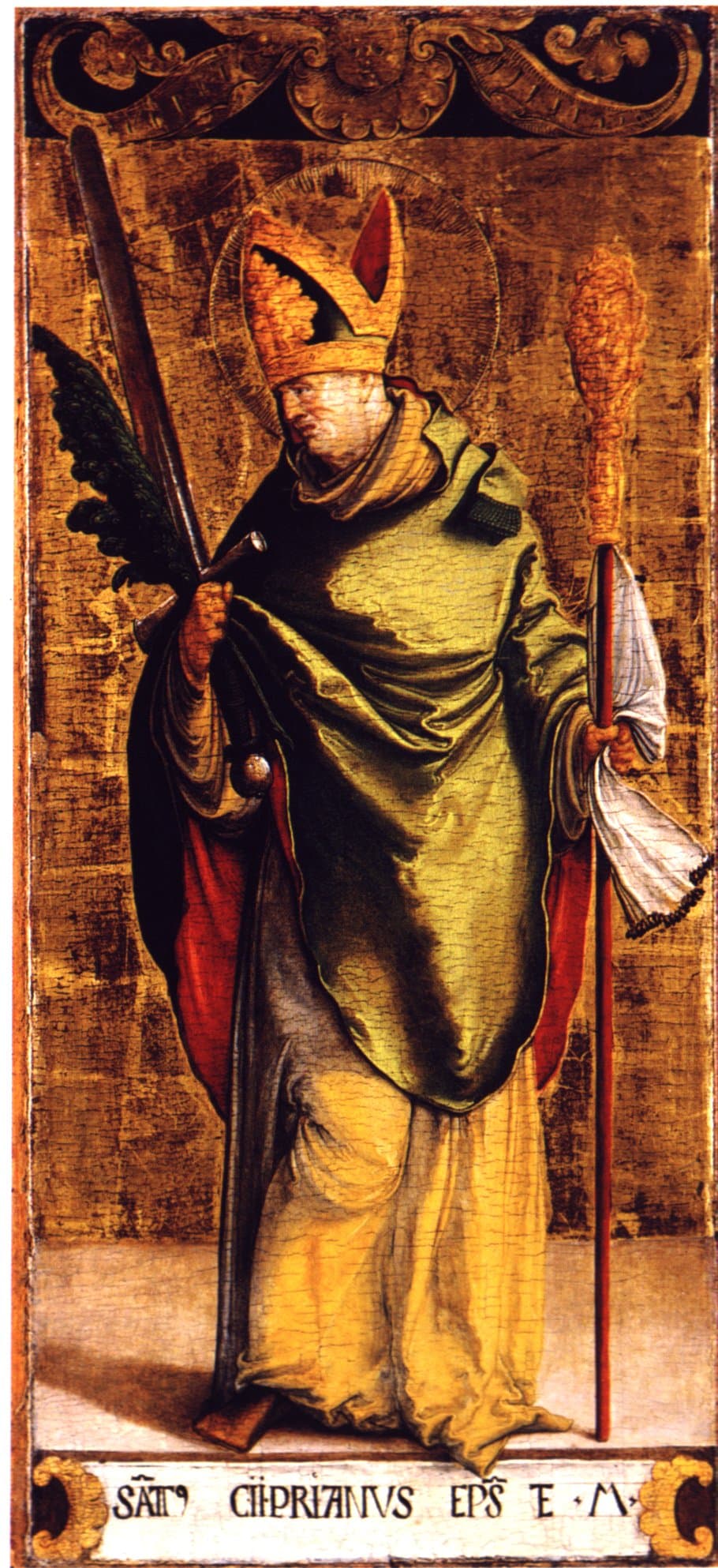
- Feast day
- September 16 2
- Born
- Unknown. "Of the date of the saint's birth and of his early life nothing is known" 1
- Died
- Beheaded near Carthage on September 14, 258, the first bishop of that city to be martyred 1
- Baptized
- About 246, probably on Easter eve, April 18, as an adult convert 1
- Bishop of Carthage
- About 248 or early 249, against his will, "constrained by the people" 1
- Wrote
- Eighty-one surviving letters and some dozen treatises, including "De Ecclesiae Catholicae Unitate" 1
- Was wrong about
- The baptism of heretics. Chapman says the principle that settled it came later, from Augustine 1
Saint Cyprian was a wealthy North African orator who became a Christian somewhere past the middle of his life, was made bishop of Carthage about two years later over his own objection, and then spent nine years deciding hard questions under persecution. 1 He hid from the emperor Decius and was reproached for it for the rest of his life. 1 He organized the nursing of a plague city that blamed the plague on him. 12 He fought a pope to a standstill over a sacrament and was, the encyclopedia says, mistaken. 1 He was beheaded outside Carthage in 258, and refused to be tried anywhere else. 1
A convert with nothing behind him
The article opens by admitting what it does not have. "Of the date of the saint's birth and of his early life nothing is known." 1 At his conversion he had "perhaps, passed middle life"; he was famous as an orator and a pleader, had considerable wealth, and held a great position in the chief city of Roman Africa. 1 Everything known about the first forty or fifty years of him is that they went well.
His deacon Pontius wrote his life and it survives, which is why anything is known about his manner: "his mien was dignified without severity, and cheerful without effusiveness." 1 Franciscan Media reaches the same reading by a different road, calling him "a mixture of kindness and courage, vigor and steadiness" and noting that he was "cheerful and serious, so that people did not know whether to love or respect him more." 2
Chapman then declines to inflate him. "He was not a thinker, a philosopher, a theologian, but eminently a man of the world and an administrator, of vast energies, and of forcible and striking character." 1 That is the frame for everything that follows. Cyprian was not handed a set of doctrines to defend; he was handed a diocese in an emergency and had to decide.
He was converted by an aged priest named Caecilianus, in whose house he seems to have lived, and who on dying commended his own wife and family to Cyprian's care. 1 While still a catechumen he decided to observe chastity, and gave away most of his revenues. 1 Franciscan Media says the vow of chastity before baptism is what amazed his fellow citizens. 2 He sold his property, including his gardens at Carthage - which came back to him, apparently bought for him by friends, though Chapman notes he would have sold them a second time had the persecution made keeping them unwise. 1
He was baptized about 246. Within two years he was a priest, and about 248 or the beginning of 249 he was made bishop of Carthage. 12 He had declined the office and was "constrained by the people"; five priests voted against him and stayed his enemies afterward. 1
The bishop who went into hiding
Decius became emperor in October 249 and published his edict against Christians in January 250. Bishops were to be killed; everyone else tortured until they recanted. 1 Pope Fabian was martyred on January 20, and at about the same time Cyprian left Carthage for a place of safety. 1
"His enemies continually reproached him with this," Chapman writes, and then argues the other side: to stay was to court death, to bring greater danger on others, and to leave the church without government, since electing a replacement bishop was impossible under the edict. 1 Franciscan Media records the same criticism in a single parenthesis - he fled "to a hiding place from which to direct the Church - bringing criticism on himself." 2 Neither source pretends the criticism was not made.
What he did from hiding was administrative and unglamorous. He handed a large sum to a confessor priest, Rogatian, for the needy. He suspended the pay of clergy who had fled, because their work was needed and they were in less danger than he was. He wrote to the confessors in prison and wrote up the martyrs as they died. 1
Meanwhile the city apostatized. Chapman is exact about the shape of the collapse: at Carthage "the majority apostatized", some sacrificing outright and others buying certificates - libelli - saying that they had. Of these libellatici "there were several thousands in Carthage." 1 Some bought their whole family's exemption at the price of their own sin. 1
What to do with the people who gave in
This is the question that made him. Franciscan Media puts its importance plainly: the reinstatement of the lapsed "caused the great controversies of the third century, and helped the Church progress in its understanding of the Sacrament of Penance." 2
There was already a practice of the lapsed begging peace from those who had suffered, and it had gotten loose. A confessor named Lucian obtained a commission from a dying martyr to grant peace to anyone who asked, and issued pardons with a vague formula: "Let such a one with his family communicate." 1 The five priests who had opposed Cyprian's election were admitting anyone who arrived with a confessor's recommendation, and the confessors then issued a general indulgence. 1 Novatus, the most prominent of the five, set himself up in Cyprian's absence and took back every apostate with no penance at all. 2
Cyprian held a middle course and it satisfied nobody. Those who had actually sacrificed to idols could receive Communion at the point of death; those who had only bought certificates could be admitted after a period of penance. 2 He was prepared to give the improperly granted indulgences some weight, but only through the bishop, and he wanted the whole question held until councils could meet at Rome and Carthage and decide together. 1 His argument was not about severity. "The lapsed must surely not be placed in a better position than those who had stood fast, and had been tortured, or beggared, or exiled." 1
Franciscan Media notes that even this was relaxed when the next persecution came. 2 The principle survived the concession.
The plague
Plague reached Carthage in 252. Chapman describes what Cyprian did in one clause that is easy to read past: he "with wonderful energy, raised a staff of workers and a great fund of money for the nursing of the sick and the burial of the dead." 1 The pamphlet he wrote for it, "On the Mortality", Chapman calls beautiful. 1
Franciscan Media adds the instruction that gives the episode its edge: during the plague "Cyprian urged Christians to help everyone, including their enemies and persecutors." 2 This was a city in which the majority had renounced the faith two years earlier and in which he was personally blamed for the disease. One of his other works, "ad Demetrianum", is a reply "to the accusation of a heathen that Christianity had brought the plague upon the world" - and Chapman says it is the only one of his writings "couched in a pungent strain." 1
He also wrote "On Almsgiving" at some point, which Chapman suspects was an answer to the rumor that Cyprian's own lavish giving was a way of buying supporters. 1
Losing an argument with Rome
The African church held that baptism administered by heretics was no baptism, and had said so in council before Cyprian was born. 1 He stated it with force: converts from heresy "are not washed there but rather defiled, nor are their faults purged but heaped up." 1
Stephen became pope in May 254. When sixty-one African bishops signed a letter in 256 explaining their practice and claiming that bishops were free to differ on it, Stephen issued a peremptory decree that no innovation was to be made and the Roman custom must be observed everywhere, on pain of excommunication, with some severe censures on Cyprian by name. 1
Cyprian's reply to Pompeius is quoted at length by Chapman and is not a document about patience. "As you read it, you will note his error more and more clearly: in approving the baptism of all the heresies, he has heaped into his own breast the sins of all of them; a fine tradition indeed! What blindness of mind, what depravity!" 1 Then the encyclopedia turns on him: "ineptitude", "hard obstinacy" - "such are the expressions which run from the pen of one who declared that opinion on the subject was free, and who in this very letter explains that a bishop must never be quarrelsome, but meek and teachable." 1
A larger council in September 256 backed Cyprian unanimously, and he made a point of not deciding for it: he "declared that no one made himself a bishop of bishops, and that all must give their true opinion", so each bishop voted in a short speech and the minutes survive. 1 The messengers who carried the result to Rome were refused an audience by the pope and denied hospitality, and came straight home. 1
It ended without resolution. Stephen died in August 257 and his successor Sixtus II, whom Pontius calls "a good and peace-loving bishop", simply communicated with Cyprian, and the question was dropped. 1 Chapman's verdict is that Cyprian argued from "a wrong inference from the unity of the Church", and that the principle which actually settles the matter - that the validity of a sacrament does not depend on the minister, Ipse est qui baptizat - was not formulated by anybody until Augustine. 1
It was during this quarrel that he wrote his treatise on patience. Franciscan Media says his own feelings "must have concerned him" and dates the treatise to exactly this period; Chapman, reading the letters, has him sending a copy of the newly written "De Bono Patientiae" to Jubaianus in the middle of the dispute. 12 Franciscan Media closes the matter with Augustine's judgment, that "Cyprian atoned for his anger by his glorious martyrdom." 2
Refusing to die anywhere else
The first trial went on the record and survives as the opening of the proconsular Acts. Cyprian said he was a Christian and a bishop, that he served one God to whom he prayed day and night for all men and for the safety of the emperor. The proconsul Paternus asked whether he persevered in this. "A good will which knows God cannot be altered." Asked whether he could go into exile at Curubis, he said: "I go." Asked for the names of his priests, he refused, on the ground that informing was forbidden by the laws and they could be found easily enough in their own cities. 1 Pontius, who went with him, reports that the town was lonely but sunny and pleasant, with plenty of visitors and kind citizens. 1
In August 258 he learned that Pope Sixtus had been put to death in the catacombs with four of his deacons, under a new edict ordering the immediate execution of bishops, priests and deacons. 1 The new proconsul, Galerius Maximus, sent for him. Many people of rank urged him to run, "but he had now no vision to recommend this course, and he desired above all to remain to exhort others." 1 Franciscan Media renders the same decision in one line: "He refused to leave the city, insisting that his people should have the witness of his martyrdom." 2
He did hide, but only from the summons to Utica, "for he declared it was right for a bishop to die in his own city." 1 When Galerius returned to Carthage, Cyprian was fetched from his own gardens by two officials in a chariot; the proconsul was ill, so he spent the night in an official's house with his friends around him. 1
On the morning of September 14 a crowd was ordered to gather at the villa of Sextus. He refused to sacrifice and said that in such a matter there was no room for thought of the consequences to himself. When the sentence was read the crowd shouted, "Let us be beheaded with him!" 1
The detail of the execution is the part worth reading slowly. He was taken to a hollow surrounded by trees, which people climbed to see. He took off his cloak, knelt, and prayed. He took off his dalmatic and gave it to his deacons and stood in his linen tunic, waiting, and ordered that twenty-five gold pieces be given to the executioner. The congregation threw down cloths and handkerchiefs in front of him to catch his blood. He bandaged his own eyes, helped by a priest and a deacon who were both named Julius. "So he suffered." 1
His body was left on show for the rest of the day to satisfy the curiosity of the pagans, and at night the Christians carried him away with candles and torches to the cemetery of Macrobius Candidianus, in the suburb of Mapalia. 1 He was the first bishop of Carthage to be martyred. 1
What is Saint Cyprian the patron saint of?
Neither source cited here gives him a patronage. 12 Chapman's article runs to many thousands of words on his writings, his councils and his death and never raises the question, and Franciscan Media's entry ends with the feast day. This page leaves it open rather than filling it in.
What he is plainly for is the situation he actually handled: a leader deciding, without precedent, what to do about people who failed under pressure and want to come back.
Saint Cyprian's feast day
The feast of Saint Cyprian is September 16. 2 Franciscan Media states it in the last line of its entry: "His liturgical feast is celebrated on September 16." 2
He died on September 14. Chapman is unambiguous about it - the crowd gathered "on the morning of the 14th", and the trial and beheading followed the same day. 1 Neither source explains the two-day gap between the death and the feast, and this page does not guess at one.
Praying with Saint Cyprian
He is the saint for a decision you are not qualified to make and cannot postpone. Nothing in his background had prepared him for any of it. He was a lawyer and a public speaker who had been a Christian for about two years when he was handed a diocese, and four years later an empire-wide persecution arrived and thousands of his people signed away their faith to stay alive.
The middle course he took is instructive because it is not a compromise between mercy and rigor so much as a refusal to let either be cheap. He would not tell people who had sacrificed to idols that nothing had happened, and he would not tell them that nothing could be done. He also would not decide it alone, and said so at a council that agreed with him unanimously: "no one made himself a bishop of bishops." 1
He was also wrong, publicly, at length, and in print. Chapman says so, quotes the worst of what he wrote to Pompeius, and points out that the man denouncing Stephen's obstinacy had himself written that a bishop must be "meek and teachable." 1 Nothing in the article suggests that being a saint protected him from this. What it does record is that in the middle of the quarrel he sat down and wrote a treatise on patience, which suggests he knew. 12
Then the plague, and the instruction to nurse the people who had informed on them. 2 Then a proconsul, and a chance to leave, and the refusal to be tried in a town where his congregation could not see it. He gave away his cloak, tipped his executioner, and let two men named Julius tie the bandage over his eyes. 1
Saint Cyprian, pray for us.
Sources
Saints to turn to next
Others in this collection who are turned to for some of the same things.
- Saint John Paul IIMay 18, 1920 - April 2, 2005CourageSuffering and illnessConversion
- Saint Josephine Bakhitac. 1869 - February 8, 1947Suffering and illnessConversionCourage
- Saint Patrickc. 415 - 493CourageConversionSuffering and illness
- Saint Thomas Becketc. 1118 - December 29, 1170CourageConversionSuffering and illness