Saint Gregory the Illuminator
c. 257 - c. 337 (both dates uncertain)
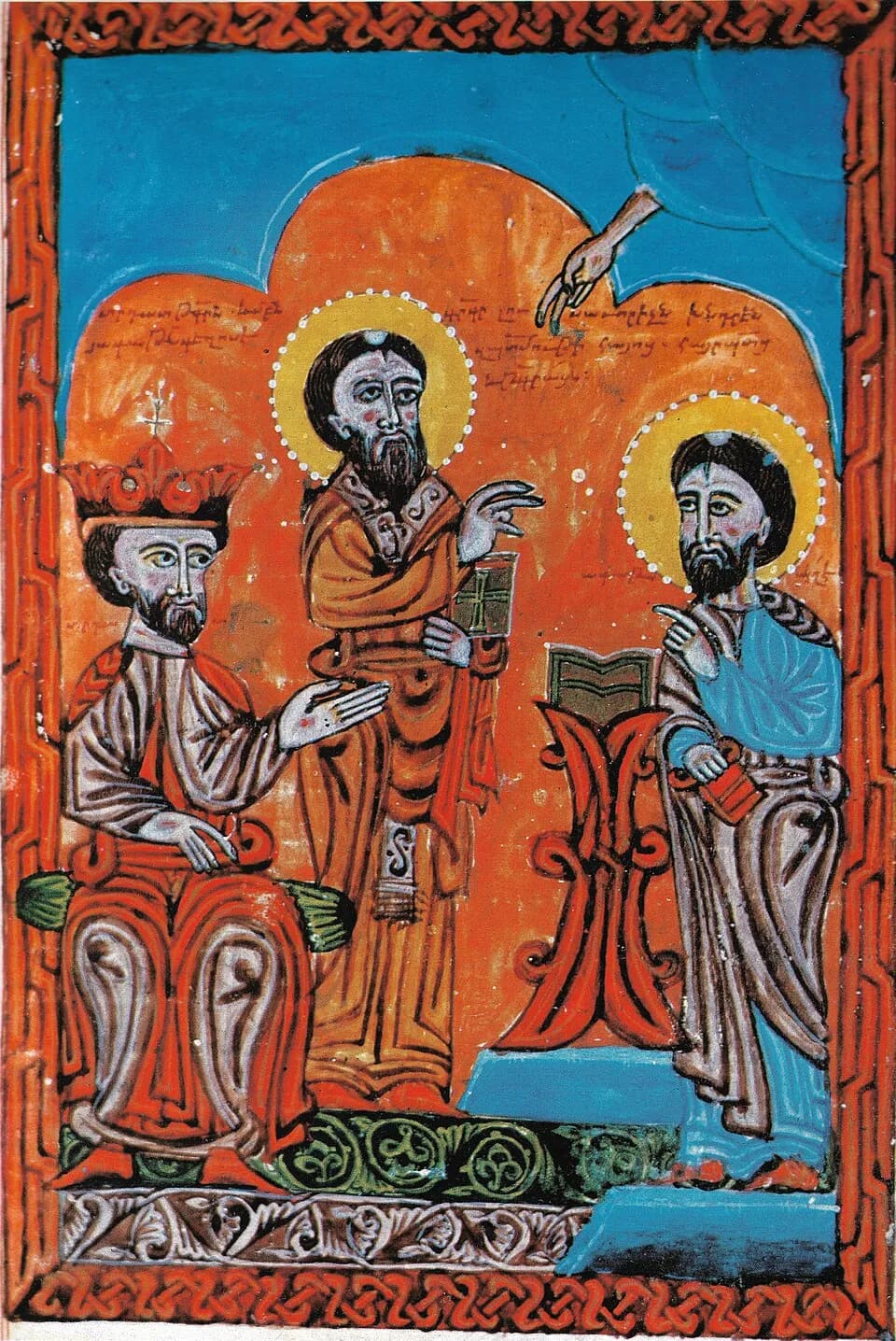
- Born
- Perhaps 257; the Catholic Encyclopedia prints the year with a question mark 1
- Traditional date of the conversion
- 301 2
- Ordained bishop
- At Caesarea, by Leontius 1
- Died
- Perhaps 337; buried at Thortan 1
- Patron saint of
- Armenia: "the apostle, national saint, and patron of Armenia" 1
Saint Gregory the Illuminator is the bishop who, at the start of the fourth century, converted King Tiridates of Armenia and with him made Armenia what John Paul II called "the first officially Christian people." 12 The Catholic Encyclopedia names him "the apostle, national saint, and patron of Armenia." 1 A sober outline of his life can be drawn, and around it stands a famous legend of a pit, a martyred virgin and a king turned into a boar. The Roman Martyrology keeps him on September 30. 4
Armenia before Gregory
Adrian Fortescue begins his encyclopedia article with a correction: "He was not the first who introduced Christianity into that country." 1 The Armenians trace their faith to the apostles Bartholomew and Thaddeus, a tradition John Paul II also mentions, and the encyclopedia holds it certain that there were Christians, and even bishops, in Armenia before Gregory. 12
That earlier church was wrecked by war. Armenia was the frontier state between Rome and Persia, and in the third century the new Sassanid dynasty overran it and imposed its own religion. The Armenian king Khosrov was murdered, on the Persian king's orders, by a Parthian named Anak. Khosrov's son Trdat, or Tiridates, escaped, was trained in the Roman army, and eventually came back to drive the Persians out and restore the kingdom. 1
What can be said with some certainty
Gregory had been brought up a Christian at Caesarea in Cappadocia and seems to have belonged to a distinguished Armenian family. He was married and had two sons. 1 He was persecuted at first by Tiridates, who defended the old Armenian religion, and in the end converted him. 1
The king then made Christianity the faith of the nation. The nobles followed easily, and after them, in Fortescue's dry phrase, "the people followed — or were induced to follow — too." 1 Temples became churches and the people were baptized in thousands. Because this happened while Diocletian was emperor, between 284 and 305, the encyclopedia grants that Armenia "has a right to her claim of being the first Christian State." 1 John Paul II gives the traditional year as 301. 2
Gregory went back to Caesarea to be ordained, and its bishop Leontius made him bishop of the Armenians. He set up other bishops through the country and fixed his own seat at Ashtishat, where the chief temple had become a church called the "mother of all Armenian churches." 1 One choice of his had long consequences: "He preached in the national language and used it for the liturgy." 1
Toward the end of his life he retired, and his son Aristakes succeeded him and attended the Council of Nicaea in 325. 12 The Pope's letter says Gregory withdrew to the desert to live as a hermit; the Martyrology speaks of a cave where the branches of the Euphrates meet, in which he died in peace. 24 He was buried at Thortan, and a monastery was built by the grave. 1 "This," Fortescue concludes, "is what can be said with some certainty about the Apostle of Armenia." 1
The legend of the pit
The story most people know comes from a Life written under the name of Agathangelos, who claims to be the king's secretary. The encyclopedia dates it after 456 and says it "embellishes the narrative with wonderful stories that need not be taken very seriously." 1 John Paul II, retelling it for the anniversary, calls it "a tale full of symbolism." 2
In this Life Gregory is the son of Anak, the man who killed the king's father. As a child he is carried to Caesarea by a Christian nurse and baptized there. 1 Grown, he returns to Armenia, and when Tiridates orders a sacrifice to the national gods he refuses. The Pope names the goddess as Anahit and gives Gregory's reason, that there is only one Creator of heaven and earth. 12 He is tortured, and then thrown into what the letter describes as "a deep pit, a dark, narrow place infested with snakes, where previously no one had ever survived." 2 There he stays for years, fifteen in the encyclopedia's summary and thirteen in the Pope's, kept alive by bread that a widow brings him. 12
Meanwhile the king kills the virgin Hripsime, who had refused him, together with her companions. As a punishment he is turned into a wild boar. 12 A vision tells his sisters that only Gregory's prayers can save him, though everyone supposes Gregory long dead. They find him alive in the pit. He comes out, the king is restored, and the conversion of the country follows. 1
From there the numbers grow. In the Life, Gregory baptizes four million people in seven days, comes to rule four hundred bishops, and travels with Tiridates and seventy thousand men to congratulate Constantine. 1 Fortescue points out the models: "Gregory in the pit acts like Daniel in the lion's den," and the king as a boar is Nebuchadnezzar. 1 A long sermon put into Gregory's mouth, more than half the book, bears the marks of the later fifth century, and yet was used for centuries by the Armenian Church as a kind of official creed. 1
What the Pope drew from it
John Paul II did not ask anyone to take the tale as a chronicle. "In addition to its legendary aspects," he wrote, "this traditional story contains elements of great spiritual and moral significance." 2 The first is that Armenia's baptism was paid for in suffering, Gregory's and that of Hripsime and her companions. The second is in the king who becomes a beast: "there is no absolute sacredness to power and not all that it does is always justified." 2
He also explained the title. "Illumination" is the old Christian word for baptism, the passage from darkness into light, and in Armenian it carries a second sense, the spread of learning through teaching. 2 In his homily at the Armenian-rite liturgy for the anniversary he called Gregory "the great saint who made Armenians a Christian people," and said he had recently entrusted "a renowned relic of the holy Illuminator" to Catholicos Karekin II and would do the same that day with Patriarch Nerses Bedros XIX. 3
What is Saint Gregory the Illuminator the patron saint of?
Saint Gregory the Illuminator is the patron saint of Armenia. The Catholic Encyclopedia opens with it: he "is the apostle, national saint, and patron of Armenia." 1 John Paul II calls him "the Father of Christian Armenia" and the father in faith of the whole Armenian people, and the Martyrology says he earned the name of apostle of the Armenians. 24 None of these sources gives him any patronage beyond his country.
Saint Gregory the Illuminator's feast day
The Roman Martyrology lists Saint Gregory the Illuminator on September 30. 4 The encyclopedia records that the Armenians keep that day as the anniversary of the laying of his relics at Thortan, and that the Byzantine Church and the Syrians keep it too. 1 In the Roman calendar he arrived late and on a different day: Pope Gregory XVI admitted him in September 1837 and appointed October 1, among the feasts for particular places. 1 The Armenians also have separate feasts for his sufferings, his going into the pit and his coming out of it. 1
John Paul II made a point of the shared date in his letter: "The ancient calendars of the still undivided Church celebrated him on the same day in both the East and the West as a tireless apostle of truth and holiness." 2
Praying with Saint Gregory the Illuminator
There are two Gregorys on this page, and it is honest to keep both in view. One is a bishop from Caesarea who persuaded a hostile king, organized a church, and preached to his people in their own language. 1 The other spends years at the bottom of a pit and walks out to heal the man who put him there. 12 The first is history as far as it can be recovered. The second is how a nation has remembered him.
The Armenian word for what he did is worth dwelling on. To illuminate, John Paul II explains, means both to baptize and to teach, and the monks who followed Gregory were teachers. 2 In his account the Gospel came to Armenia as light in both senses, and a church that prayed in its own tongue went on to give its people an alphabet. 12
The legend is hard on kings and gentle with widows. A woman with a loaf of bread keeps the saint alive for years, unnoticed, while the court assumes he is dead. 12 Tiridates is restored only when he releases the prisoner from the pit. 2
Gregory is honored by Armenians who are in communion with Rome and by those who are not. When the Pope handed over the relics in 2001 he said, "We are not dividing the relics," but praying that those who received them would be united. 3 At the same liturgy he said Gregory was about to be invoked as "the pillar of light for the holy Armenian Church." 3
Saint Gregory the Illuminator, pray for us.
Sources
- 1.Adrian Fortescue, "Gregory the Illuminator," The Catholic Encyclopedia, vol. 7 (New York: Robert Appleton Company, 1910).
- 2.John Paul II, Apostolic Letter for the 1,700th Anniversary of the Baptism of the Armenian People, February 2, 2001.
- 3.John Paul II, Homily at the Divine Liturgy in the Armenian Rite on the 1,700th anniversary of the Baptism of Armenia, February 18, 2001.
- 4."San Gregorio, detto l'Illuminatore, vescovo," Santo del giorno, 30 settembre, from the Roman Martyrology, Conferenza Episcopale Italiana (in Italian).
Saints to turn to next
Others in this collection who are turned to for some of the same things.
- Saint CyprianBirth unknown - September 14, 258CourageConversionSuffering and illness
- Saint EustaceMartyred at Rome, in 118 by tradition; other accounts give 140 or 188ConversionCourageSuffering and illness
- Saint John Paul IIMay 18, 1920 - April 2, 2005CourageSuffering and illnessConversion
- Saint Josephine Bakhitac. 1869 - February 8, 1947Suffering and illnessConversionCourage