Saint Therese of Lisieux
January 2, 1873 - September 30, 1897
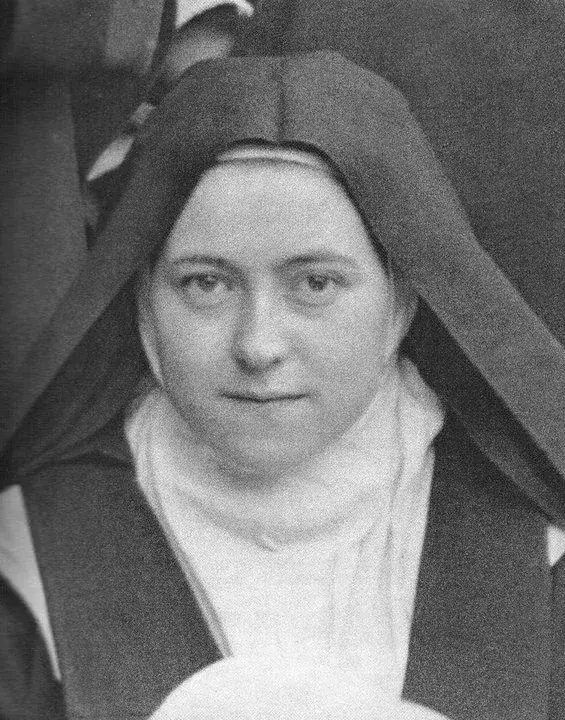
- Patron saint of
- Missionaries, florists, priests, and pilots 2
- Feast day
- October 1 2
- Born
- Alencon, France, January 2, 1873 1
- Died
- Lisieux, France, September 30, 1897, aged twenty-four 1
- Religious name
- Therese of the Child Jesus and the Holy Face 1
- Entered Carmel
- April 9, 1888, at the age of fifteen 1
- Canonized
- May 17, 1925, by Pope Pius XI 1
- Patroness of the missions
- Declared December 14, 1927, by Pope Pius XI 1
- Doctor of the Church
- Proclaimed October 19, 1997, by Pope John Paul II 1
Saint Therese of Lisieux entered a cloister at fifteen, never left it, died at twenty-four, and is now one of only a handful of women named a Doctor of the Universal Church. She did nothing that would register as an achievement. Her whole contribution is a claim about how ordinary people become saints - and the Church has judged that claim important enough to rank her teaching alongside Augustine and Aquinas.
A short life in a small place
She was born Marie-Francoise-Therese Martin at Alencon in France on 2 January 1873. 1 On 9 April 1888, at the age of fifteen, she entered the Carmel at Lisieux, taking the name Therese of the Child Jesus and the Holy Face. 1 She died there on 30 September 1897, aged twenty-four. 1
That is the entire external biography. There is no mission, no foundation, no public work. Everything that made her matter happened inside an enclosed convent in Normandy in under a decade, and would have been lost entirely if her superiors had not asked her to write.
The little way
What Therese taught is usually called the little way, and John Paul II's apostolic letter naming her a Doctor of the Church describes it as "the Gospel way of holiness for all," insisting that "everyone is called to holiness." 1 Not a spiritual elite. Everyone.
Its center is what the letter calls spiritual childhood - "the experience of divine filiation," recognizing yourself as one of "the Father's adoptive children in Jesus." 1 The practical consequence is that greatness is not the point. Small things done with love are not a consolation prize for people who cannot manage heroic ones; they are the road itself.
This is why she is a saint for people who suspect they are not cut out for sanctity. Her argument is that the suspicion is beside the point - you were never going to earn it, and a child does not earn its father.
From an unknown nun to a Doctor of the Church
Her autobiography, published as The Story of a Soul, spread with remarkable speed and remains one of the most widely read spiritual books ever written. 2 Pope Pius XI canonized her on 17 May 1925, less than thirty years after her death, and on 14 December 1927 declared her patroness of the missions - a contemplative who never left her convent, made patron of the Church's missionary work. 1
On 19 October 1997, John Paul II proclaimed her a Doctor of the Universal Church. 1 Franciscan Media notes she was only the third woman to receive the title. 2 The letter calls her "a Teacher for our time, which thirsts for living and essential words, for heroic and credible acts of witness," and says her teaching is "particularly effective in illumining the paths of young people." 1
What is Saint Therese the patron saint of?
Saint Therese is the patron saint of missionaries, florists, priests, and pilots. 2 The missionary patronage is the one to sit with: the Church gave the work of spreading the faith across the world to a woman who spent her adult life behind an enclosure wall, on the grounds that prayer and love do the work that travel only carries.
Saint Therese's feast day
The feast of Saint Therese of Lisieux is celebrated on October 1. 2
Praying with Saint Therese
Therese's whole teaching is that everyone is called to holiness and that the road runs through ordinary things. 1 If you have quietly decided sanctity is for other people, she is the Doctor of the Church appointed to disagree with you.
Spiritual childhood means taking your standing with God as a gift rather than a wage, as the Father's adopted children in Jesus. 1 For anyone worn out by spiritual bookkeeping, that is where the ledger closes.
The little way is not a technique to master. It is doing the next ordinary thing with love, which is available within the next ten minutes and needs no preparation.
She had a convent corridor and twenty-four years, and the Church made her patroness of the missions. 12 Whatever the scale of your life, the objection that it is too small has been formally overruled.
Saint Therese of Lisieux, pray for us.
Sources
Saints to turn to next
Others in this collection who are turned to for some of the same things.
- Saint Louis de MontfortJanuary 31, 1673 - April 28, 1716PrayerSuffering and illness
- Saint Charles de FoucauldSeptember 15, 1858 - December 1, 1916PrayerSuffering and illness
- Saint Claude de la Colombiere1641 - February 15, 1682PrayerSuffering and illness
- Saint Ignatius of Antiochc. 50 - c. 107Suffering and illnessPrayer