Saint Claude de la Colombiere
1641 - February 15, 1682
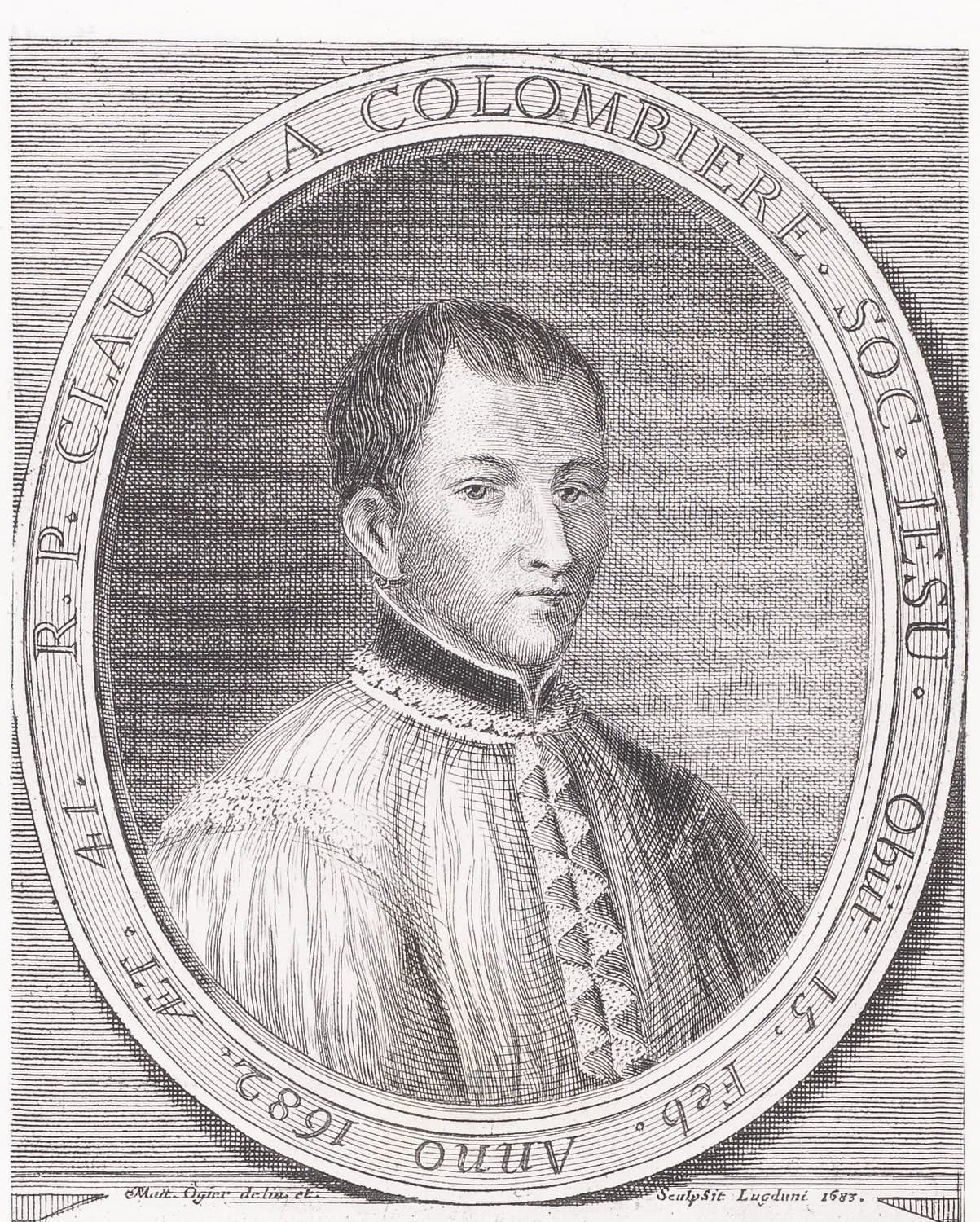
- Born
- Saint-Symphorien-d'Ozon, between Lyons and Vienne, 1641, of noble parentage 1
- Entered the Society of Jesus
- 1659, at eighteen 1
- The vow
- After fifteen years, to keep his order's rule and constitutions exactly, under penalty of sin 1
- Imprisoned
- In London, denounced as a conspirator; he escaped death and was exiled in 1679 1
Saint Claude de la Colombiere was the priest who believed Margaret Mary Alacoque when her own community thought she was deluded. 2 He had already made a private vow to keep his order's rule exactly, under penalty of sin, and those who lived with him said he kept it. 1 He died at forty-one, his health broken by a London prison, on February 15, 1682. 1
A vow nobody asked him to make
He was born of noble parentage at Saint-Symphorien-d'Ozon, between Lyons and Vienne, in 1641, and entered the Society of Jesus at eighteen in 1659. 1 The Jesuits record the ordinary shape of it: grammar, literature, philosophy and theology, teaching at Avignon, theology in Paris, ordination in 1669, more teaching, then preaching at the Jesuit church. 2
During his tertianship - a year given over to prayer and reflection - something happened that the encyclopedia and the Society both think worth recording. He "felt moved to take a special private vow to obey all the rules of the Society in the most strict manner possible." 2 The encyclopedia is more precise about the terms: after fifteen years of religious life he vowed, "as a means of attaining the utmost possible perfection, to observe faithfully the rule and constitutions of his order under penalty of sin." 1
That is a severe thing to do to yourself. What makes it worth citing is the next sentence: "Those who lived with him attested that this vow was kept with great exactitude." 1 It was not a gesture, and the people in the house with him noticed.
Paray-le-Monial, and believing her
In 1674 he was made superior of the Jesuit house at Paray-le-Monial, a small community beside a convent of cloistered Visitation sisters. 12 One of them was Sister Margaret Mary Alacoque, and God was revealing something to her in prayer that her own sisters did not accept. The Jesuits state the cost of that plainly: "Some other members of her community thought her prayer was a delusion, and their skepticism caused her suffering." 2
She had been told to expect him. "She received assurance from the Lord, however, that he was sending her his 'faithful servant and perfect friend.'" 2
He became confessor to the convent and her spiritual director, and she told him what was happening. "He had the insight to recognize this prayer as a real gift from God and a true revelation." 2 The encyclopedia says what followed: he "was thereafter a zealous apostle of the devotion to the Sacred Heart of Jesus." 1
In June 1675 the request came through her and included him by name: to establish the Friday after the octave of Corpus Christi as a feast of the Sacred Heart, "and to tell Colombiere to do all he could to spread this devotion." 2 He was at Paray only until October 1676. 2
London, and a prison
In 1676 he was sent to England as preacher to the Duchess of York, later queen. 1 The encyclopedia records that he "lived the life of a religious even in the Court of St. James and was as active a missionary in England as he had been in France." 1 Despite the difficulties he kept directing Margaret Mary by letter. 1
It ruined him. "His zeal soon weakened his vitality and a throat and lung trouble seemed to threaten his work as a preacher." 1 Then, while he was waiting to be recalled to France, "he was suddenly arrested and thrown into prison, denounced as a conspirator." 1
He survived because of who he worked for and whose subject he was: "Thanks to his title of preacher to the Duchess of York and to the protection of Louis XIV, whose subject he was, he escaped death but was condemned to exile (1679)." 1 Other men accused in the same panic were executed.
He had two years left. He spent them at Lyons as spiritual director to the young Jesuits, and at Paray-le-Monial, "whither he repaired for his health." 1 He died there on February 15, 1682, at forty-one. 1 His relics are kept in the monastery of the Visitation nuns at Paray. 1
What is Saint Claude de la Colombiere the patron saint of
He is a patron of spiritual directors and of the Sacred Heart devotion, and no source cited here gives him a formal list. 12 What he is for is unmistakable from the record: being the one person who takes seriously what someone is telling you, when everyone around them has decided it is nonsense.
He is also, quietly, a patron of writers. The encyclopedia lists his works - "Pious Reflections", "Meditations on the Passion", "Retreat and Spiritual Letters" - collected and published a century and a half after his death. 1
Saint Claude de la Colombiere's feast day
The feast of Saint Claude de la Colombiere is February 15, the day he died at Paray-le-Monial in 1682. 13 His memorial is proper to the Society of Jesus rather than the General Roman Calendar, which is why it is absent from the universal day-by-day calendars.
The date itself is not in doubt. The encyclopedia gives "died at Paray-le-Monial, 15 Feb., 1682"; the Society of Jesus states his death as 02/15/1682; and the engraving on this page, cut at Lyons in 1683, is lettered around the oval "Obiit 15 Feb. Anno 1682" - a year after the fact, by a man in his own city. 123
He was beatified in 1929 and canonized by John Paul II in St. Peter's Basilica on Sunday, May 31, 1992. 3
Praying with Saint Claude de la Colombiere
The thing he is remembered for took no courage in the ordinary sense and cost him nothing at the time. A nun told him what she had seen, and he believed her. 2 Her community had already concluded otherwise. He was her superior's equivalent, newly arrived, thirty-three, and it would have been easier and more prudent to be careful.
What made him able to do it is probably the vow. 1 A man who has bound himself to keep every rule exactly is not a man with a loose relationship to authority - he is the opposite - and that is what makes his judgment here worth something. He was not credulous. He was exact, and he examined it, and he said it was real.
Then England, which reads like an interruption and was the rest of his life. He preached at a hostile court, wore himself out, developed the throat and lung trouble that would kill him, and was thrown into prison on a fabricated charge. 1 He got out because of a title and a king, not because anyone found him innocent.
Two years later he was dead at forty-one, and the devotion he had been told to spread had barely begun. 12 He never saw it take. Margaret Mary outlived him by eight years and was not believed by many more people at her death than at his. The work was done and the results were somebody else's to see.
Saint Claude de la Colombiere, pray for us.
Sources
- 1."Ven. Claude de la Colombiere," The Catholic Encyclopedia, Vol. 16 (New York: The Encyclopedia Press, 1914).
- 2."Saint Claude La Colombiere," Saints and Blessed, the Society of Jesus (Curia Generalizia, Rome).
- 3.John Paul II, Homily for the Canonization of Claude La Colombiere, Vatican Basilica, Sunday 31 May 1992.
Saints to turn to next
Others in this collection who are turned to for some of the same things.
- Saint Louis de MontfortJanuary 31, 1673 - April 28, 1716PrayerCourageSuffering and illness
- Saint Pio of PietrelcinaMay 25, 1887 - September 23, 1968Suffering and illnessPrayerDiscernment
- Saint Ignatius of Antiochc. 50 - c. 107CourageSuffering and illnessPrayer
- Saint Joseph CafassoJanuary 15, 1811 - June 23, 1860PrayerDiscernmentSuffering and illness