Saint Pio of Pietrelcina
May 25, 1887 - September 23, 1968
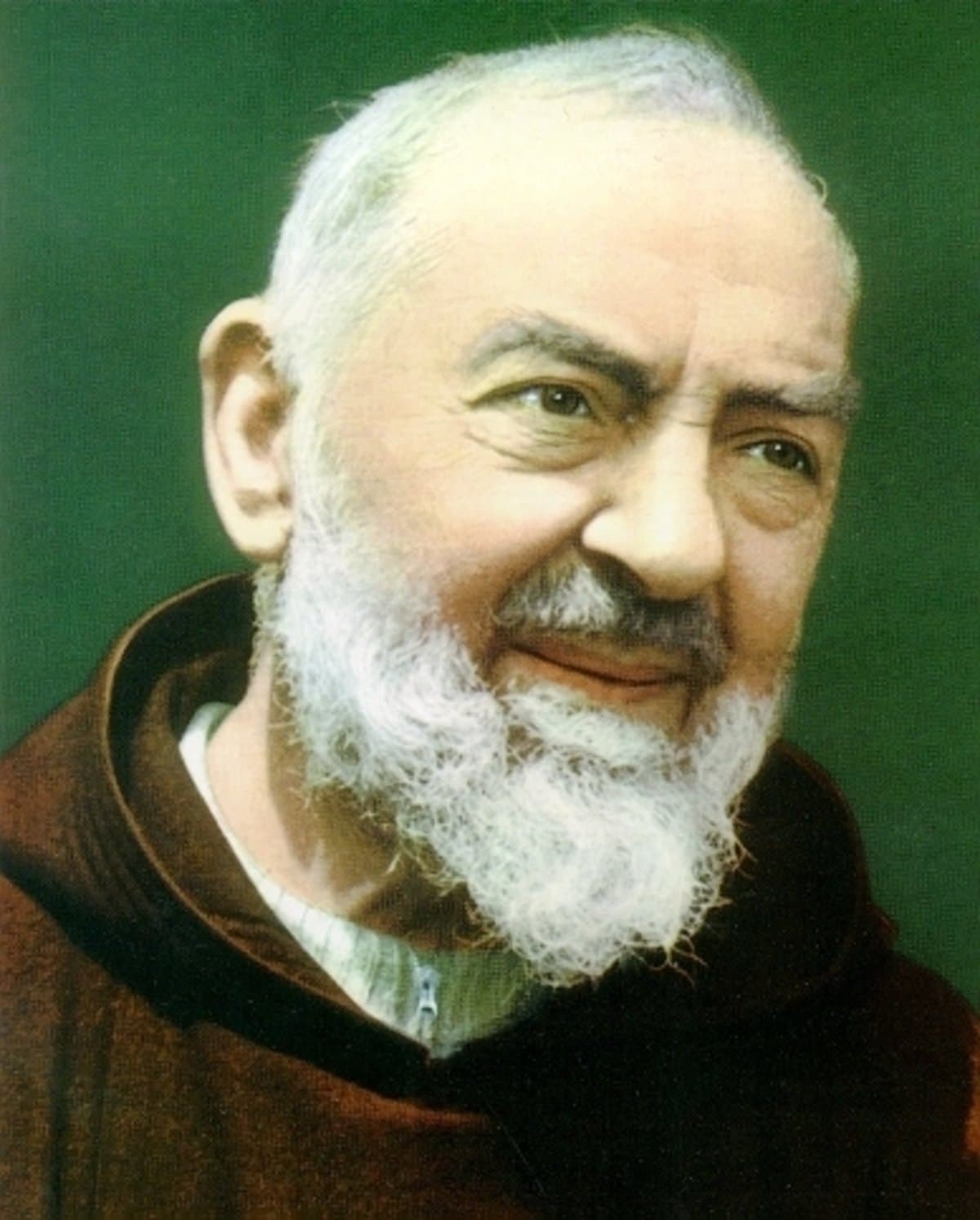
- His father
- Worked twice in Jamaica, New York, to provide the family income 1
- The stigmata
- September 20, 1918, after Mass, following a vision of Jesus - in his hands, feet and side 1
- Suspended twice
- In 1924 and 1931 he was forbidden to say Mass publicly or hear confessions. He did not complain 1
- Canonized
- June 16, 2002, before more than 300,000 people in blistering heat 1
Saint Pio of Pietrelcina received the stigmata at thirty-one and spent the next fifty years hearing confessions from five in the morning until noon, and again every afternoon. 1 Twice the Church forbade him to do it while it investigated him, and "he did not complain of these decisions, which were soon reversed." 1 He wrote no letters after 1924. 1
Francesco Forgione
He was born Francesco Forgione and "grew up in a family of farmers in southern Italy." 1 Franciscan Media records what that cost: "Twice his father worked in Jamaica, New York, to provide the family income." 1 His father emigrated to keep them fed.
At fifteen he joined the Capuchins and took the name Pio. 1 He was ordained in 1910 and drafted in the First World War; "after he was discovered to have tuberculosis, he was discharged." 1 In 1917 he was sent to the friary at San Giovanni Rotondo, seventy-five miles from Bari, and he stayed there. 1
Vatican News notes what shaped him: "Inspired by Saint Francis of Assisi, Francesco Forgione, known by his religious name 'Padre Pio,' spent his life focused on the Passion and Cross of our Lord Jesus Christ." 2
September 20, 1918
Franciscan Media gives it in two sentences and does not embellish. "On September 20, 1918, as Saint Pio of Pietrelcina was making his thanksgiving after Mass, Padre Pio had a vision of Jesus. When the vision ended, he had the stigmata in his hands, feet, and side." 1
What followed is the part people forget. "Life became more complicated after that. Medical doctors, Church authorities, and curiosity seekers came to see Padre Pio." 1
"In 1924, and again in 1931, the authenticity of the stigmata was questioned; Padre Pio was not permitted to celebrate Mass publicly or to hear confessions." 1 The two things he existed to do were taken from him, twice, by his own Church, on the suspicion that the wounds were fraudulent.
"He did not complain of these decisions, which were soon reversed. However, he wrote no letters after 1924. His only other writing, a pamphlet on the agony of Jesus, was done before 1924." 1 Whatever the investigation cost him, that is where the written record of his interior life stops.
The confessional
He "rarely left the friary after he received the stigmata, but busloads of people soon began coming to see him." 1
The schedule is the biography. "Each morning after a 5 a.m. Mass in a crowded church, he heard confessions until noon. He took a mid-morning break to bless the sick and all who came to see him. Every afternoon he also heard confessions." 1
Seven hours of confessions a day, for decades, in a friary in Puglia that people crossed a continent to reach.
One of those who asked for his prayers is worth naming. "In 1962, when he was still an archbishop in Poland, he wrote to Padre Pio and asked him to pray for a Polish woman with throat cancer. Within two weeks, she had been cured of her life-threatening disease." 1 The archbishop was Karol Wojtyla, who forty years later canonized him.
What is Saint Pio of Pietrelcina the patron saint of
He belongs to the sick, to those in physical pain, and to confessors. 1 At his canonization John Paul II "stressed Padre Pio's witness to the power of suffering. If accepted with love, the Holy Father stressed, such suffering can lead to 'a privileged path of sanctity.'" 1
The pope also named what he considered the center of it: prayer and charity. "This is the most concrete synthesis of Padre Pio's teaching." 1 Not the stigmata, which is what draws people to him, and not the healings.
Saint Pio of Pietrelcina's feast day
The feast of Saint Pio of Pietrelcina is September 23, the day he died in 1968. 12 Vatican News keeps his day page there. 2
He was canonized on June 16, 2002, "in one of the largest such ceremonies in history" - the forty-fifth canonization of John Paul II's pontificate, with more than three hundred thousand people in St. Peter's Square and the streets around it, in blistering heat. 1
Praying with Saint Pio of Pietrelcina
The suspensions are the place to start, because they are the part that does not fit the devotional picture. A friar with wounds in his hands was told by his own superiors that he could not say Mass in public or hear anyone's confession, and he obeyed, and said nothing. 1 Twice.
That he stopped writing letters in 1924 is a small fact with a large shadow. 1 He lived another forty-four years and left almost nothing in his own words. Whatever he made of being doubted, he kept.
Then the timetable. 1 Mass at five, confessions until noon, a break to bless the sick, confessions again all afternoon. That is not mysticism, it is shift work, and he did it for half a century in one building he almost never left. The extraordinary thing about him was in his hands; what he actually did with his days was sit in a box and listen to people.
And the letter from Poland. 1 An archbishop nobody outside Krakow had heard of wrote to ask prayers for a sick woman, and the friar prayed, and the woman recovered, and neither of them could have known what the archbishop would become or who would canonize whom. Most of what we ask for is like that: sent off, answered or not, and only legible much later.
Saint Pio of Pietrelcina, pray for us.
Sources
Saints to turn to next
Others in this collection who are turned to for some of the same things.
- Saint Claude de la Colombiere1641 - February 15, 1682DiscernmentPrayerSuffering and illness
- Saint Joseph CafassoJanuary 15, 1811 - June 23, 1860PrayerDiscernmentSuffering and illness
- Saint Teresa of CalcuttaAugust 26, 1910 - September 5, 1997DiscernmentSuffering and illnessPrayer
- Saint Margaret Mary AlacoqueJuly 22, 1647 - October 17, 1690PrayerSuffering and illnessDiscernment