Saint Margaret Mary Alacoque
July 22, 1647 - October 17, 1690
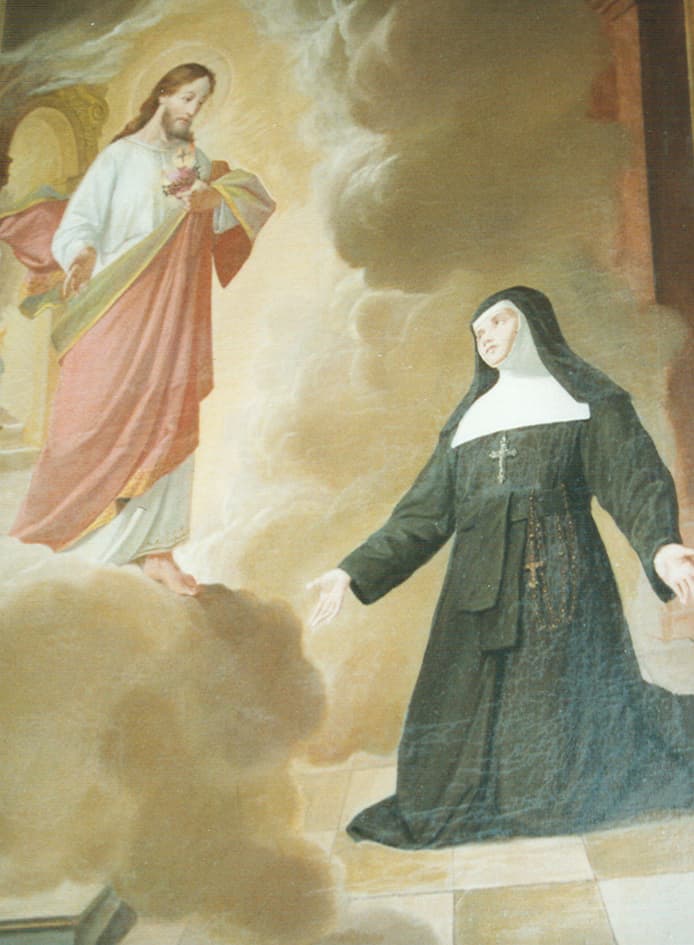
- Feast day
- October 16. The 1910 encyclopedia gives October 17; its own editorial note records the change 1
- Born
- Lhautecour, France, July 22, 1647 1
- First revelation
- December 21, 1674, three years a nun. They continued at intervals for thirteen months 2
- Was told
- By the theologians examining her that her visions were delusions, and that she should eat more 2
- Canonized
- By Benedict XV in 1920 1
Saint Margaret Mary Alacoque was a slow, clumsy Visitation nun who could not meditate the way her order expected, and who reported that Christ had appeared to her asking that his heart be made the sign of his love. 2 Her own community treated her as a visionary and her superior ordered her to live like everybody else. 1 The theologians brought in to assess her concluded she was deluded and should eat more heartily. 2 One confessor believed her, and the devotion she described is now kept across the world. 2
Four years in bed, and a ball
Doll's account of her childhood is severe and unembarrassed. After her first Communion at nine "she practised in secret severe corporal mortifications, until paralysis confined her to bed for four years." 1 She made a vow to consecrate herself to religious life and "was instantly restored to perfect health." 1
Then the family collapsed. "The death of her father and the injustice of a relative plunged the family in poverty and humiliation." 1 Franciscan Media gives her own words about that stretch, and they are not about herself: "The heaviest of my crosses was that I could do nothing to lighten the cross my mother was suffering." 2
At seventeen the property came back and her mother wanted her married. Doll writes what happened next without excusing it: "Her filial tenderness made her believe that the vow of childhood was not binding... Then, still bleeding from her self-imposed austerities, she began to take part in the pleasures of the world." 1 After a ball she had a vision of Christ as he was during the scourging, "reproaching her for infidelity". 1
And then the detail that says most about her: "During her entire life Margaret mourned over two faults committed at this time - the wearing of some superfluous ornaments and a mask at the carnival to please her brothers." 1 She wore jewelry once and a mask once, to please her brothers, and grieved over it for thirty years.
Not extraordinary except by being ordinary
She entered the Visitation convent at Paray in May 1671 and took final vows the following November. 1 Franciscan Media quotes the ideal of the order she had joined - a Visitation nun was "not to be extraordinary except by being ordinary" - and then observes, dryly, that "the young nun was not to enjoy this anonymity." 2
The portrait of her as a member of the community is unflattering in a way that reads as true. "Slow, quiet, and clumsy, she was assigned to help an infirmarian who was a bundle of energy." 2 She could not pray the way she was supposed to: "She could not meditate in the formal way expected, though she tried her best to give up her 'prayer of simplicity'." 2 Note the direction of that sentence. She was trying to give up the way of praying that came naturally, because it was not the prescribed one.
What a fellow novice noticed about her was not the visions. She was "humble, simple, and frank, but above all, kind and patient under sharp criticism and correction." 2 The criticism came first.
What she said she was asked for
The first revelation came on December 21, 1674, three years into religious life, and Franciscan Media records her caution about it: she felt "invested" with the presence of God, "though always afraid of deceiving herself in such matters." 2 Over the next thirteen months the appearances continued at intervals. 2
The requests were specific and practical rather than doctrinal. Communion on the first Friday of every month; an hour of prayer every Thursday night "in memory of his agony and isolation in Gethsemane"; and a feast of reparation. 2 Doll adds the physical form the Holy Hour took: she was "to pray lying prostrate with her face to the ground from eleven till midnight on the eve of the first Friday of each month, to share in the mortal sadness He endured when abandoned by His Apostles." 1
The content of the first great revelation, in Doll's summary, was a desire rather than a doctrine: Christ "made known to her His ardent desire to be loved by men and His design of manifesting His Heart with all Its treasures of love and mercy, of sanctification and salvation." 1 He appointed the Friday after the octave of Corpus Christi as the feast, and called her "the Beloved Disciple of the Sacred Heart". 1
Franciscan Media states the purpose in one line: "His human heart was to be the symbol of his divine-human love." 2
Eat more heartily
The opposition came from inside. "These extraordinary occurrences drew upon her the adverse criticism of the community, who treated her as a visionary, and her superior commanded her to live the common life." 1 Franciscan Media is blunter: "Some of her own sisters were hostile." 2
Then the examination. "Theologians who were called in declared her visions delusions and suggested that she eat more heartily." 2 It is worth sitting with what that means: the formal ecclesiastical assessment of the woman who gave the Church the devotion to the Sacred Heart was that she was imagining things because she was not eating enough.
It did not stop there. "Later, parents of children she taught called her an impostor, an unorthodox innovator." 2 She was teaching children, and the parents complained about her.
One person believed her. "A new confessor, the Jesuit Claude de la Colombière, recognized her genuineness and supported her." 2 That is the whole of the support she had, and it was enough.
Doll records how it ended inside the convent, and the mechanism is worth noting: not argument, but conduct. "But her obedience, her humility, and invariable charity towards those who persecuted her, finally prevailed, and her mission, accomplished in the crucible of suffering, was recognized even by those who had shown her the most bitter opposition." 1 The people who had been hardest on her changed their minds.
Forty-three
She served as novice mistress and assistant superior - the community that had called her a visionary put her in charge of forming its novices. 2 Franciscan Media records one more demand she resisted: "Against her great resistance, Christ called her to be a sacrificial victim for the shortcomings of her own sisters, and to make this known." 2 She did not want it and she did not want to announce it.
In her last illness "she refused all alleviation, repeating frequently: 'What have I in heaven and what do I desire on earth, but Thee alone, O my God'". 1 She died at forty-three while being anointed, saying: "I need nothing but God, and to lose myself in the heart of Jesus." 2
The vindication took a long time and was thorough. "All her actions, her revelations, her spiritual maxims, her teachings regarding the devotion to the Sacred Heart... were subjected to the most severe and minute examination." 1 Leo XII declared her Venerable in 1824, Pius IX Blessed in 1864, and Benedict XV canonized her in 1920 - two hundred and thirty years after her death. 1
What is Saint Margaret Mary Alacoque the patron saint of?
Neither source cited here gives her a patronage. 12 Doll's article ends with her tomb and the pilgrims who come to it, and Franciscan Media ends with her last words; neither names a cause she is invoked for, and this page does not supply one.
What she is unmistakably for is being disbelieved by the people best placed to judge, and being right.
Saint Margaret Mary Alacoque's feast day
The feast of Saint Margaret Mary Alacoque is October 16. 1
The 1910 encyclopedia gives a different date, and then corrects itself. The article ends "Her feast is celebrated on 17 October", and a note added to the text by New Advent's editors follows: "St. Margaret Mary was canonized by Benedict XV in 1920. Her feast is now 16 October." 1 October 17 is the day she died, and was her feast when the article was written; the calendar moved her to the 16th afterward.
Both dates are printed here rather than one being quietly replaced, because a reader who meets October 17 in an older book is not looking at a mistake.
Praying with Saint Margaret Mary
She is the saint for not being believed. Not by strangers - by her own community, her superior, the theologians brought in to assess her, and the parents of the children she taught. 12 The verdict of the experts was that she was deluded and hungry. There is no version of this story in which she was given the benefit of the doubt.
What she did about it is the part worth copying. She did not campaign. Doll says what actually turned the community was "her obedience, her humility, and invariable charity towards those who persecuted her" - she kept doing the ordinary work, kindly, under people who thought she was a fraud, until they stopped thinking so. 1 The novice who described her put the criticism and the patience in the same sentence. 2
She is also the saint for praying wrong. She could not meditate in the form her order taught, and her instinct was to try to give up the way that worked for her because it was not the approved one. 2 Anyone who has sat through a method of prayer that does not fit them, assuming the fault is theirs, is in that sentence.
And the two faults she mourned for thirty years were some jewelry and a carnival mask worn to please her brothers. 1 It is a scruple out of all proportion, and it is on the page because it is true of her. The same woman who could not forgive herself a mask was told by the Christ she saw that what he wanted was to be loved. 1
Saint Margaret Mary Alacoque, pray for us.
Sources
Saints to turn to next
Others in this collection who are turned to for some of the same things.
- Saint Claude de la Colombiere1641 - February 15, 1682DiscernmentPrayerSuffering and illness
- Saint Joseph CafassoJanuary 15, 1811 - June 23, 1860PrayerDiscernmentSuffering and illness
- Saint Pio of PietrelcinaMay 25, 1887 - September 23, 1968Suffering and illnessPrayerDiscernment
- Saint Teresa of CalcuttaAugust 26, 1910 - September 5, 1997DiscernmentSuffering and illnessPrayer