Saint Joseph Cafasso
January 15, 1811 - June 23, 1860
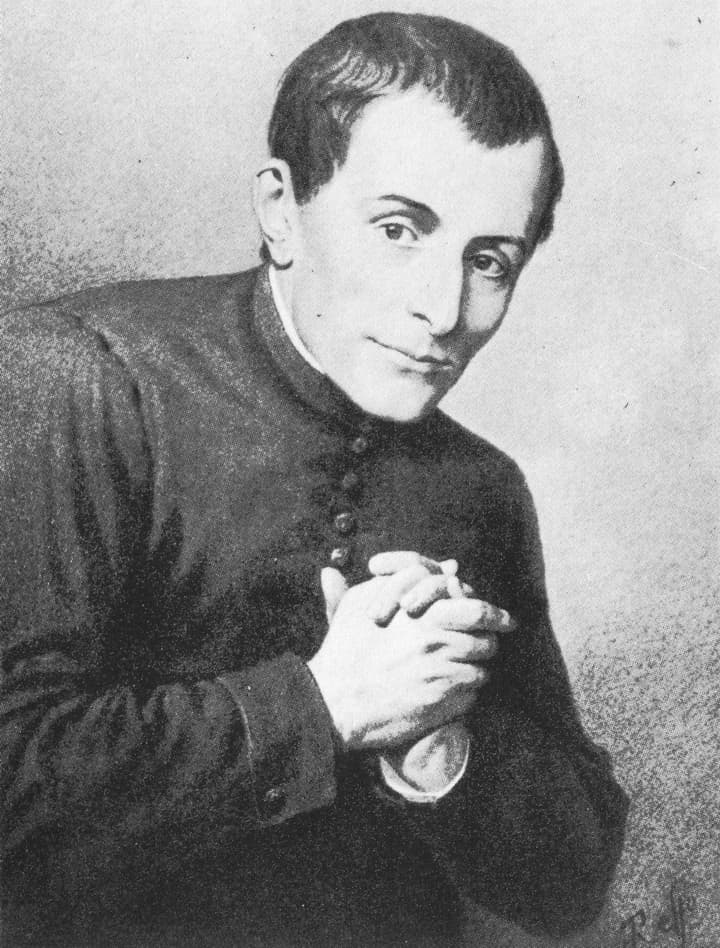
- Born
- Castelnuovo d'Asti, January 15, 1811 - the same village as Saint John Bosco 1
- His whole priesthood
- One institution: the Convitto Ecclesiastico di San Francesco d'Assisi in Turin 1
- Director to John Bosco
- For twenty-five years, 1835 to 1860, through every major decision of Bosco's life 1
- On the scaffold
- He accompanied fifty-seven condemned men to their executions, having heard each confession 1
- Patron of Italian prisons
- Declared so by Pius XII on April 9, 1948 1
Saint Joseph Cafasso spent his entire priesthood in one building in Turin, teaching other men how to be priests, and Don Bosco said of the place that there "men learn to be priests." 1 He founded nothing. 1 He also walked fifty-seven condemned men to the scaffold, having heard their confessions and given them Communion, and stayed with them "until the last breath of their earthly existence." 1
One room in Turin
He was born at Castelnuovo d'Asti on January 15, 1811, the third of four children, in the same village that produced John Bosco. 1 His younger sister Marianna became the mother of Blessed Joseph Allamano, who founded the Consolata missionaries. 1 Benedict XVI notes what that density means: nineteenth-century Piedmont was "marked by serious social problems but also by many Saints who strove to find remedies for them." 1
He was ordained in 1833, and four months later entered the Convitto Ecclesiastico di San Francesco d'Assisi in Turin. Benedict XVI calls it "the fundamental and only stage in his priestly life." 1 He went in to improve his own pastoral practice and never left, eventually as its rector.
The Convitto was not a seminary. It took young priests, mostly from the countryside, who were already ordained and did not yet know how to hear a confession or preach a sermon. 1 It formed them in the spirituality of Ignatius and the moral theology of Alphonsus Liguori, after the model of Charles Borromeo and Francis de Sales. 1 Don Bosco's summary of it is the line that stuck: at the Convitto "men learn to be priests." 1
Pius XI, approving his beatification in 1924, set him beside the Cure of Ars and marked the difference: one "small and humble, poor and simple as he was glorious", the other "a beautiful, great, complex and rich figure of a priest, the educator and formation teacher of priests." 1
Calmness, wisdom, and not making copies
Bosco remembered three virtues in him as a teacher: "calmness, wisdom and prudence." 1 But Benedict XVI says the test of the teaching was not the lecture hall. "For him the test of the lessons taught was the ministry of Confession, to which he himself devoted many hours of the day." 1 Bishops, priests, religious and ordinary people came, "and he was able to give them all the time they needed." 1
His teaching "was never abstract, nor based exclusively on the books that were used in that period." It came out of "the long hours he spent in the confessional and in spiritual direction." 1 Blessed Clement Marchisio put the effect of the place bluntly: "You entered the Convitto as a very mischievous, thoughtless youth, with no idea of what it meant to be a priest; and you came out entirely different, fully aware of the dignity of the priest." 1
The most useful thing in the whole catechesis is what he did not do with his most famous student. He directed John Bosco for twenty-five years, through every fundamental decision of his life. 1 And "Cafasso never sought to form Don Bosco as a disciple in his own image and likeness, and Don Bosco did not copy Cafasso." 1 Benedict XVI calls that "a sign of the wisdom of the spiritual teacher and of the intelligence of the disciple: the former did not impose himself on the latter but respected his personality and helped him to interpret God's will for him." 1
Cafasso's own account of what he was aiming at has no technique in it at all: "All a person's holiness, perfection and profit lies in doing God's will perfectly.... Happy are we if we succeed in pouring out our heart into God's, in uniting our desires and our will to his to the point that one heart and one will are formed." 1
The fifty-seven
For more than twenty years he worked in the prisons of Turin, where men "lived in inhumane and dehumanizing conditions." 1 He began with large sermons that could reach almost the whole prison population, and over time gave that up for "plain catechesis in conversation and in personal meetings." 1 He was "respectful of each individual's affairs." 1
Benedict XVI records the effect without decorating it: "Cafasso's simple presence did good: it reassured, it moved hearts hardened by the events of life and above all it enlightened and jolted indifferent consciences." 1
Then the sentence this page exists to carry. "He accompanied to the scaffold 57 of the men sentenced to death, having heard their confession and having administered the Eucharist to them. He accompanied them with deep love until the last breath of their earthly existence." 1
Franciscan Media records the same work in one line - "Noted for his work with condemned prisoners, he helped many of them die at peace with God" - and names prisoners among his patronages. 2 Pius XII made it formal on April 9, 1948, proclaiming him Patron of Italian prisons. 1
What is Saint Joseph Cafasso the patron saint of
Prisoners, by the declaration of Pius XII in 1948, and priests, by the Apostolic Exhortation Menti Nostrae of September 23, 1950, which held him up as the model for priests engaged in confession and spiritual direction. 1 Franciscan Media lists prisoners as well. 2
The two patronages are one job seen from both ends. He spent his mornings teaching men how to hear a confession and his afternoons hearing the confessions of men who would be dead by the end of the week.
Saint Joseph Cafasso's feast day
The feast of Saint Joseph Cafasso is June 23, the day he died in Turin in 1860, at forty-nine. 12 Franciscan Media states it outright: "His liturgical feast is celebrated on June 23." 2
Its own column runs him on June 17, which is a publishing slot and not a feast. The date to keep is the one both sources give.
Praying with Saint Joseph Cafasso
He is the saint for the person whose work is entirely other people's work. He founded no order, wrote no rule, and left no institute with his name on it. Benedict XVI puts it exactly: "his foundation was the school of priestly life and holiness." 1 Everything he made was made inside somebody else.
The restraint with Bosco is the hardest thing here and the most worth imitating. He had twenty-five years of authority over a man of enormous energy, and he used it to help Bosco become Bosco rather than a second Cafasso. 1 Anyone who has ever formed, taught, parented or managed knows how much easier the other thing is, and how it passes for care.
Then the prisons, where he changed method because the method was not working. The great sermons reached everyone and he abandoned them for conversations. 1 That is not a small humility; it is giving up the part of the work that looked like ministry for the part that was.
And the fifty-seven. 1 There is no way to read that number quickly. Fifty-seven times he heard a man's confession, gave him Communion, walked out with him, and stayed. He called his own secret simple: "to be a man of God; to do in small daily actions what can result in the greater glory of God and the advantage of souls." 1 Fifty-seven times, that was the small daily action.
Saint Joseph Cafasso, pray for us.
Sources
Saints to turn to next
Others in this collection who are turned to for some of the same things.
- Saint Aloysius GonzagaMarch 9, 1568 - June 21, 1591DiscernmentSuffering and illnessConversion
- Saint Claude de la Colombiere1641 - February 15, 1682DiscernmentPrayerSuffering and illness
- Saint Josephine Bakhitac. 1869 - February 8, 1947Suffering and illnessConversionPrayer
- Saint Pio of PietrelcinaMay 25, 1887 - September 23, 1968Suffering and illnessPrayerDiscernment