Saint Kateri Tekakwitha
1656 - April 17, 1680
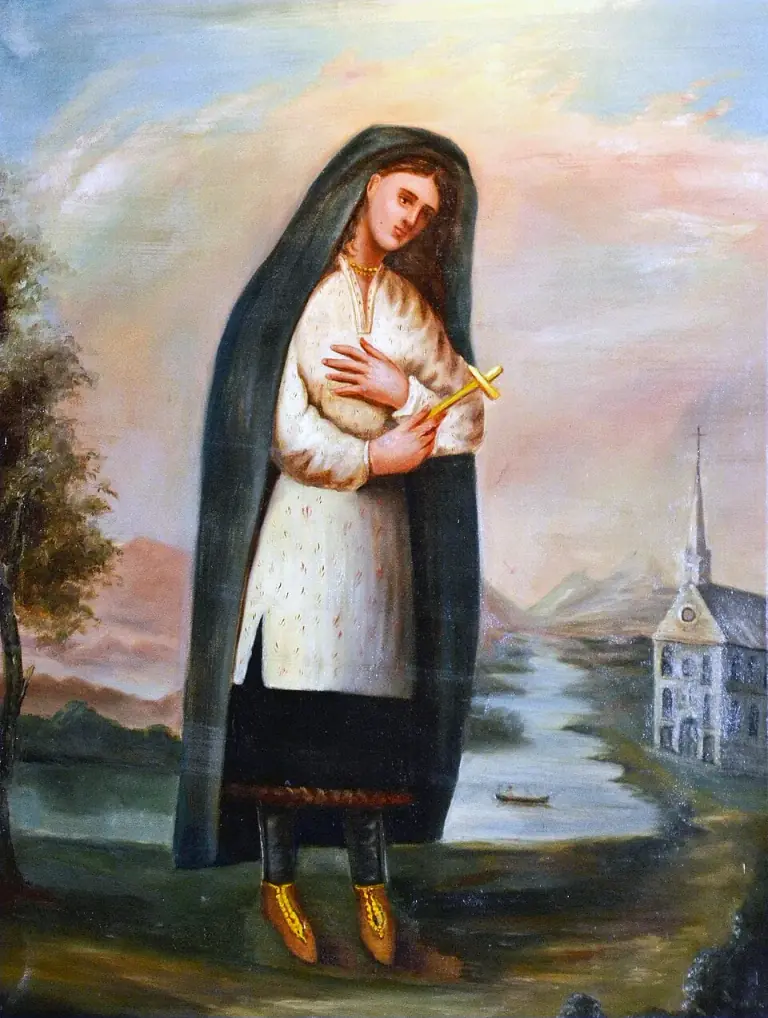
- Patron saint of
- Benedict XVI addressed her as "Protectress of Canada and the first native American saint" 2
- Feast day
- July 14 1
Saint Kateri Tekakwitha lost her parents and her brother to smallpox before she was five, and the disease left her face scarred and her eyesight badly damaged. 1 She was baptized in her late teens, was threatened and persecuted for it until Christian Mohawks helped her escape to a mission on the St Lawrence, and died there at twenty-four. 13 Francis calls her "the first native North American woman to be canonized." 3
Ossernenon
She was born in 1656 - the encyclopedia says at the Turtle Castle of Ossernenon according to some authorities and at Gandaouge according to others - to a Mohawk father and a mother who was a Christian Algonquin, captured by the Iroquois and spared by the man who married her. 1 Francis notes what that mother did: she "taught Kateri to pray and sing hymns to God," and he makes the general point out of it, that "the faith is always transmitted in dialect by mothers, by grandmothers." 3
When she was about four a smallpox epidemic killed her parents and her younger brother. It left her, in the encyclopedia's words, with a face marked and her eyesight seriously impaired, and a manner that was "reserved and shrinking." 1 She was adopted by two aunts and an uncle who had become chief of the Turtle clan. 1
Her aunts began arranging marriages for her while she was still very young, and she resisted every one, the encyclopedia says, "with great risk to herself." 1
Baptism, and what it cost
In 1667 three Jesuits accompanying Mohawk deputies home from Quebec spent three days in her uncle's lodge, and she heard about Christianity from them. She accepted it inwardly at once and did not ask for baptism. 1 The clan later moved north of the Mohawk River, and there, the encyclopedia says, "in the midst of scenes of carnage, debauchery, and idolatrous frency Tekakwitha lived a life of remarkable virtue." 1
When Father Jacques de Lamberville arrived to take charge of the mission, she asked him for baptism and received it. 1 How old she was is where the sources part: the encyclopedia says eighteen, Benedict XVI says twenty, and Francis dates it to Easter Sunday 1676. 123 All three are printed here.
Afterward she "practised her religion unflinchingly in the face of almost unbearable opposition." 1 Francis lists what that meant: "the misunderstandings, persecutions, and even death threats she suffered following her Baptism." 3 In the end her uncle's lodge "ceased to be a place of protection to her," and Christian Indians helped her escape to Caughnawaga on the St Lawrence. 1
Caughnawaga
She lived in the cabin of Anastasia Tegonhatsihonga, a Christian Mohawk woman, and her holiness impressed "not only her own people but the French and the missionaries." 1 Benedict XVI describes the routine: she "remained faithful to her love for Jesus, to prayer and to daily Mass," and "her greatest wish was to know and to do what pleased God." 2
Francis fills in the days. She went to Mass every morning, spent time before the Blessed Sacrament, prayed the Rosary, lived a life of penance, taught the children of the mission to pray, and cared for the sick and the elderly. 3 "The faith is always expressed through service," he adds. "The faith is not about putting on make-up, putting make-up on the soul; no, it is to serve." 3
He also notices the effect she had, and explains it in a way that is not about technique: "they recognized in Kateri a holiness that was appealing because it stemmed from her deep love for God. This is proper to holiness: to attract. God calls us through attraction." 3 Benedict XVI's summary of the same four years is shorter - she "lived a life radiant with faith and purity" - and he notes that she stayed "faithful to the traditions of her people" while giving up their religious convictions. 2 Neither pope presents the mission as requiring her to stop being Mohawk.
The encyclopedia says her mortifications were extreme, and quotes Chauchetière that "she had attained the most perfect union with God in prayer." 1 Encouraged to marry, she refused, and on 25 March 1679 - unable to enter consecrated life - she made a private vow of perpetual virginity. 3 She died a year later, on 17 April 1680, at twenty-four. Francis records her last words: "Jesus, I love you." 3
Devotion to her began immediately among her own people, and pilgrims came to her grave at Caughnawaga; a monument was put up there in 1884, and the Councils of Baltimore and Quebec petitioned for her canonization. 1 The encyclopedia article, written in 1912, ends with those petitions still outstanding. It would be another sixty-eight years before she was beatified and a century before she was canonized. 1
Francis makes one further point about the vow of 1679 that is worth separating from the rest. She was not able to enter consecrated life - no order was open to her - so she made the vow privately, on the feast of the Annunciation. 3 "Of course, not everyone is called to make the same vow as Kateri," he says, "but every Christian is called to give him- or herself daily with an undivided heart to the vocation and mission entrusted to them by God." 3 The form was closed to her and she found a way to mean it anyway.
What Rome made of her
John Paul II beatified her on 22 June 1980. 1 Benedict XVI canonized her on 21 October 2012, and what he said about her is unusually specific about the difficulty: "Kateri impresses us by the action of grace in her life in spite of the absence of external help and by the courage of her vocation, so unusual in her culture." 2
Then the sentence that has been quoted since: "In her, faith and culture enrich each other! May her example help us to live where we are, loving Jesus without denying who we are." And the invocation: "Saint Kateri, Protectress of Canada and the first native American saint, we entrust to you the renewal of the faith in the first nations and in all of North America! May God bless the first nations!" 2
Francis returned to her in 2023 in a catechesis on apostolic zeal, and drew the ordinary lesson rather than the exotic one: "Kateri's life is further proof that apostolic zeal implies both union with Jesus, nourished by prayer and the sacraments, and the desire to spread the beauty of the Christian message through fidelity to one's particular vocation." He asks that we "learn to do ordinary things in extraordinary ways." 3
What is Saint Kateri the patron saint of?
The only patronage any source cited here gives her is Benedict XVI's address at the canonization: "Saint Kateri, Protectress of Canada and the first native American saint." 2 That is a pope invoking her under a title rather than a formal decree of patronage, and it is recorded here as what it is.
The wider associations - ecology, the environment, Native American Catholics - are not stated in any of these three sources and are not claimed on this page.
Saint Kateri Tekakwitha's feast day
Praying with Saint Kateri
Benedict XVI put his finger on the thing that makes her hard to imitate and worth imitating: grace acted in her "in spite of the absence of external help." 2 There was no community of believers around her for most of it, no family support, no one whose approval she could rely on. She had three days of Jesuit conversation when she was eleven and then years of holding on to it alone.
She was persecuted at home for being baptized and eventually had to leave in the dark with help from strangers. 1 The cost of her conversion was her family, her clan and her country, and she was in her late teens when she paid it.
Francis is right that the interesting part is how ordinary the rest was. Morning Mass, the Rosary, teaching children their prayers, sitting with sick and old people. 3 Four years of that, and then a fever at twenty-four. "Learn to do ordinary things in extraordinary ways" is the whole method. 3
The scarred face is worth keeping in mind against the paintings, which tidy it away. Smallpox took her parents, her brother, most of her sight and her appearance before she was five. 13 Francis reads that as what gave her "a great love for the Cross" - not as an explanation of her holiness, but as the material she had to work with. 3
Saint Kateri Tekakwitha, pray for us.
Sources
- 1.Blanche Mary Kelly, "Blessed Kateri Tekakwitha," The Catholic Encyclopedia, Vol. 14 (New York: Robert Appleton Company, 1912), with New Advent's editorial note on her beatification and feast.
- 2.Benedict XVI, Homily at the Canonization of Kateri Tekakwitha and six others, 21 October 2012.
- 3.Francis, General Audience of 30 August 2023, "To pray and to serve with joy: Kateri Tekakwitha, first native saint of North America."
Saints to turn to next
Others in this collection who are turned to for some of the same things.
- Saint Bernardo TolomeiMay 10, 1272 - August 20, 1348PrayerCourageSuffering and illness
- Saints Carpus, Papylus and Agathonicad. c. 170 or 250CourageSuffering and illnessPrayer
- Saint Claude de la Colombiere1641 - February 15, 1682PrayerSuffering and illnessCourage
- Saint Dominic SavioApril 2, 1842 - March 9, 1857PrayerSuffering and illnessCourage