Saint Bernardo Tolomei
May 10, 1272 - August 20, 1348
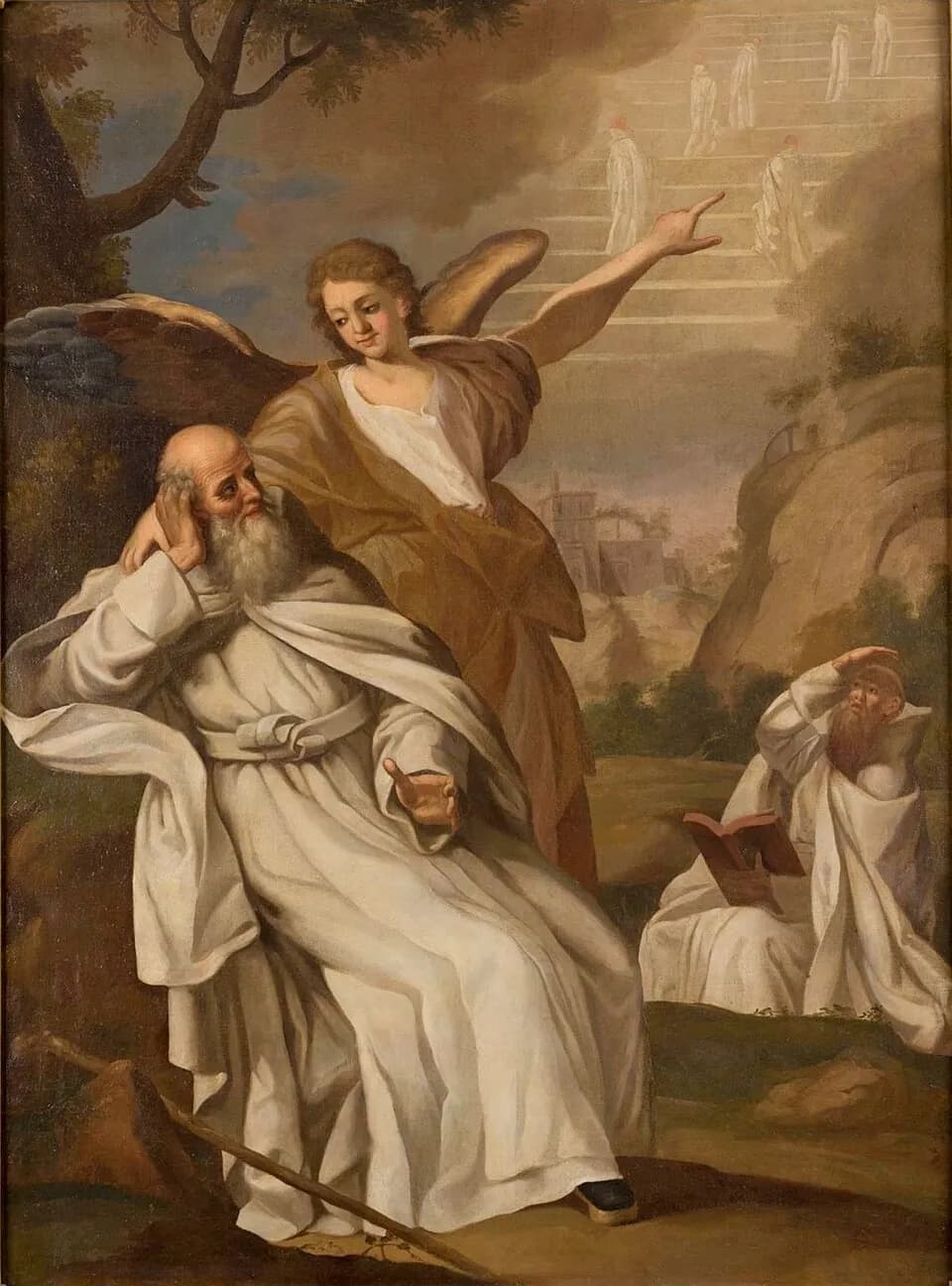
- Patronage
- Catholic Culture lists olive growers, the Olivetans and Siena, without naming an authority 6
Saint Bernardo Tolomei was a Sienese nobleman trained in the law who lost most of his sight, left the city in 1313 to live as a hermit, and six years later founded the Benedictine monastery of Monte Oliveto. 1 His monks, who had ruled that an abbot should serve one year only, re-elected him every year until he died. 12 In 1348 he went back to Siena to nurse his brethren through the plague and died of it with them; Benedict XVI, canonizing him in 2009, called him "an authentic martyr of love." 12
Giovanni Tolomei of Siena
He was born in Siena on May 10, 1272, the son of Mino Tolomei, and baptized Giovanni. 1 The Tolomei were one of the city's noble families. 4 The Holy See's biography says he was "probably educated by the Dominicans" at San Domenico in Siena; the Diocese of Arezzo says he lived with the friars from the age of six to twelve, taught in part by an uncle who was one of them, and the 1907 Catholic Encyclopedia also names the Dominican uncle. 134
His family then set him on a public career. He studied law, and Rudolph I of Hapsburg made him a knight. 14 The encyclopedia says instead that he "served in the armies of Rudolph of Hapsburg," and that Siena afterward gave him its highest offices. 3 He also joined a confraternity, the Disciplinati di Santa Maria della Notte, whose members served the sick in the hospital of Santa Maria della Scala. 14
Then his eyes failed. The Holy See describes "a progressive and almost total blindness" that forced him to give up public life. 1 The encyclopedia tells it as a sudden blow and a cure: he was struck blind, recovered his sight "through the intervention of the Blessed Virgin," and withdrew from the world afterward. 3 The modern sources do not have the cure. They show him still needing a dispensation for his eyesight in 1326. 14
Arezzo mentions one more thing in order to set it aside. Older chroniclers told of a dissolute period after his knighthood and a conversion from it, and the diocese notes that they offered no documents or proof. 4
Accona
In 1313 he left Siena with two friends from the confraternity, Patrizio Patrizi and Ambrogio Piccolomini, both merchants of noble family. 1 They went to Accona, a property of the Tolomei about thirty kilometers southeast of the city, which the encyclopedia puts at about ten miles. 13 There Giovanni took the name Bernardo, in honor of Saint Bernard of Clairvaux. 13
The three lived as hermits, in what the Holy See calls a "penitential life characterised by prayer, manual work and silence." 1 Arezzo adds detail: caves for shelter, rough dark clothing tied with a rope, bare feet, and a small oratory. None of them was a priest, so they called in priests for the sacraments. 4 Bernardo gave his town house in Siena to the Dominicans who had raised him. 4
The hermits drew attention, and with it suspicion. The encyclopedia says Bernardo was accused of heresy and went to Avignon, where he "cleared himself of this charge before John XXII without difficulty." 3 Arezzo says a legate of John XXII looked into the hermits' orthodoxy between 1316 and 1319, probably after a complaint to the local inquisitor, at a time when the Church was wary of new and unapproved communities. 4
The ladder and the white habit
Late in 1318 or early in 1319, the Holy See's biography says, Bernardo was deep in prayer when "he saw a ladder on which monks in white habits ascended, helped by angels, and awaited by Jesus and Mary." 1 Arezzo reports the fifteenth-century Olivetan chronicler Antonio da Barga as saying he called the others and they saw it too. 4
To give the group a standing in law, Bernardo and Patrizio Patrizi went to the Bishop of Arezzo, Guido Tarlati, in whose diocese Accona then lay. On March 26, 1319, he authorized a monastery of Santa Maria di Monte Oliveto under the Rule of Saint Benedict, and his delegate received their monastic profession. 14 The first stone of the church was laid on April 1. 1
They took a white habit in honor of Our Lady. The Holy See quotes the bishop from Antonio da Barga's chronicle: "it pleases you to wear a white monastic habit, therefore showing outwardly that purity which you harbour within." 1 The hermits had become monks. 1
Abbot for one year, twenty-seven times
The new monastery changed one thing in Benedictine custom. Its abbot would hold office for one year and could not be re-elected. 14 Arezzo calls the rule providential, because it later kept the congregation from falling under commendatory abbots. 4
Bernardo kept himself out of the first election on the ground of his eyesight, and Patrizi, Piccolomini and a third monk served in turn. 1 On September 1, 1322, the brethren would take no more refusals, and he became the fourth abbot. 1 A papal legate formally dispensed him from the impediment of his sight in 1326. 1
He never got out of the office again. The monks set aside their own rule and re-elected him every year; the Holy See counts twenty-seven consecutive years, and Benedict XVI put it down to "his rare spirit of humility and brotherly acceptance." 12 At least twice, in 1326 and 1342, he tried to resign, pleading that he "was not a priest but only in Minor Orders." 1 In 1347 the general chapter went the other way and gave him authority to govern without consulting it. 1
The foundation grew. Arezzo lists daughter houses at Siena in 1322, Camprena in 1324 and Arezzo in 1333. 4 On January 21, 1344, Pope Clement VI approved the congregation, which by then numbered ten monasteries. Bernardo did not go to Avignon for it. He sent two monks. 12
The plague of 1348
When the plague reached Tuscany in 1348, it was especially severe in Siena. 1 Bernardo, at seventy-six, left Monte Oliveto for the Olivetan monastery of San Benedetto at Porta Tufi in the city, to look after the monks who had caught it. 124 He died there on August 20, 1348, and eighty-two of his monks died in the same epidemic. 14
The 1907 encyclopedia knows only part of this. It says Bernard and his monks cared for the sick "without any personal ill effects," and records his death at seventy-six without a cause. 3 The Roman Martyrology, like the Holy See, has him die among the stricken monks at Siena. 5
He has no tomb. Plague victims were buried in a common pit of quicklime, and the Holy See says the search for his body and the others "has been unsuccessful to this day." 1 Arezzo adds that the Siena monastery itself was destroyed in a war in 1554. 4
A canonization 661 years later
His monks kept his memory. Arezzo dates the Holy See's confirmation of his cult to November 24, 1644, under Innocent X, with a Mass and Office granted in 1673; the encyclopedia gives 1634. 34 A cause for canonization begun in the eighteenth century stalled when religious orders were suppressed, and was taken up again in 1968. 4
Benedict XVI canonized him on April 26, 2009, with four others. 2 In the homily he called Bernardo "the initiator of a unique Benedictine monastic movement" and said, "His was a Eucharistic life, entirely dedicated to contemplation, expressed in humble service to neighbour." 2
What is Saint Bernardo Tolomei the patron saint of?
Neither the Holy See's biography, the canonization homily, the encyclopedia nor the Martyrology names Saint Bernardo Tolomei as patron of anything. 1235 Catholic Culture lists him as patron of "olive growers or farmers; Olivetans; Siena, Italy," but gives no authority for the list, and this page reports it only as that. 6
Saint Bernardo Tolomei's feast day
The Roman Martyrology enters him on August 20, the day he died, and Catholic Culture lists him among that day's commemorations. 56 His own congregation, the Olivetans, keeps his liturgical memorial a day earlier, on August 19. 4 The 1907 encyclopedia found him in the Martyrology of its time on August 21. 3 August 20 is also the memorial of the saint whose name he took, Bernard of Clairvaux. 6
Praying with Saint Bernardo Tolomei
He lost his eyes and his career together. 1 The sources do not say what that was like for him, only what he did next, which was to leave. 14
He spent the rest of his life trying to avoid being in charge. He ducked the first election, tried twice to resign, and reminded everyone that he was not even a priest. 1 His monks answered by breaking their own rule for him every year for twenty-seven years. 12
The Holy See's biography notes that while studying law he had belonged to a confraternity that nursed the sick in Siena's hospital. 1 At seventy-six he went back into the same city to do the same work. 14
The same biography calls him a "hero of penance and martyr of charity." 1 Benedict XVI drew a plain lesson from it: a faith lived in prayer and spent in the service of others, "impelled by a love that is also ready to make the supreme sacrifice." 2
Saint Bernardo Tolomei, pray for us.
Sources
- 1."Bernardo Tolomei (1272-1348)," biography for the canonization of April 26, 2009, the Holy See (vatican.va).
- 2.Pope Benedict XVI, Homily at the Mass for the Canonization of Arcangelo Tadini, Bernardo Tolomei, Nuno de Santa Maria Alvares Pereira, Gertrude Comensoli and Caterina Volpicelli, April 26, 2009.
- 3.P. A. Fournet, "St. Bernard Tolomeo," The Catholic Encyclopedia, vol. 2 (New York: Robert Appleton Company, 1907).
- 4."San Bernardo Tolomei, abate: la vita e il culto," Centro Pastorale per il Culto, Diocesi di Arezzo-Cortona-Sansepolcro, 2015.
- 5."Beato Bernardo Tolomei, abate," Santo del giorno, 20 agosto (from the Roman Martyrology), Conferenza Episcopale Italiana.
- 6."St. Bernard Tolomei," Liturgical Year, August 20, Catholic Culture.
Saints to turn to next
Others in this collection who are turned to for some of the same things.
- Saint Claude de la Colombiere1641 - February 15, 1682DiscernmentPrayerSuffering and illnessCourage
- Saint Carmen RendilesAugust 11, 1903 - May 9, 1977PrayerDiscernmentSuffering and illness
- Saint CasimirOctober 3, 1458 - March 4, 1484CouragePrayerDiscernment
- Saint Clare of Montefalcoc. 1268 - August 1308PrayerSuffering and illnessDiscernment