Saint Casimir
October 3, 1458 - March 4, 1484
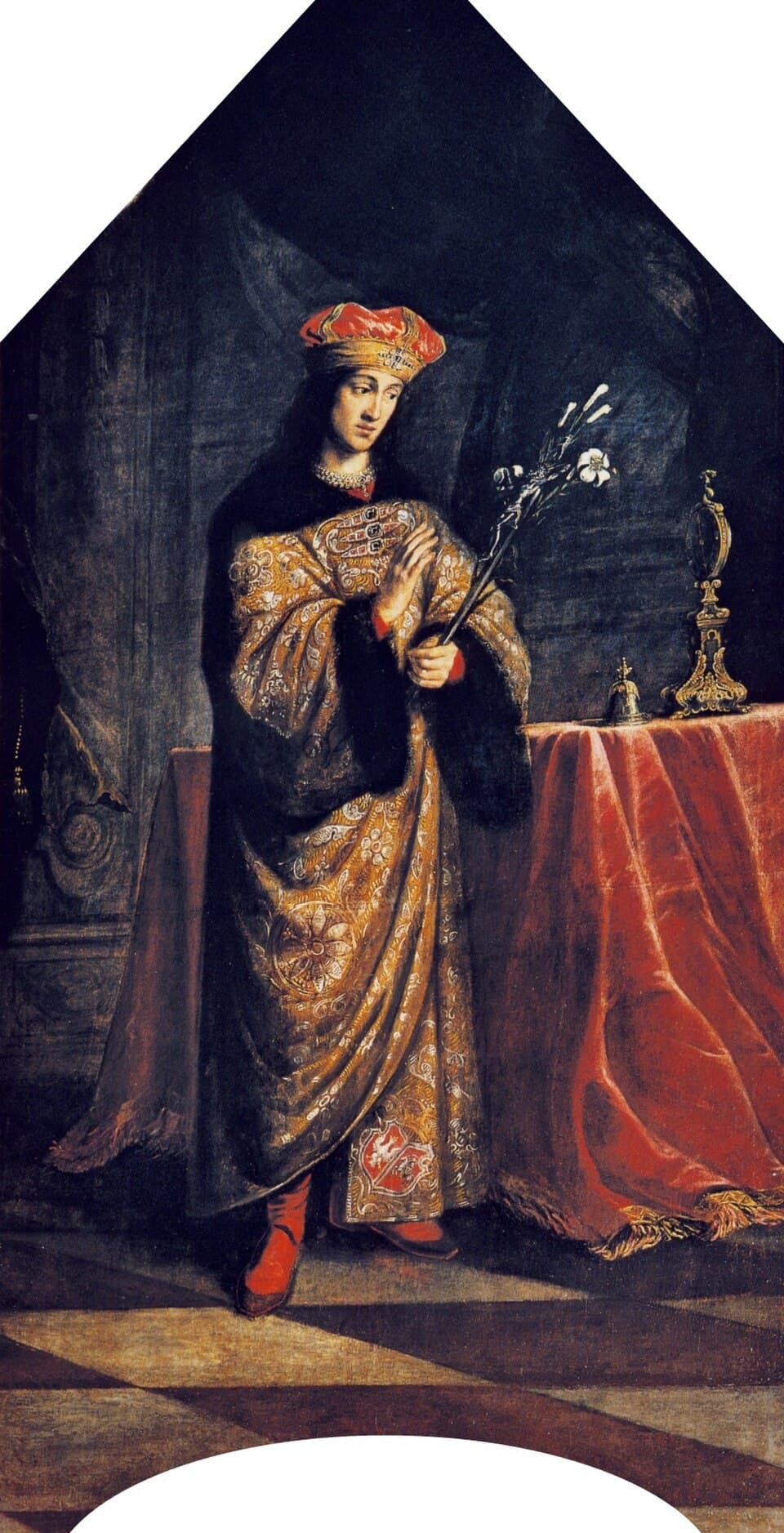
- Patron saint of
- Poland, Lithuania and Russia, per Franciscan Media. Abraham adds Belgium and Naples 12
- Feast day
- March 4, named by Clement VIII 1
- Born
- The royal palace at Cracow, 3 October 1458, second son of Casimir IV of Poland 1
- Ruled Poland
- From 1481 to 1483, in his father's absence, "with great prudence and justice" 1
- Imprisoned
- By his own father, for three months, for turning an army around 2
- Canonized
- By Adrian VI in 1522 1
Saint Casimir was the son of a king, brother to three more, and heir to Poland. 1 At about fourteen his father sent him to seize the throne of Hungary; he found an army that was outnumbered and deserting because it had not been paid, and brought it home. 2 His father locked him up for three months. 2 He came out having decided never to take part in a war again, and he never did.
A family of kings
He was born in the royal palace at Cracow on 3 October 1458, second son of King Casimir IV and of Queen Elizabeth, daughter of the Emperor Albert II. 1 His grandfather was the king "who introduced Christianity into Lithuania", and an uncle had died at Varna in 1444 fighting the Turks. 1
The rest of the family is a list of thrones. His elder brother became King of Bohemia in 1471 and of Hungary in 1490; his four younger brothers "in turn occupied the Polish throne"; and the youngest became Archbishop of Gnesen, Bishop of Cracow, and a cardinal. 1 Every male child of that household except Casimir ended up ruling something.
At nine he was put in the care of Jan Dlugosz, the Polish historian, whom Abraham describes as "a deeply religious man, a loyal patriot, and... well versed in statecraft." 1 Franciscan Media credits Dlugosz directly: Casimir "was filled with exceptional values and learning by a great teacher." 2
What he did with that education, as a teenager, was austere to the point of alarming. "As a teenager, Casimir lived a highly disciplined, even severe life, sleeping on the ground, spending a great part of the night in prayer and dedicating himself to lifelong celibacy." 2 Abraham adds a detail that reads oddly until you picture it: "Often at night he would kneel for hours before the locked doors of churches, regardless of the hour or the inclemency of the weather." 1 Locked doors. He knelt outside in the Polish winter because he could not get in.
Hungary
A faction of Hungarian nobles, discontented with Matthias Corvinus, offered their crown to Casimir, and his father agreed to send him for it. 12
He went willingly, and for a reason. Abraham: "Eager to defend the Cross against the Turks, he accepted the call and went to Hungary to receive the crown." 1 The family had a dead uncle at Varna. He was not a boy being marched somewhere against his will.
What he found is described by Franciscan Media in terms any soldier would recognize: "The army he was supposed to lead was clearly outnumbered by the 'enemy'; some of his troops were deserting because they were not paid." 2 The quotation marks around enemy are Franciscan Media's.
"At the advice of his officers, Saint Casimir decided to return home." 2 Abraham puts it flatly: "He was unsuccessful, however, and returned a fugitive to Poland." 1
His father was not understanding. "His father was irked at the failure of his plans, and confined his 15-year-old son for three months." 2 Three months, imposed by the king of Poland on his own heir.
And the confinement settled it. "The lad made up his mind never again to become involved in the wars of his day, and no amount of persuasion could change his mind." 2
Franciscan Media makes the comparison explicit rather than leaving it to the reader: "Casimir obeyed his father, as many young men over the centuries have obeyed their governments." 2 And it answers the charge that always follows: "Even his critics could not say that his conscientious objection indicated softness." 2 A boy who slept on the ground and knelt all night in the snow was not refusing out of delicacy.
Governing instead
He went back to Dlugosz and to his studies until 1475, and then to his father, who "initiated him so well into public affairs" that when his elder brother took the Bohemian crown, Casimir became heir-apparent to Poland. 1
And then he did the job. In 1479 the king left for Lithuania for five years and put Casimir in charge of the kingdom. "From 1481 to 1483 [he] administered the State with great prudence and justice." 1 Franciscan Media: "He reigned briefly as king of Poland during his father's absence." 2
Two years governing Poland in his early twenties, by a young man who had refused to lead an army. The refusal was not a withdrawal from public life; it was specific.
The other pressure was marriage. His father tried to arrange a match with a daughter of the Emperor Frederick III, and "Casimir preferred to remain single" - holding to the celibacy he had decided on as a teenager, against his father a second time. 12
Grodno
Abraham gives the end in a single clause that contains its own explanation: "Shortly afterwards he fell victim to a severe attack of lung trouble, which, weak as he was from fastings and mortifications, he could not withstand." 1 The austerity that proved he was not soft is also what left him with nothing to fight the illness with.
He died on a journey to Lithuania, at the court of Grodno, on 4 March 1484 - Franciscan Media says at twenty-five. 12 He was buried in the chapel of the Blessed Virgin in the cathedral at Vilnius, where he remains. 12
Abraham's summary of the man is worth having: "St. Casimir was possessed of great charms of person and character, and was noted particularly for his justice and chastity." 1 He had a particular devotion to the Virgin, and the hymn "Omni die dic Mariae" was long attributed to him - though Abraham says only that it was attributed, not that he wrote it. 1
Sigismund I, his own younger brother and by then king, petitioned Rome for his canonization. Leo X sent a commission; the inquiry finished in 1520; Adrian VI canonized him in 1522, thirty-eight years after his death. 1
What is Saint Casimir the patron saint of?
Saint Casimir is the patron saint of Poland and Lithuania, and Franciscan Media adds Russia. 2 Abraham notes his cult reached much further: he "is honoured as far as Belgium and Naples." 1
He is also, and this is the claim worth making for him now, a patron for young people under pressure to do something they have concluded they should not do. He was the king's son and the heir; the cost of refusing was three months' imprisonment and his father's lasting anger; and he did not give way then or later, over the war or the marriage. 12
In Lithuania his feast is a national occasion, and Vilnius still holds a fair named for him in early March.
Saint Casimir's feast day
The feast of Saint Casimir is March 4. Abraham records who set it: "Pope Clement VIII named 4 March as his feast." 1 It is the day he died at Grodno.
The year is not agreed. Abraham gives 4 March 1484; Franciscan Media says he died at twenty-five, which - from a birth of October 1458 - gives 1484 as well, though the dates circulated for him commonly say 1483. 12 Both are in the record and this page follows Abraham.
The two sources also differ on his age in Hungary: Abraham says he was thirteen when the crown was offered, Franciscan Media that he was fifteen when his father confined him. 12 They may both be right, with the campaign falling between.
Praying with Saint Casimir
The turning point of his life is a military decision made by a teenager, and it is worth reading on its own terms. He had gone willingly, to fight Turks, in a family that had already lost a man doing it. 1 Then he looked at what he had been given - outnumbered, unpaid, deserting - listened to his officers, and took them home. 2 That is not cowardice and it is not pacifism. It is a fourteen-year-old declining to spend other men's lives on his father's political arrangement.
What he did in the three months of confinement is the part nobody recorded, and it is where the rest of him was decided. He came out with a position he held for the remaining decade of his life against a king who wanted otherwise. 2
His refusal was specific, not general, and that distinction matters. He would not go to war; he governed Poland for two years and did it well. 1 People who take a stand are often expected to withdraw from everything else, and he did the opposite - he stayed in public life, in the most public office available, and simply would not do the one thing.
The austerities killed him, and Abraham says so without admiring it: weak from fasting, he could not survive a lung infection at twenty-five. 1 That sits uncomfortably beside everything admirable in him, and it should. The same severity that made his refusal credible to his critics also meant he had nothing left when he got ill.
Saint Casimir, pray for us.
Sources
Saints to turn to next
Others in this collection who are turned to for some of the same things.