Saint Matthias
First century
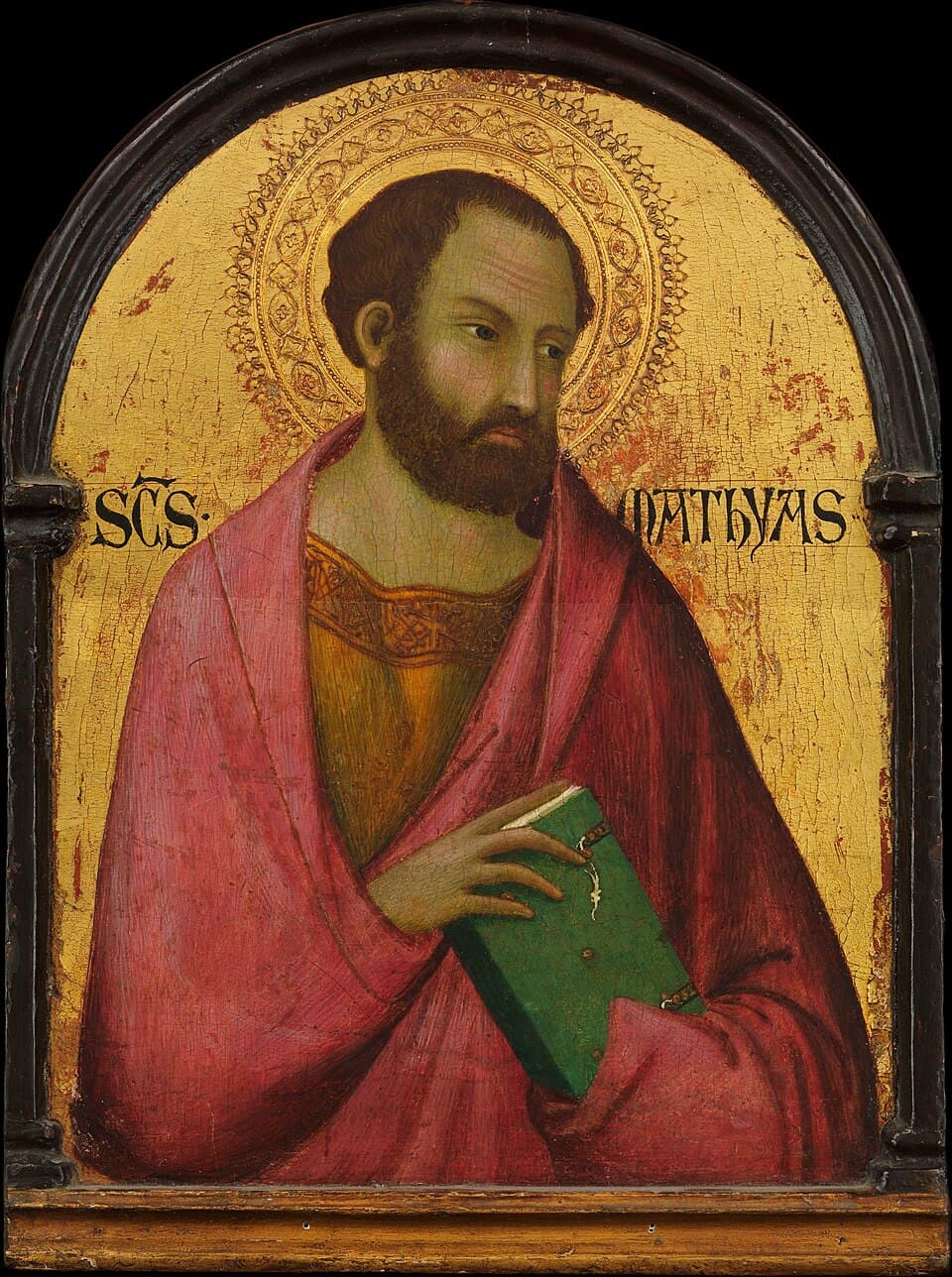
- Feast day
- May 14. Jacquier gives 24 February for the Latin Church and 9 August for the Greek; the Latin date has since moved 1
- His name
- From the Hebrew Mattithiah - "gift of Yahweh" 1
- Qualification
- He had been with Jesus from the baptism by John to the Ascension - one of the seventy disciples 12
- What is known after that
- Jacquier: "vague and contradictory." Three different accounts of his death survive 1
Saint Matthias is named once in the whole New Testament. 2 After the Ascension the apostles needed to replace Judas, set out the qualification - a man who had been with them the whole time, from John's baptism to the Ascension - nominated two, prayed, and drew lots. 12 The lot fell on Matthias. Nothing certain is known about him afterward. 1
The vacancy
His name is Greek, from the Hebrew Mattithiah, and it means "gift of Yahweh." 1 Jacquier records that he "was one of the seventy disciples of Jesus, and had been with Him from His baptism by John to the Ascension." 1 He had been there the whole time, without being one of the Twelve.
Franciscan Media sets the scene from Acts. In the days after the Ascension, Peter stood up among about a hundred and twenty followers and said that Judas's office had to be filled. 2 The qualification he laid down is quoted in full: "Therefore, it is necessary that one of the men who accompanied us the whole time the Lord Jesus came and went among us, beginning from the baptism of John until the day on which he was taken up from us, become with us a witness to his resurrection." 2
Two men met it: Joseph called Barsabbas, and Matthias. 12 "They prayed and drew lots. The choice fell upon Matthias, who was added to the Eleven." 2
Jacquier notes that the account has been challenged - Zeller argued it was unhistorical because the apostles were in Galilee after the death of Jesus - and answers it: "As a matter of fact they did return to Galilee, but the Acts of the Apostles clearly state that about the feast of Pentecost they went back to Jerusalem." 1
And then Franciscan Media's closing sentence, which is the whole difficulty: "Saint Matthias is not mentioned by name anywhere else in the New Testament." 2
Three deaths
Jacquier is blunt: "All further information concerning the life and death of Matthias is vague and contradictory." 1 He then lays out the options rather than choosing one.
Nicephorus says he preached first in Judea, then in Ethiopia - "that is to say, Colchis", on the eastern shore of the Black Sea - and was crucified. 1
The Synopsis of Dorotheus is more specific and stranger. Jacquier quotes the Latin and translates it: Matthias "preached the Gospel to barbarians and cannibals in the interior of Ethiopia, at the harbour of the sea of Hyssus, at the mouth of the river Phasis. He died at Sebastopolis, and was buried there, near the Temple of the Sun." 1
"Still another tradition maintains that Matthias was stoned at Jerusalem by the Jews, and then beheaded." 1
Crucified far away, died of natural causes at the far end of the Black Sea, or killed in Jerusalem. The three cannot be reconciled and Jacquier does not try.
Even the relics are uncertain. Helena is said to have brought them to Rome, with a portion going to Trier - but Bollandus "doubts if the relics that are in Rome are not rather those of the St. Matthias who was Bishop of Jerusalem about the year 120, and whose history would seem to have been confounded with that of the Apostle." 1 Two men, one name, a century apart.
One sentence attributed to him
Something he may have said does survive, at several removes, and Jacquier handles it carefully.
Clement of Alexandria records a saying "that the Nicolaitans ascribe to Matthias": "we must combat our flesh, set no value upon it, and concede to it nothing that can flatter it, but rather increase the growth of our soul by faith and knowledge." 1
Jacquier says this "was probably found in the Gospel of Matthias" - a work mentioned by Origen, by Eusebius (who attributes it to heretics), by Jerome, and declared apocryphal in the Decree of Gelasius. 1 Clement quoted from what he called the traditions of Matthias, and noted that the heretics Valentinus, Marcion and Basilides had claimed his authority. 1
So: a sentence, quoted by a third-century writer, from a book the Church rejected, attributed to Matthias by a sect. That is the entirety of what might be his own voice, and the chain of custody is worth stating exactly rather than quietly presenting it as his.
What is Saint Matthias the patron saint of?
Neither Jacquier nor Franciscan Media assigns Saint Matthias a patronage. 12 Various trades claim him in local tradition, and this page will not repeat claims its sources do not make.
What he is genuinely useful for is discernment. His whole appearance in scripture is a decision procedure: state the qualification, find who meets it, pray, and then accept the outcome. 12 Anyone facing a choice between two candidates - for an office, a vocation, a life - has an apostle whose one recorded moment is exactly that.
He also belongs to the runner-up, from the other side. Joseph Barsabbas met every qualification, stood there, and was not chosen. 12 Scripture does not say what he did next, and most people have been him at some point.
Saint Matthias's feast day
The feast of Saint Matthias is May 14.
This entry carries the clearest illustration in the library of why that has to be checked. Jacquier, writing in 1911, states the practice of his own day: "The Latin Church celebrates the feast of St. Matthias on 24 February and the Greek Church on 9 August." 1 The publisher has since appended a note to the article: "After this article was written, the Latin Church moved the feast of St. Matthias to 14 May." 1
So three dates are in the record - February 24 in the West before the reform, August 9 in the East, and May 14 now - and a reader consulting an older book will find the February date given as current. 1 All three are printed here and May 14 is the one kept.
No year can be given for his birth or death. Jacquier offers none, and what he does offer about the death is three mutually exclusive traditions. 1
Praying with Saint Matthias
He is the apostle for people who were there all along and were never noticed. Matthias had followed Jesus from the baptism to the Ascension - the entire public ministry - and appears in the record only at the moment he is promoted. 12 He had been present for everything the Twelve were present for. Nobody wrote his name down until there was a vacancy.
The method of his choosing deserves attention because the Church has never repeated it. They set a hard qualification, found the two men who met it, prayed, and drew lots - and then treated the result as settled. 2 There is no suggestion that the better man won; there is no argument about the merits of Joseph Barsabbas. Two men were equally qualified and one was taken.
And then nothing. Jacquier cannot tell us where he went, what he did, or how he died, and offers three incompatible accounts in place of an answer. 1 The obscurity is not a gap in the record so much as the shape of the life: he was chosen to be a witness, he presumably went and witnessed, and no one kept notes. Most people's work disappears exactly like that.
The one line that might be his is about not flattering the flesh and growing the soul by faith and knowledge - preserved by a heretical sect, quoted by a third-century Egyptian, from a book the Church discarded. 1 It may not be his at all. It is a fittingly uncertain inheritance from a man whose entire biography is one paragraph and a drawn lot.
Saint Matthias, pray for us.
Sources
Saints to turn to next
Others in this collection who are turned to for some of the same things.