Saint Columban
543 - November 21, 615
- Born
- West Leinster, Ireland, in 543 - the year Benedict died 1
- Deported for
- Telling a king to marry. It threatened the queen mother's position 2
- His biographer
- Jonas of Bobbio, writing about 643 from the testimony of men who had known him 1
Saint Columban left Ireland at about forty with twelve companions and spent the rest of his life walking across Europe founding monasteries. 12 He got out of Ireland by stepping over his own mother, who had lain down in the doorway to stop him. 1 He was later deported from Burgundy for telling the king to marry, shipwrecked on the way, and went straight back to work. 2
The advice of a woman in a cell
He was born in West Leinster in 543 - Edmonds notes it was "the year St. Benedict died" - and was well taught from childhood. 1
The problem of his youth is stated with unusual directness. "He was handsome and prepossessing in appearance, and this exposed him to the shameless temptations of several of his countrywomen. He also had to struggle with his own temptations." 1 Franciscan Media: he was "greatly tormented by temptations of the flesh." 2
What he did about it was ask somebody. "At last he betook himself to a religious woman", an anchoress, and Edmonds gives her answer in her own words: "Twelve years ago I fled from the world, and shut myself up in this cell. Hast thou forgotten Samson, David and Solomon, all led astray by the love of women? There is no safety for thee, young man, except in flight." 1
Franciscan Media: "He saw in her answer a call to leave the world." 2 The decisive counsel of his life came from a woman who had been walled up for twelve years, and he took it literally.
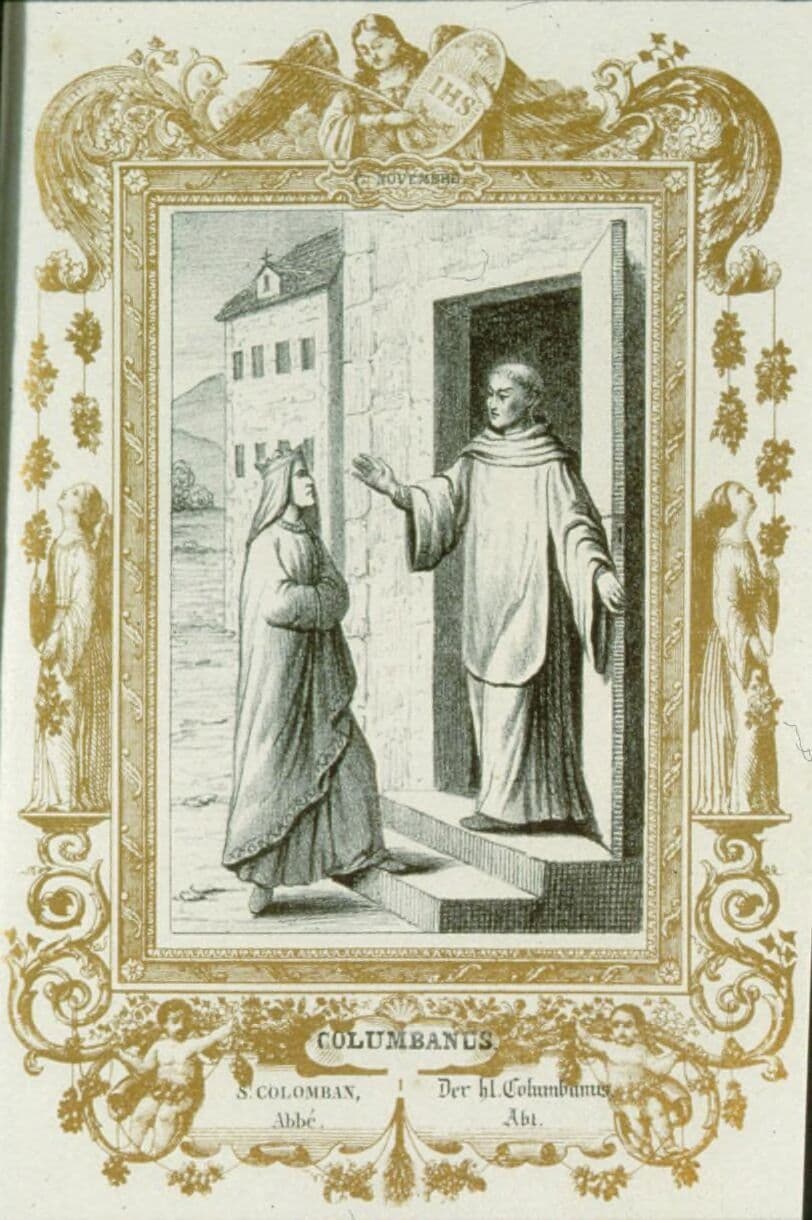
His family fought him. "He encountered opposition, especially from his mother, who strove to detain him by casting herself before him on the threshhold of the door. But, conquering the feelings of nature, he passed over the prostrate form and left his home forever." 1
Edmonds records it and does not comment. Neither will this page, except to say that it is one of the hardest sentences in this library, and that Edmonds chose to leave it in.
Twenty years at Bangor
He went first to Sinell, Abbot of Cluaninis on Lough Erne, and under him "composed a commentary on the Psalms." 1 Then to Bangor on the coast of Down, then the greatest school in Ireland, whose abbot was Comgall. 12
And there he stayed, "for many years led a life conspicuous for fervour, regularity, and learning." 1 Franciscan Media: "After many years of seclusion and prayer, he traveled to Gaul." 2
"At about the age of forty he seemed to hear incessantly the voice of God bidding him preach the Gospel in foreign lands. At first his abbot declined to let him go, but at length he gave consent." 1 Twenty years in one monastery, and then permission, reluctantly given, to leave at forty.
Twelve went with him, and Edmonds lists every name: "St. Attala, Columbanus the Younger, Cummain, Domgal, Eogain, Eunan, St. Gall, Gurgano, Libran, Lua, Sigisbert and Waldoleno." 1 One of them, Gall, would give his name to a Swiss city and an abbey whose library still exists.
Bark and berries in the Vosges
They crossed to Britain, stayed briefly, and reached France about 585. 1 Edmonds describes what they found: "Owing partly to the incursions of barbarians, and partly due to the remissness of the clergy, vice and impiety were prevalent." 1 Franciscan Media calls it "a time characterized by clerical laxity and civil strife", and says the Irishmen "won wide respect for the rigor of their discipline, their preaching, and their commitment to charity." 2
Gontram, King of Burgundy, received them and invited Columban to stay. 1 He chose "the half-ruined Roman fortress of Annegray in the solitudes of the Vosges Mountains." 1
What they lived on is worth quoting exactly: "Here the abbot and his monks led the simplest of lives, their food oftentimes consisting of nothing but forest herbs, berries, and the bark of young trees." 1
And it worked, which created the problem that followed him everywhere. "The fame of Columbanus's sanctity drew crowds to his monastery. Many, both nobles and rustics, asked to be admitted into the community." 1 He kept escaping it: "But Columbanus loved solitude. Often he would withdraw to a cave seven miles distant, with a single companion, who acted as messenger between himself and his brethren." 1
The numbers forced a second house. He got the old Gallo-Roman castle of Luxeuil from the king, eight miles away, "in a wild district, thickly covered with pine forests and brushwood" - and Luxeuil became one of the great abbeys of Europe. 1
Deported
Two fights ended his time in Gaul, and both were about refusing to bend.
The first was with the Frankish bishops, over Irish customs - the dating of Easter chief among them. Franciscan Media: "Ultimately he had to appeal to the pope against complaints of Frankish bishops, for vindication of his orthodoxy and approval of Irish customs." 2 An Irish abbot writing to Rome over the heads of the local hierarchy.
The second was personal and cost him the country. "He reproved the king for his licentious life, insisting that he marry. Since this threatened the power of the queen mother, Columban was deported back to Ireland." 2 A king with no lawful wife left his grandmother in control; a married king would not. Columban said so and was put on a ship.
The ship did not get there. "His ship ran aground in a storm, and he continued his work in Europe." 2 Deported, wrecked, and back at it.
He made his way to Italy, "where he found favor with the king of the Lombards", and in his last years founded Bobbio, the monastery whose library became one of the most important in Europe. 12 He died there on 21 November 615. 1
His writings survived: "a treatise on penance and against Arianism, sermons, poetry, and his monastic rule." 2 The Rule of Columban was used across the continent before the Rule of Benedict displaced it.
What is Saint Columban the patron saint of?
Neither Edmonds nor Franciscan Media assigns Saint Columban a patronage. 12 He is invoked by missionaries, and is honored in Ireland, in France at Luxeuil, and in Italy at Bobbio.
Franciscan Media's opening line is the claim usually made for him: he "was the greatest of the Irish missionaries who worked on the European continent." 2 The monasteries he and his followers founded ran from the Vosges to Lombardy, and they "became centers of religion and culture" at a moment when there were very few. 2
He is also, in practice, a patron for people who emigrate at an age when it is no longer expected of them. He was about forty and had been in the same monastery for two decades. 1
Saint Columban's feast day
The feast of Saint Columban is November 23. 2 Edmonds gives his death as 21 November 615, so the feast falls two days later - the 21st and 22nd being already occupied in the calendar. 1
A reader should be careful not to confuse him with Saint Columba of Iona, who died in 597 and is kept on 9 June. The names differ by one letter, both were Irish, both were abbots and both founded famous monasteries abroad. This library's own research pipeline made exactly that mistake and paired Columban with Columba's encyclopedia article before the error was caught. 1
Praying with Saint Columban
The doorway is the thing nobody can make comfortable. His mother lay down across it and he walked over her and never came back. 1 Edmonds calls it "conquering the feelings of nature", which is the language of his century rather than ours. A reader is entitled to find it appalling and to notice, at the same time, that without it there is no Luxeuil and no Bobbio. Both things are true and the sources let them stand together.
The advice he acted on came from a woman in a cell who had been there twelve years, and it was blunt: you are not safe, go. 1 He did not get a vision. He asked somebody who had faced the same thing, and she told him what had worked for her.
What he did for the next twenty years was nothing remarkable - Bangor, the Psalms, the round of a monastery. 1 Then at forty he heard he should go, his abbot said no, and eventually said yes. Everything he is remembered for started after that, in a foreign country, in a ruined fort, eating bark.
And the deportation is the shape of his whole life. He told a king something true about his household, lost the argument with the people who ran it, was shipped out - and the sea put him back. 2 He did not treat that as a sign to stop. He walked to Italy and started again, in his seventies, and built the house he died in.
Saint Columban, pray for us.
Sources
Saints to turn to next
Others in this collection who are turned to for some of the same things.