Saint Benedict of Nursia
c. 480 - March 21, 547
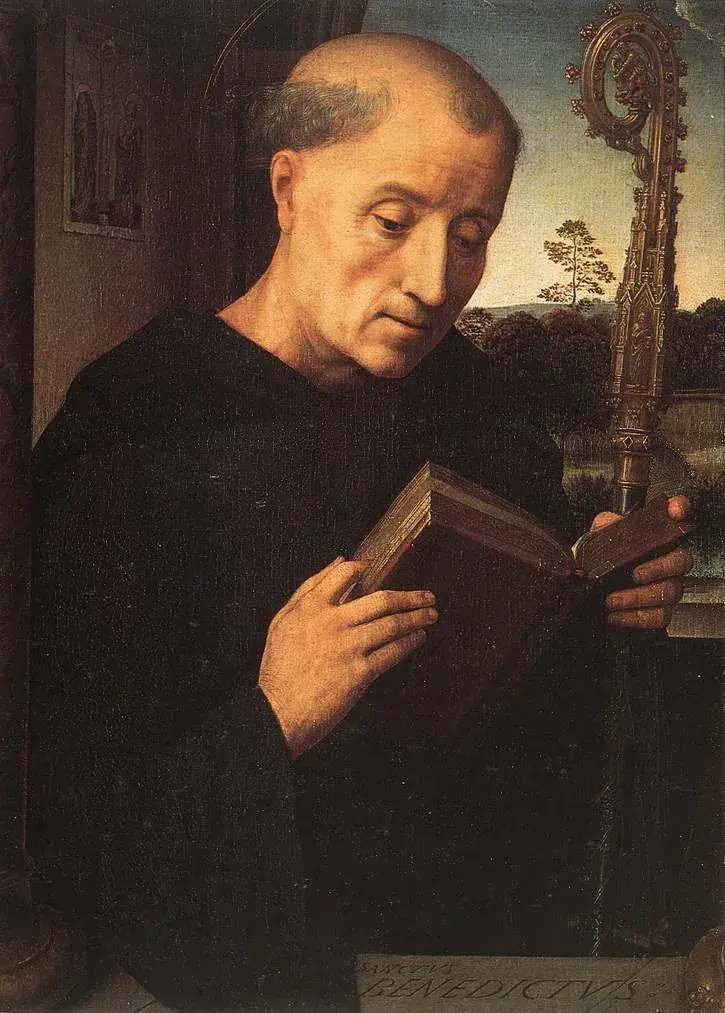
- Patron saint of
- Europe, monastics, and schoolchildren 2
- Feast day
- July 11 2
- Died
- March 21, 547 1
- Founded
- Monte Cassino, in 529 1
- Wrote
- The Rule, which he called "minimal, just an initial outline" 1
- Patron of Europe
- Proclaimed by Pope Paul VI on October 24, 1964 1
Saint Benedict walked out of his studies in Rome because he could not stand what his fellow students were doing with their lives, and went to live alone in a cave. What came out of that retreat was a short, temperate, humane rule for living in community that shaped Western civilization for fifteen hundred years - and which is still the best practical document anyone has written about ordering a day.
Walking out of Rome
Benedict was born around 480 in the province of Norcia and sent by wealthy parents to study at Rome. 12 He abandoned his studies, disturbed by the dissolute lives of the other students, wanting only to "please God," and withdrew into the mountains east of the city. 1
It is worth noticing that this is a young man rejecting a promising future because the culture around it disgusted him. The most influential institution-builder in Western monasticism began by refusing an institution.
Three years in a cave
At Subiaco he lived alone for three years in a cave later called the Sacro Speco, the Holy Grotto. 1 Benedict XVI describes him overcoming three fundamental temptations in that solitude: self-affirmation, sensuality, and anger or revenge. 1
Those three are not medieval curiosities. They are ego, appetite, and resentment - and a person who has not made peace with them will not be able to live with other people, which is what Benedict was about to spend the rest of his life arranging.
Monte Cassino and the Rule
In 529 he moved to Monte Cassino, a shift Benedict XVI reads as the move from private holiness to a mission visible to the Church and to society. 1 There he wrote the Rule.
He described it himself as "minimal, just an initial outline." 1 That modesty is the reason it worked: it is short, it is moderate, it assumes people are ordinary, and it balances prayer with work rather than demanding heroics. Its governing instruction is the one Benedict XVI quotes: "Let nothing be preferred to the Work of God" - the Divine Office. 1 Everything else in the day arranges itself around that fixed point.
He died on 21 March 547. 1 On 24 October 1964 Paul VI proclaimed him Patron of Europe, recognizing what the monasteries built on his Rule had done for the continent. 1
What is Saint Benedict the patron saint of?
Benedict is patron of Europe, of monastics, and of schoolchildren, and is invoked against poisoning and in kidney disease. 2 The European patronage is the substantive one, and it is a historical claim as much as a devotional one.
Saint Benedict's feast day
The feast of Saint Benedict is celebrated on July 11. 2
Praying with Saint Benedict
Benedict thought the shape of a day mattered more than intensity. Fix the hours of prayer, and the rest arranges itself around them. 1 It reads as unremarkable advice until you try living without it.
He called his own Rule minimal, just an initial outline. 1 The modesty is the point. It was written for ordinary people who would be at this for forty years, not for a burst of heroism followed by nothing.
Three temptations went down in the cave at Subiaco, and Benedict XVI names them: self-assertion, appetite, and the urge to get even. 1 Anyone who has tried to live alongside other people will recognize which one is theirs.
There is a sequence in his life worth noticing. Three years by himself first, then Monte Cassino and a community. 1 He learned solitude before he tried company, and the order does not seem to be reversible.
Saint Benedict of Nursia, pray for us.
Sources
Saints to turn to next
Others in this collection who are turned to for some of the same things.
- Saint Agnes of Montepulcianoc. 1268 - April 1317PrayerWork and vocationDiscernment
- Saint Andrew Avellino1521 - November 10, 1608DiscernmentWork and vocationPrayer
- Saint Benedict of Anianec. 750 - February 11, 821DiscernmentPrayerWork and vocation
- Saint Carmen RendilesAugust 11, 1903 - May 9, 1977PrayerDiscernmentWork and vocation