Saint Benedict of Aniane
c. 750 - February 11, 821
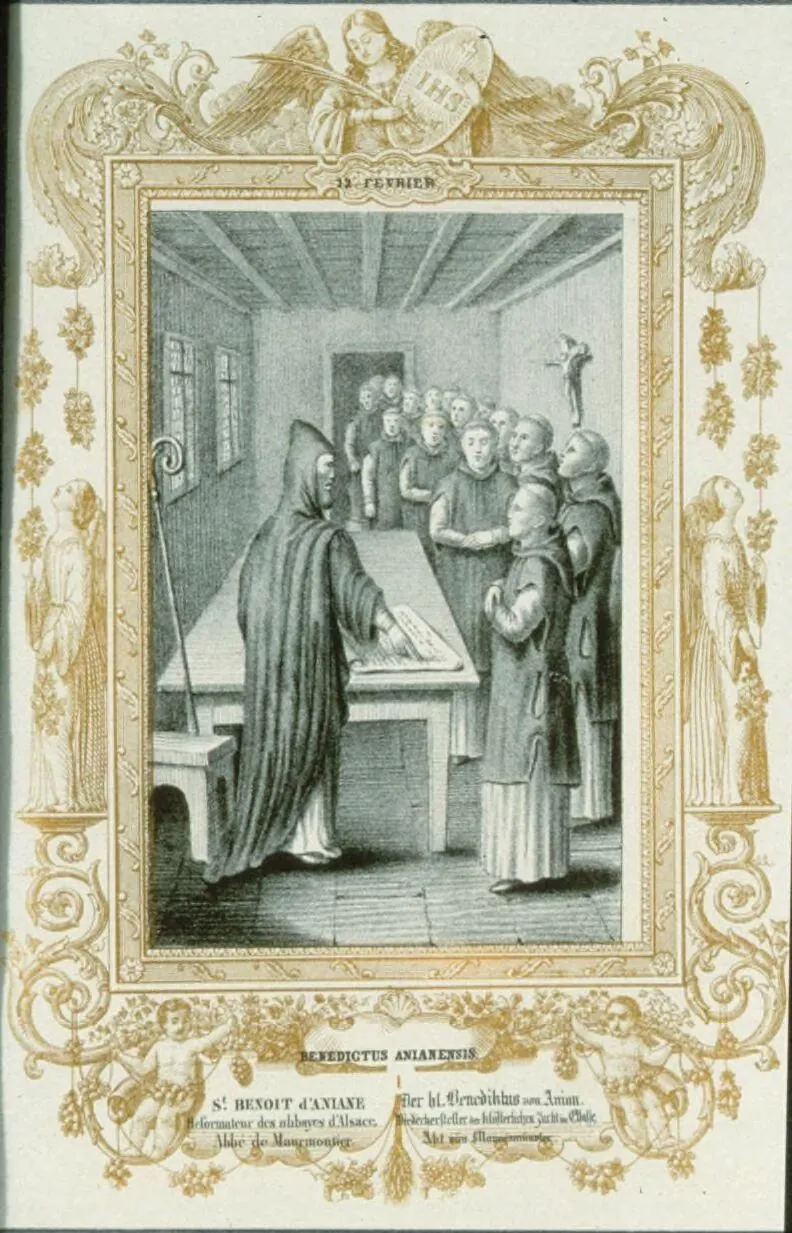
- Patron of
- With Pope Saint Cornelius, the Abbey of Kornelimünster 3
Saint Benedict of Aniane was a Visigothic count's son named Witiza who left Charlemagne's army to become a monk, founded the Abbey of Aniane on his family's land in southern France, and became the adviser through whom Emperor Louis the Pious set the Rule of Saint Benedict over the monasteries of the Frankish empire. 12 He died on February 11, 821, at the abbey the emperor had built for him near Aachen. 13 The Roman Martyrology enters him on February 12. 8
Witiza at court
He was born in the south of France around 750; the Catholic Encyclopedia says "about 745-750," and katolsk.no, the website of the Catholic Church in Norway, allows 747. 123 His family belonged to the Visigothic nobility of the region, his father, Aigulf, was Count of Maguelone, and his own name was Witiza. 123
He was brought up at the Frankish court of King Pepin and entered the royal service. 13 He rode with Charlemagne on the campaign against the Lombards in Italy, which the encyclopedia and the monks of Kornelimünster, the abbey he later founded, date to 773; katolsk.no has him distinguishing himself at the siege of Pavia in 774. 123
The encyclopedia says only that after that campaign he left his royal master for the religious life. 1 Katolsk.no tells more: a conversion at about twenty, some years as a penitent at court and in the army, and then a vow to leave the world, made after he almost drowned in the river Ticino near Pavia trying to rescue his brother. 2 Leaving was awkward for a man with his connections, and he had to make up a story about a visit to the court at Aachen in order to get away. 2
Saint-Seine and the stream at Aniane
He was received at the monastery of St. Sequanus, Saint-Seine, near Dijon, and it was there, katolsk.no says, that he took the name Benedict. 123 He stayed two and a half years, living on bread and water, sleeping on the floor, often praying the whole night, and going barefoot even in winter. 2 The Rule of Saint Benedict of Nursia did not seem to him enough, and he added whatever he found prescribed in the rules of Saint Pachomius and Saint Basil. 2 The encyclopedia remembers a man "imbued with the rigid austerity of the East." 5
When the abbot of Saint-Seine died the monks wanted Benedict in his place. He refused: the house was too lax for him, and he knew the brothers were against anything that looked like reform. 2 He went home instead, to land he had inherited beside a small stream called the Aniane, near Montpellier, and lived there as a hermit for some years. Others joined him. 2 They worked in the fields and copied books, the superior alongside the rest, on bread and water, with a little milk or wine on Sundays and feasts if somebody had given it in alms. 2
The sources date what came next a little differently. The encyclopedia has him come home in 779 and found the settlement then, and the abbey says about 779. 13 Katolsk.no says that in 779 he gathered the hermits into a monastery under very strict rules of his own, that the results disappointed him, and that he then adopted the Rule of Saint Benedict and in 792 built a larger monastery on the same site. 2 Aniane became, in the encyclopedia's words, "the model and centre of the monastic reform in France." 1
He was also drawn into the doctrinal quarrel of his day. When two Spanish bishops, Felix of Urgel and Elipandus of Toledo, taught what is called Adoptionism, Benedict "took the part of orthodoxy," the encyclopedia says, and "reported as early as 800 the conversion of 20,000 clerics and laymen." 127
The emperor's abbot
Aniane lay in Aquitaine, which the young Louis the Pious governed as king, and Benedict and his monastery gained great influence with him. 3 By the time Charlemagne died in 814, the encyclopedia says, Benedict was "the most famous monk in western Europe." 6
The new emperor wanted him close. He first sent him to Marmoutier in Alsace, but that was too far from the palace for a man he kept sending for. 24 So Louis had a monastery built in a valley about six miles from Aachen and named Inda after its stream; it is the present Kornelimünster. 24 Ardo, Benedict's pupil and biographer, records that the emperor came to the dedication of the church and fixed the community at thirty monks. 4
Ardo also describes what the move cost him. Benedict began going in and out of the palace again, putting up with the bustle of a court he had once given up. People who had been wronged and wanted the emperor's help came to him. He greeted them with a kiss, wrote their complaints down on slips, and carried them to Louis at a suitable moment. 4
Then Louis set him over every monastery in the empire. 45 Benedict led the synods held at Aachen in 816 and 817, whose decrees for the restoration of monastic discipline are dated July 10, 817. 1 According to Ardo he sat for many days with the assembled abbots and went through the Rule from the ground up, and the emperor sent inspectors to the monasteries to see the result kept. 4 One measure of food, drink, vigils and chant was laid down for all, in eighty capitula, so that it might seem as if "all had been taught by one single master in one single spot." 456
What the reform left behind
Ardo, writing a year after his master died, calls the result a complete and flourishing work. 4 The encyclopedia is cooler. The very minuteness of the capitula made them "vexatious and ultimately intolerable," Cyprian Alston writes, and the scheme of central authority "lasted only for the lifetime of Benedict himself." 5 The monks of Kornelimünster say plainly that the reform met resistance and that the resistance grew once he was dead. 3
Yet the encyclopedia goes on to say what survived. The capitula were accepted as a needed supplement to the Rule on points it had not settled, the first example of what monks now call constitutions. 56 And when Cluny adopted a centralized government a century later, it was a system "hitherto unknown to Benedictine monachism, except as suggested by St. Benedict of Aniane." 5 Katolsk.no notes that he is often called the second Benedict. 2
His death at Inda
The abbey prints the letter in which four monks of Inda reported his death to Ardo. Four days before he died Benedict was at the palace, feeling well, laying before the emperor everything he thought needed saying; that same day a fever took him. 3 On the emperor's order the brothers carried him to Inda before dawn on the Saturday. 3
The next day he called the brothers in and told them, the letter says, that in forty-eight years as a monk he had never once eaten his bread without first thanking God with tears. 3 He also dictated a letter to the monks of Aniane, in which he calls himself the last of all abbots and asks them to be of one mind in charity, to give the poorer brothers whatever they could spare, and to stay united with Inda like brothers. 3
He died on February 11, 821, in his seventies by the monks' letter and at seventy-one by katolsk.no. 123 In time his grave was forgotten, and it has never been found. The monks of Kornelimünster take that as a sign of how little he was venerated in the north; only a limited devotion grew up, they say, in his homeland in the south of France. 23
What is Saint Benedict of Aniane the patron saint of?
None of the sources consulted for this page names Saint Benedict of Aniane as patron of any trade, condition or country. The one patronage they state is local. Together with Pope Saint Cornelius he is the patron of the Abbey of Kornelimünster, to which the Benedictines returned on his feast day in 1906, a little over a century after Napoleon suppressed the old house. 3
Saint Benedict of Aniane's feast day
Saint Benedict of Aniane's feast is February 12. The Roman Martyrology enters him on that day at Kornelimünster, as the abbot who spread the Rule of Saint Benedict, gave the monks customs to observe, and worked hard for the renewal of the Roman liturgy. 8 He died on February 11. Katolsk.no says the newest edition of the Martyrology moved his memorial from the day of his death to the twelfth, the day of his burial and the day on which he had usually been kept. 2
Praying with Saint Benedict of Aniane
He began by overdoing it. Bread and water, bare feet in winter, a rule of his own stricter than anybody else's: by katolsk.no's account he tried all of it, saw that it was not forming the monks he hoped for, and took up a moderate rule written two and a half centuries earlier by another man. 2 He kept his own fasts to the end and wore himself out with them. 2
The work he is remembered for was unglamorous. He sat in meetings for days, settled measures of food and drink, and went back and forth to a palace he had once made up a story to escape. 24 Ardo says he bore the court for the good of many. 4
Most of the scheme did not outlast him. The sources say so without embarrassment, his own abbey among them. 35 Even his grave was lost. 3
What the monks of Inda chose to tell Ardo about his last days was something smaller than the reform. He said he had never eaten his bread in forty-eight years without first giving thanks, and his last letter asked the brothers at Aniane to stay of one mind and to share what they could spare with the poorer brothers. 3
Saint Benedict of Aniane, pray for us.
Sources
- 1.Johann Peter Kirsch, "St. Benedict of Aniane," The Catholic Encyclopedia, Vol. 2 (New York: Robert Appleton Company, 1907).
- 2.Per Einar Odden, "Den hellige Benedikt av Aniane (~750-821)," Den katolske kirke (the Catholic Church in Norway), last updated January 29, 2009 (in Norwegian).
- 3."Benedikt von Aniane: Gründerabt von Kornelimünster," with his farewell letter to the monks of Aniane and the letter of the monks of Inda to Ardo, translated by Abbot Berthold Simons, O.S.B., Benediktinerabtei Kornelimünster (in German).
- 4."Die Gründung des Klosters Kornelimünster: Auszug aus Ardos Vita des Benedikt von Aniane," Benediktinerabtei Kornelimünster (in German).
- 5.George Cyprian Alston, "The Benedictine Order," The Catholic Encyclopedia, Vol. 2 (New York: Robert Appleton Company, 1907).
- 6.Gilbert Huddleston, "Western Monasticism," The Catholic Encyclopedia, Vol. 10 (New York: Robert Appleton Company, 1911).
- 7.Joseph Sollier, "Adoptionism," The Catholic Encyclopedia, Vol. 1 (New York: Robert Appleton Company, 1907).
- 8.Roman Martyrology, entry for February 12, "San Benedetto, abate di Aniane," as printed in "Santo del giorno," Conferenza Episcopale Italiana (in Italian).
Saints to turn to next
Others in this collection who are turned to for some of the same things.
- Saint Agnes of Montepulcianoc. 1268 - April 1317PrayerWork and vocationDiscernment
- Saint Andrew Avellino1521 - November 10, 1608DiscernmentWork and vocationPrayer
- Saint Benedict of Nursiac. 480 - March 21, 547PrayerWork and vocationDiscernment
- Saint Carmen RendilesAugust 11, 1903 - May 9, 1977PrayerDiscernmentWork and vocation