Saint Andrew Avellino
1521 - November 10, 1608
- Buried
- The Church of St. Paul, Naples 1
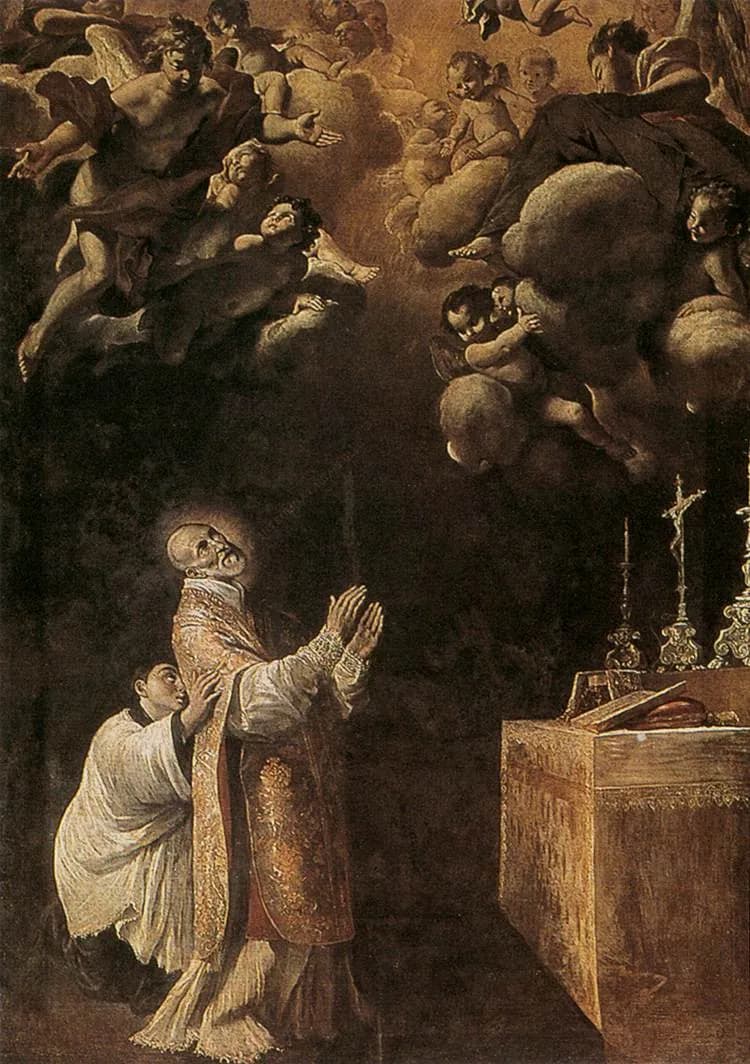
Saint Andrew Avellino was a church lawyer in Naples who gave up the law over a single lie told in court, became a Theatine priest, and spent the next half century reforming a convent, founding houses and directing souls, among them Lorenzo Scupoli, the author of "The Spiritual Combat." 1 He was stricken at the foot of the altar as he began Mass on November 10, 1608, and died that day at eighty-eight. 12 That is why he is invoked against a sudden death, and November 10 is his feast. 123
Lancelotto from Castronuovo
He was born in 1521 at Castronuovo and baptized Lancelotto. 12 The 1913 Catholic Encyclopedia places the town in Sicily; the Dicastery for the Causes of Saints places it in the province of Potenza, on the mainland. 12 The Dicastery says an uncle who was an archpriest set him on his studies. 2 After school at home he was sent to Venice for the humanities and philosophy, and Michael Ott, the encyclopedia's writer, adds that he was a handsome young man who took the clerical tonsure partly to be left alone by the women who admired him. 1
From there he went to Naples to study canon and civil law and took a doctorate in both. 1 The two sources order the next steps differently. Ott has him qualify in law and then be ordained a priest at twenty-six; the Dicastery has him ordained in 1545 and arriving at the university in Naples in October 1547 to begin the law. 12 Either way, for some years he was a priest who earned his living as a lawyer, pleading cases in the ecclesiastical court of Naples. 1
One lie in court
The turn in his life was small and specific. Pleading a friend's case, he told a lie in the heat of the argument. 1 Soon afterward he came on a line in the Book of Wisdom, which Ott quotes as "The mouth that belieth killeth the soul" (Wisdom 1:11), and he was stricken with remorse. 1 He gave up practicing as an ecclesiastical lawyer and spent a period doing nothing but meditation and spiritual exercises. 1
The Archbishop of Naples then gave him a hard job: the reform of a convent whose lax discipline had become a public scandal. 1 He restored order there by his own example and persistence, and it cost him. Men who had been in the habit of meeting the nuns in secret resented his interference, and one night they attacked him and wounded him badly. 1
A Theatine at thirty-five
He was carried to the house of the Theatines to recover, and there he decided to give himself entirely to God in their order. 1 The Theatines, or Clerics Regular, had been founded in 1524 by Saint Cajetan and companions to recall the clergy to an edifying life and the laity to virtue. 4 The Dicastery says his spiritual director, Blessed Giovanni Marinonio, guided him in, and that he took the habit at San Paolo Maggiore in Naples in 1556. 2 Ott says he was invested on the vigil of the Assumption, at thirty-five. 1
He took the name Andrew out of love for the cross, Ott says, and the Dicastery calls Andrew the apostle of the cross. 12 It suited the house he was joining: Cajetan had consecrated his order to the cross, taken it as the order's emblem, and founded it on May 3, the feast of the Finding of the Holy Cross. 4 The Dicastery records that he added two private vows to the usual three: to make a little progress in Christian perfection every day, and always to deny his own will in everything. 2 It says he kept both heroically until he died. 2
Novice master, superior and founder
After his novitiate he was given leave to visit the tombs of the apostles and martyrs in Rome, and on his return he was made master of novices, an office the Dicastery dates from 1560 to 1570. 12 He was then elected superior. 1 His zeal for discipline and for the purity of the clergy led the general of the order to send him to found two new Theatine houses, at Milan and at Piacenza, and many more followed in other dioceses of Italy through his efforts. 12
Ott describes him as a preacher and spiritual director with unusual success in bringing back sinners, and says disciples gathered around him wanting his guidance. 1 The best known of them was Lorenzo Scupoli, whose "The Spiritual Combat" Ott called in 1907 "that still popular book." 1 Saint Charles Borromeo, the reforming Archbishop of Milan, was a close friend who asked his advice on the most important affairs of the Church. 1
He also wrote. With all the preaching, confessions and visits to the sick, he still produced ascetical works; his letters were published at Naples in two volumes in 1731, and his other writings three years later in five. 1
At the foot of the altar
On November 10, 1608, he was beginning Mass when he was struck by apoplexy. 1 He received Viaticum and died that day, at eighty-eight. 1 The Dicastery's summary of his life ends the same way: he died, it says, at the foot of the altar. 2 He was buried in the Church of St. Paul in Naples. 1
Urban VIII beatified him on October 14, 1624, only sixteen years after his death, and Clement XI canonized him in St. Peter's Basilica on May 22, 1712. 12
What is Saint Andrew Avellino the patron saint of?
The 1913 Catholic Encyclopedia says he is venerated as patron by Naples and Sicily and invoked especially against a sudden death. 1 The encyclopedia's article on the Theatines names him again as the order's saint invoked against sudden death, alongside Saint Cajetan, whom it calls the saint invoked for the help of Providence. 4 Neither article explains the patronage, though the manner of his death is hard to miss: stricken without warning at the altar, he still had time to receive the last sacraments. 1
Saint Andrew Avellino's feast day
Praying with Saint Andrew Avellino
The thing that changed his life was one lie, told for a friend in an argument he wanted to win. 1 Nothing in the sources suggests it was a large one. He read a verse from Wisdom, took it at its word, and left a profession over it. 1 A reader who has shaded the truth at work will recognize the moment, and his answer to it was unusually thorough.
His second turn came by violence. He was sent to clean up a convent, did it, and was attacked and badly wounded for it, and the place he was taken to recover became the order he joined. 1 The sources do not make anything tidy of that, and neither should we.
For the rest of his life he kept two vows of his own making: a little progress every day, and his own will set aside. 2 Neither is dramatic. Over fifty years they produced a novice master, a founder of houses, a friend Charles Borromeo trusted, and the director of the man who wrote "The Spiritual Combat." 12
People pray to him against a sudden death, and his own death is the obvious link. 14 He was stricken at the beginning of Mass, at eighty-eight, still doing what he had done every day, and lived long enough to receive Viaticum. 1
Saint Andrew Avellino, pray for us.
Sources
- 1.Michael Ott, "St. Andrew Avellino," The Catholic Encyclopedia, Vol. 1 (New York: Robert Appleton Company, 1907).
- 2."Andrea Avellino (1521-1608)," Santi e Beati, Dicastery for the Causes of Saints (in Italian).
- 3."St. Andrew Avellino, Theatine, Priest," Saint of the Day, November 10, Vatican News.
- 4.Francesco Ragonesi, "Theatines," The Catholic Encyclopedia, Vol. 14 (New York: Robert Appleton Company, 1912).
Saints to turn to next
Others in this collection who are turned to for some of the same things.
- Saint Agnes of Montepulcianoc. 1268 - April 1317PrayerWork and vocationDiscernment
- Saint Anthony Zaccaria1502 - July 5, 1539Work and vocationConversionPrayer
- Saint Benedict of Anianec. 750 - February 11, 821DiscernmentPrayerWork and vocation
- Saint Benedict of Nursiac. 480 - March 21, 547PrayerWork and vocationDiscernment