Saint Anthony Zaccaria
1502 - July 5, 1539
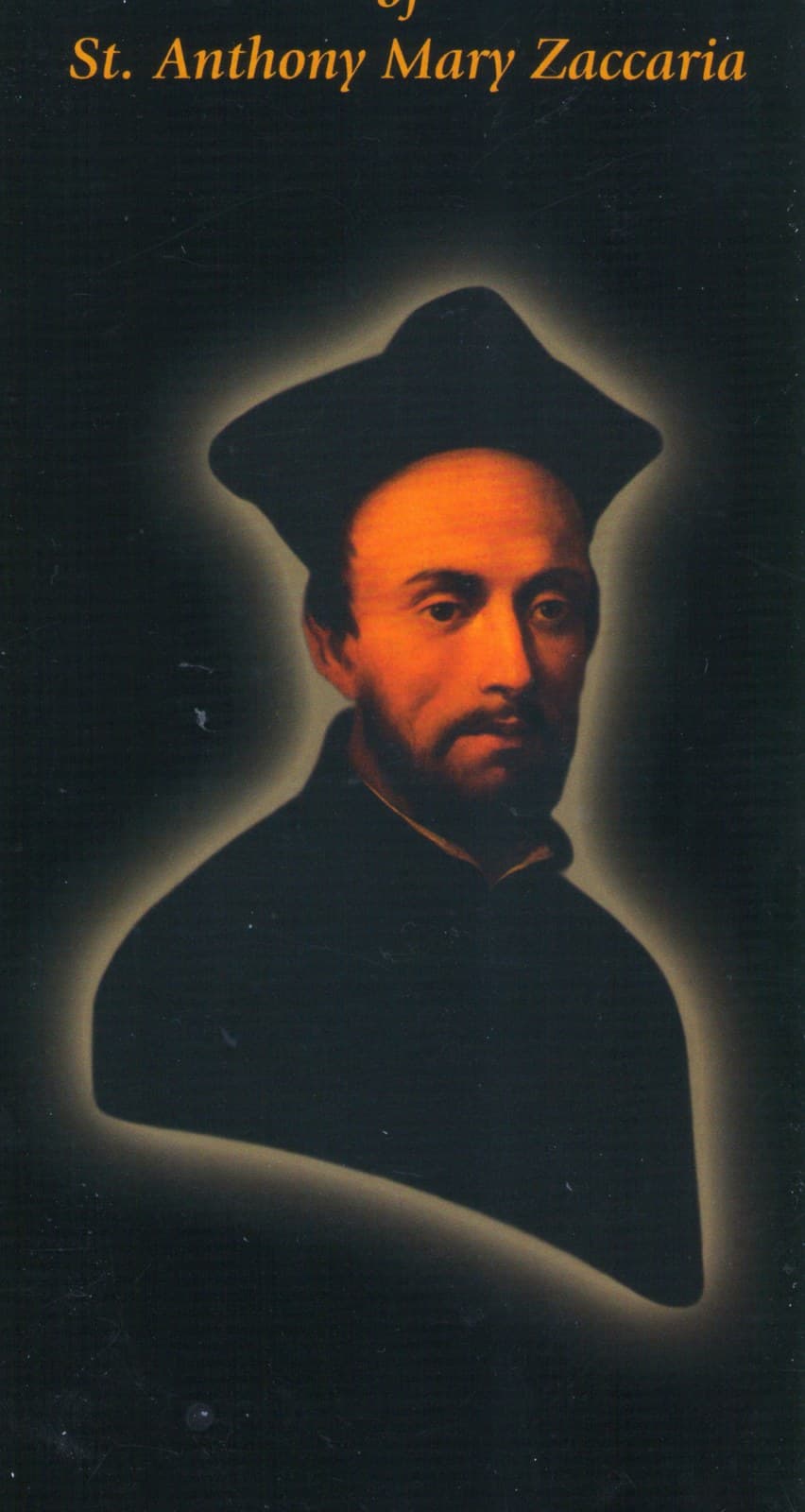
- Resigned
- As superior of his own congregation in 1536, three years after it was approved 1
- Was investigated
- Twice, by official inquiry, and cleared both times 2
Saint Anthony Zaccaria qualified as a physician at twenty-two, practiced in his home town, and then gave it up to study theology. 12 He founded three things at once in Milan - an order of priests, an order of women, and an association of married couples - and resigned as superior of the first after three years. 12 He preached in the streets with a crucifix in his hand and rang the church bells at three on Fridays. 12 He was dead at thirty-six or thirty-seven, worn out.
His mother made him her almoner
His father died while he was an infant, and Franciscan Media gives his mother's age when it happened: "His mother became a widow at 18, and devoted herself to the spiritual education of her son." 2 She was eighteen, with a baby, and did not remarry.
How she taught him is the best sentence in Kelly's article. She "taught him compassion for the poor and suffering by making him her almoner." 1 She did not lecture him about charity; she gave him the job of handing out the money.
He studied philosophy at Padua, began medicine in 1520, "at the age of twenty-two he received his degree of Doctor of Medicine and returned to Cremona to practise his profession." 1 He was a working physician for three years before he began theology, and was ordained in 1528. 12 Franciscan Media adds that he "renounced his rights to any future inheritance, worked as a catechist" in that period. 2
What he did with holy orders was continue the medical work by other means: "visiting and consoling the sick in hospitals and poor-prisons." 1
What northern Italy looked like
Kelly explains the conditions his congregation was founded to meet, and the passage is unsparing. "Northern Italy at this period was in a deplorable condition. Frequent wars had devastated the country. The advent of the Lutheran soldiery and their contempt for everything Catholic had spread the contagion of bad example, while famine and plague followed in the track of the soldiers. These scourges combined to produce a state of misery that appealed most powerfully to Antonio and his associates." 1
Franciscan Media places him historically rather than geographically: "At the same time that Martin Luther was attacking abuses in the Church, a reformation within the Church was already being attempted. Among the early movers of the Counter-Reformation was Anthony Zaccaria." 2 He was not reacting to the Reformation; he was working on the same problem at the same time.
He went to Milan, joined a confraternity, and found two priests who agreed with him. 1 The Congregation of the Regular Clerks of St. Paul "began with five members" and was approved by Clement VII in 1533. 1
Its rule is quoted and it is modest: to "regenerate and revive the love of the Divine worship, and a truly Christian way of life by frequent preaching and the faithful administration of the sacraments." 1 Preaching and the sacraments, done reliably.
Three foundations and a resignation
Franciscan Media counts what he actually started: "he laid the foundations of three religious congregations, one for men, one for women, and an association of married couples." 2 The third is not in Kelly's article at all, and it is the least conventional of the three - lay married people organized for the same work. 12
The aim was broad and Franciscan Media states the order of it: "the reform of the decadent society of their day, beginning with the clergy, religious, and lay people." 2 Clergy first.
He was the first superior, and Kelly says he "soon became known in Milan as an apostle", giving conferences to clergy and laity and going "into the streets of the city with crucifix in hand" to preach on the Passion and the need for penance. 1 Franciscan Media adds that he "was not ashamed of doing public penance" himself. 2
And then, in 1536, "he resigned the superiorship to Father Morigia." 1 Three years after the congregation was canonically approved, its founder handed it over and went to work somewhere else.
Where he went was Vicenza, at a cardinal's request, and what he did there was reform two communities of women - helped, Kelly notes, by the order of women he had founded in Milan. 1 He also introduced the Forty Hours devotion there. 1
Bells at three on Friday
Franciscan Media lists the practices he pushed, and they are strikingly ordinary and strikingly lay: "the collaboration of the laity in the apostolate, frequent Communion, the Forty Hours devotion, and the ringing of church bells at 3:00 p.m. on Fridays." 2
The last of those is a piece of public infrastructure. Three o'clock on a Friday is the hour of the crucifixion, and ringing the bells then puts it in front of everyone in earshot whether they are in church or not.
Not everyone was pleased. "His holiness moved many to reform their lives, but as with all saints, it also moved many to oppose him. Twice his community had to undergo official religious investigation, and twice it was exonerated." 2 Kelly's article mentions neither investigation. 1
The name the order is known by came late and by accident. Kelly: in his last two years he was looking for a better church for the congregation, "and accepted the offer of the church of S. Barnabas, but died before the affair was arranged. From this church of St. Barnabas, the Congregation received the name by which its members are commonly known." 1 Franciscan Media attributes it to the apostle instead: "Greatly inspired by Saint Paul - his congregation is named the Barnabites, after the companion of that saint." 2 A building or a man; the sources do not agree.
Brought home
Kelly is blunt about the cause: "Worn out by his voluntary penances, as well as by his untiring labours of charity, he was attacked by fever during one of his missions." 1 Franciscan Media: "While on a mission of peace, Anthony became seriously ill and was brought home for a visit to his mother." 2
"Knowing that this illness was his last, he had himself brought to his native city, Cremona. There, in his mother's house, he received the last sacraments and peacefully expired." 1 He went back to the woman who had made him her almoner, and died in her house.
The sources differ by a year on his age - thirty-seven in the encyclopedia, thirty-six in Franciscan Media - which depends on whether his birthday fell before July 5. 12 Either way he had been a priest for eleven years.
Kelly records that his body "was found incorrupt 27 years after his death." 1 He was declared Blessed in 1849 and canonized by Leo XIII in 1897 - three hundred and fifty-eight years after he died. 1
What is Saint Anthony Zaccaria the patron saint of?
Saint Anthony Zaccaria's feast day
The feast of Saint Anthony Zaccaria is July 5, the day he died in 1539. 12
Kelly's 1907 article states no feast day - it gives the death date in its opening line and never names a day in the calendar. 1 July 5 is the date both the General Roman Calendar and the calendar for the dioceses of the United States keep.
Praying with Saint Anthony Zaccaria
He is the saint for handing over something you built. He founded a congregation, got it approved by a pope, served as its first superior, and resigned three years later to go and do parish reform in another city. 1 He was in his early thirties and had every reason to stay. What he wanted was evidently the work rather than the position.
He is also the saint for bringing your old job with you. He was a physician first, and when he was ordained he went to the hospitals and the prisons. 1 The training did not go to waste and it did not become his identity either; it became the shape of what he did next.
The detail about his mother is the one to keep. Widowed at eighteen, she taught him charity not by explaining it but by putting him in charge of the almsgiving. 12 Thirty-odd years later, dying of a fever picked up on a mission, he asked to be taken to her house. 1
And the bells. Frequent Communion, lay people doing the work, and the church bells rung at three o'clock every Friday so that a whole city would be reminded of something at the same moment. 2 It is a small, public, practical idea, and it is the kind of thing that outlasts the person who thought of it.
Saint Anthony Zaccaria, pray for us.
Sources
Saints to turn to next
Others in this collection who are turned to for some of the same things.
- Saint Bernardine of SienaSeptember 8, 1380 - May 20, 1444ConversionWork and vocationPrayer
- Saint John EudesNovember 14, 1601 - August 19, 1680PrayerWork and vocationConversion
- Saint Norbertc. 1080 - June 6, 1134ConversionPrayerWork and vocation
- Saint Alphonsus LiguoriSeptember 27, 1696 - August 1, 1787PrayerConversion