Saint Norbert
c. 1080 - June 6, 1134
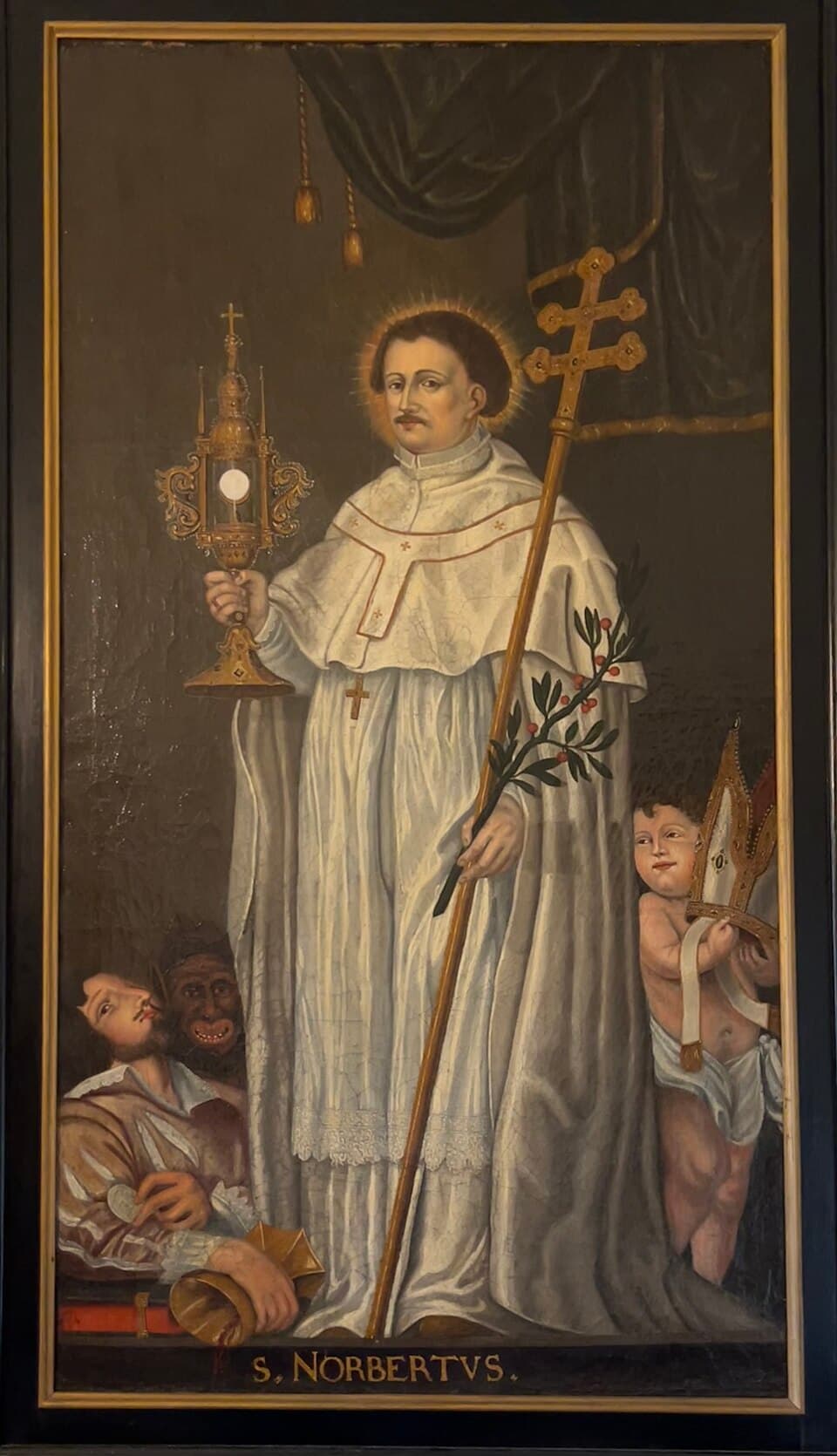
- Patron saint of
- Neither source assigns a patronage. He is invoked for peace and called the Apostle of Antwerp 1
- Born
- Xanten on the Rhine, about 1080, son of a count related to the imperial house 1
- Before his conversion
- Almoner at the court of the Emperor Henry V, and offered the bishopric of Cambrai 1
- What changed him
- A thunderbolt at his horse's feet. He lay "like one dead" for nearly an hour 1
Saint Norbert was a nobleman with a canonry, a place at the emperor's court and no particular interest in religion - he had been offered a bishopric and refused it. 1 Then lightning struck at his horse's feet on the road to Vreden and he lay unconscious for nearly an hour. 1 He gave everything away, was spat at by his fellow clerics at his first Mass, and founded an order in a swamp. 1
A cleric at court
He was born at Xanten on the Rhine about 1080. His father, Heribert, Count of Gennep, was related to the imperial house of Germany. 1 Geudens sketches him in a line: "A stately bearing, a penetrating intellect, a tender, earnest heart, marked the future apostle." 1
Ordained subdeacon, he was given a canonry at Xanten, then summoned to the court of the Prince-Bishop of Cologne, and later to that of the Emperor Henry V, whose almoner he became. 1 He was offered the bishopric of Cambrai and turned it down. 1
And Geudens then says plainly what that life was: "Norbert allowed himself to be so carried away by pleasure that nothing short of a miracle of grace could make him lead the life of an earnest cleric." 1 A man in orders, drawing the income of a canonry, living at court.
The road to Vreden
Riding to a village near Xanten, he was caught in a storm. "A thunderbolt fell at his horse's feet; the frightened animal threw its rider, and for nearly an hour he lay like one dead. Thus humbled, Norbert became a sincere penitent." 1
He resigned his court appointment and went back to Xanten to do penance - and then did something that distinguishes him from a great many sudden converts. "Understanding, however, that he stood in need of guidance, he placed himself under the direction of Cono, Abbot of Siegburg." 1 He did not trust his own new enthusiasm. He found somebody to answer to.
He was thirty-four. 1 He was ordained priest by the Bishop of Cologne, made a forty days' retreat, and celebrated his first Mass at Xanten, preaching "on the transitory character of this world's pleasures and on man's duties toward God." 1
It went badly. "The insults of some young clerics, one of whom even spat in his face, he bore with wonderful patience on that occasion." 1 The men he had been at court with had come to watch, and one of them spat at him.
Accused of being an innovator at the Council of Fritzlar, he answered by giving up everything. "He resigned all his ecclesiastical preferments, disposed of his estate, and gave all to the poor, reserving for himself only what was needed for the celebration of Holy Mass." 1
Then, "barefooted and begging his bread, he journeyed as far as St. Giles, in Languedoc, to confer with Pope Gelasius concerning his future life." 1 A count's son walked from the Rhine to Provence with nothing, to ask a pope what to do. Gelasius could not keep him at court either, and gave him leave "to preach wherever he judged proper." 1
A valley shaped like a cross
At the Council of Reims in 1119 the new pope, Calixtus II, and the Bishop of Laon asked him to found a religious order, "so that his work might be perpetuated after his death." 1
He chose badly, on purpose. "Norbert chose a lonely, marshy valley, shaped in the form of a cross, in the Forest of Coucy, about ten miles from Laon, and named Premontre." 1 His first disciples included Hugh of Fosses, Evermode of Cambrai, and seven students from the famous school of Anselm at Laon. 1
"The young community at first lived in huts of wood and clay, arranged like a camp around the chapel of St. John the Baptist, but they soon built a larger church and a monastery." 1
Franciscan Media describes the shape the order took, and one detail of it is worth noticing because it was unusual: "Many of them lived in central houses during the week and served in parishes on weekends." 2 Canons, not monks - men under a rule who went out and did parish work.
The growth was fast. Floreffe, Viviers, Laon, Liege, Antwerp, Kappenberg and others were founded in the first five years, and Honorius II confirmed the order by a Bull dated 27 February 1126. 1
Two refusals and one he could not make
The best story about him concerns a man he turned away.
Theobald, Count of Champagne, met Norbert and wanted to join the order. "But Norbert insisted that God wished Theobald to marry and do good in the world." 1 The count accepted it and asked instead for a rule he could live by. "Norbert prescribed a few rules and invested Theobald with the white scapular of the order, and thus, in 1122, the Third Order of St. Norbert was instituted." 1
A founder recruiting hard for a new order told a wealthy and willing volunteer to go home, get married, and be good there - and then wrote him a rule for doing it. The lay third order came out of that refusal.
He also refused a bishopric twice more. At Wurzburg, after he restored a blind woman's sight, the townspeople began talking about electing him their bishop, and "Norbert and his companions fled secretly." 1
The third time he was cornered. Passing through Spier, where Lothair was holding a diet and deputies from Magdeburg had come looking for an archbishop, "the papal legate and Lothair used their authority, and obliged Norbert to accept the vacant see." 1 Franciscan Media: "Reluctantly, Saint Norbert became archbishop of Magdeburg in central Germany, a territory half pagan and half Christian." 2
What he found there was what he had left behind. "He was grieved to find that much property belonging to the Church and the poor had been usurped by powerful men, and that many of the clergy led scandalous lives. He succeeded in converting some of the transgressors, but others only became more obstinate, and three attempts were made on his life." 1 Three attempts. He died at Magdeburg on 6 June 1134. 12
Antwerp and the Blessed Sacrament
The Bishop of Cambrai sent him to the Low Countries against the teaching of Tanchelin, which denied the reality of the Eucharist and was centered on Antwerp. 1
Geudens records the outcome and one extraordinary detail of it: "As a result of his preaching the people of the Low Countries abjured their heresies, and many brought back to him the Sacred Species which they had stolen and profaned." 1 People walked up to him and handed back consecrated Hosts they had taken.
"In commemoration of this, St. Norbert has been proclaimed the Apostle of Antwerp", and the Archdiocese of Mechlin keeps a separate feast of his triumph over that heresy on 11 July. 1 He is painted holding a monstrance because of it.
Franciscan Media makes the connection between the man and the devotion: he faced "rampant heresies - particularly regarding the Blessed Sacrament" and found his help "especially in devotion to the Blessed Sacrament." 2 And it is careful to say how he understood his own part: "Saint Norbert entertained no pretensions about his own ability to accomplish this multiple task... he realized that nothing could be effectively done without God's power." 2
What is Saint Norbert the patron saint of?
Neither Geudens nor Franciscan Media assigns Saint Norbert a patronage. 12 He is honored as the Apostle of Antwerp, and is widely invoked for peace - Franciscan Media lists "effecting peace and reconciliation among enemies" among the tasks he set himself. 12
He is also a natural patron for people devoted to the Blessed Sacrament, and for anyone working to restore a parish or a diocese that has gone slack. That was the job at Magdeburg, and it nearly got him killed three times. 1
And there is a smaller claim worth making. Because of Theobald, he belongs to lay people who want a serious rule of life without leaving their marriage or their work. 1
Saint Norbert's feast day
The feast of Saint Norbert is June 6, the day he died at Magdeburg in 1134. 12 Geudens gives the death date exactly and Franciscan Media presents him on the same day.
One other date belongs on the record. The Archdiocese of Mechlin keeps 11 July as the feast of his triumph over the Sacramentarian heresy at Antwerp - a local commemoration of one episode rather than of the man. 1 A reader who encounters that date is not looking at a rival feast.
His birth is given only as "about 1080." 1
Praying with Saint Norbert
The conversion has an honest shape. He was not seeking; he was thrown off a horse. 1 And what he did on getting up is the part worth copying - he put himself under the direction of an abbot, because he did not trust a man who had been living as he had been living to know what to do next. 1 Sudden certainty is the most dangerous thing a new convert has, and Norbert handed his to someone else to hold.
The spitting at his first Mass is the detail that stops him being a portrait. 1 A man who has changed publicly is not applauded; he is resented, most sharply by the people who knew the earlier version and feel accused by the new one. Geudens says he bore it patiently, which is all that can be done.
Theobald is the best thing in the entry. Norbert was building an order and needed men, and a rich count volunteered - and he sent him home to get married. 1 He could tell the difference between a vocation and an enthusiasm, in somebody else, against his own interest. The Third Order exists because he said no to a recruit.
And the end is not triumphant. He was forced into an archbishopric he had run away from twice, found the diocese in the state his own early life had been in, converted some of the offenders, failed with the rest, and survived three attempts on his life before dying at about fifty-four. 1 The order he founded outlived all of it. He built it in a swamp on purpose.
Saint Norbert, pray for us.
Sources
Saints to turn to next
Others in this collection who are turned to for some of the same things.
- Saint John EudesNovember 14, 1601 - August 19, 1680PrayerWork and vocationConversion
- Saint Anthony Zaccaria1502 - July 5, 1539Work and vocationConversionPrayer
- Saint Bernardine of SienaSeptember 8, 1380 - May 20, 1444ConversionWork and vocationPrayer
- Saint Alphonsus LiguoriSeptember 27, 1696 - August 1, 1787PrayerConversion