Saint Bernardine of Siena
September 8, 1380 - May 20, 1444
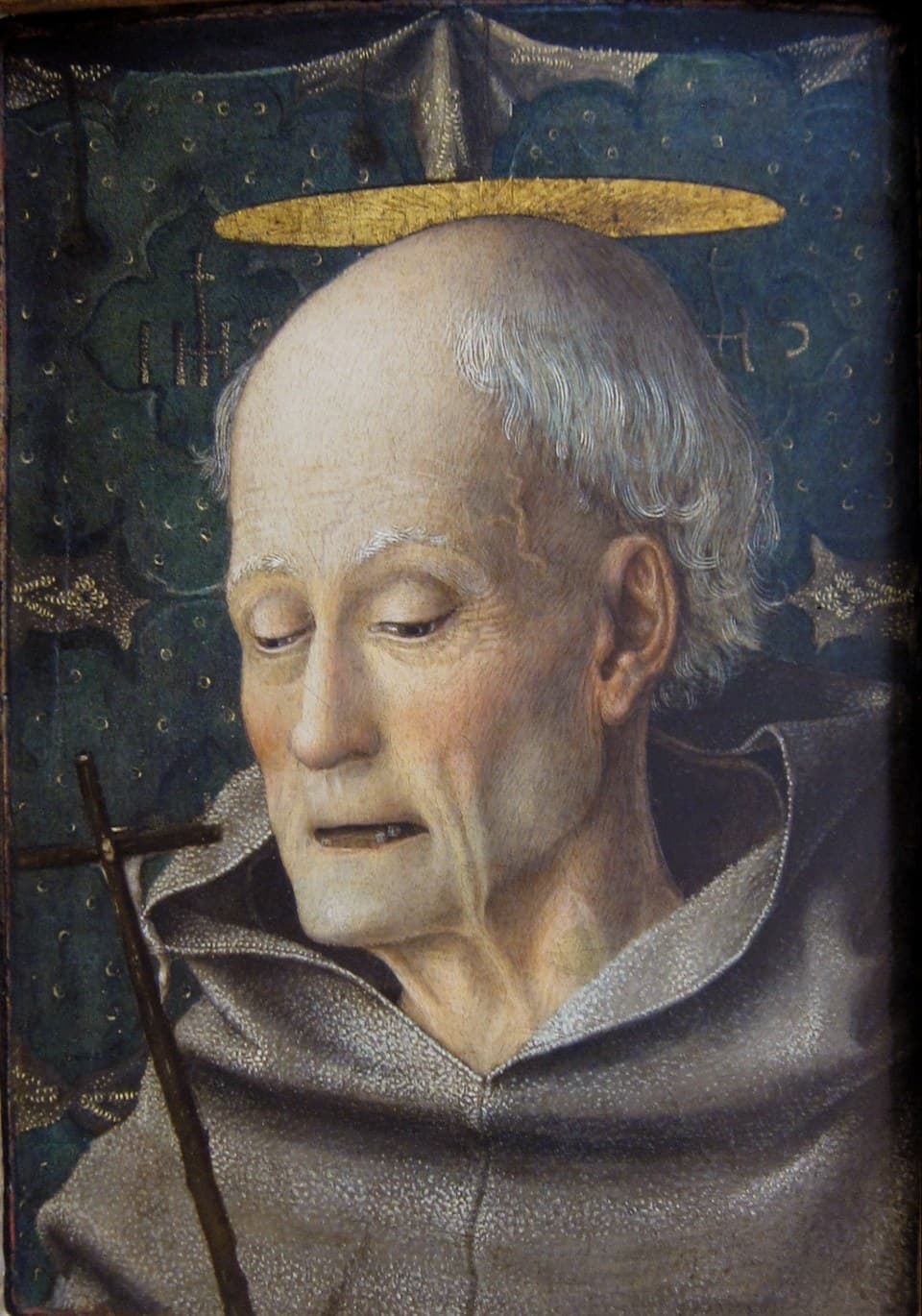
- Patron saint of
- Advertising and public relations, of Italy, and against gambling 2
- Born
- 8 September 1380 at Massa, a Sienese town his father governed. Orphaned at six 1
- His emblem
- IHS in Gothic letters on a blazing sun, designed to replace the badges of the factions 2
- His order
- 300 friars when he became its head; 4,000 when he died 2
Saint Bernardine of Siena was the greatest preacher in fifteenth-century Italy and started out with a weak, hoarse voice. 2 He drew crowds of thirty thousand into market squares, burned the vanities of whole cities, went after moneylenders, and walked everywhere on foot. 12 He is the patron saint of advertising, and not as a joke: he designed a symbol to drive the factional badges of Italy out of use, and it worked. 2
Four months in the hospital
He was born on 8 September 1380 at Massa, a Sienese town his father governed, into the noble family of the Albizeschi. 1 He was orphaned at six and "brought up with great care by his pious aunts", and Robinson says his youth was "blameless and engaging." 1
After studying civil and canon law he joined a confraternity attached to the great hospital of Santa Maria della Scala in Siena. 1 Three years later, when he was twenty, the plague came back.
Franciscan Media gives the scale: "Sometimes as many as 20 people died in one day at the hospital." 2 Robinson describes what he did: "he came forth from the life of seclusion and prayer he had embraced, to minister to the plague-stricken, and, assisted by ten companions, took upon himself for four months entire charge of this hospital." 1
A twenty-year-old ran a plague hospital for four months with ten friends. "Despite his youth Bernardine proved fully equal to this task, but the heroic and unremitting labour it involved so far shattered his health that he never completely recovered." 1 Franciscan Media: "He escaped the plague, but was so exhausted that a fever confined him for several months." 2
He then spent a year nursing an aunt who had raised him, and after her death "began to fast and pray to know God's will for him." 2 He gave away his inheritance and took the Franciscan habit at twenty-two. 12
Robinson records the dates: habit on 8 September 1402, profession on 8 September 1403, ordination on 8 September 1404. 1 He was born on 8 September. Three years running, he marked his birthday by taking another step in.
Twelve years of nothing
About 1406, Vincent Ferrer - preaching in Piedmont - said that his own mantle would fall on someone in the room, and that he would return to France and Spain "leaving to Bernardine the task of evangelizing the remaining peoples of Italy." 1
Then Robinson writes one of the most useful sentences in this library: "Nearly twelve years passed before this prediction was fulfilled. During this period, of which we have no details, Bernardine seems to have lived in retirement at Capriola." 1
Twelve years, no details. Franciscan Media: "For almost a dozen years he lived in solitude and prayer, but his gifts ultimately caused him to be sent to preach." 2 A man told he would convert Italy spent the next decade in a quiet house, and nobody recorded what he did there.
It ended at Milan at the close of 1417, when "his gift of eloquence was made manifest and his missionary life really began." 1 He was thirty-seven.
Thirty thousand in the market place
What followed is hard to convey at modern scale. "Various cities contended for the honour of hearing him, and he was often compelled to preach in the market places, his auditors sometimes numbering thirty thousand." 1 No building would hold the congregation.
He walked to all of it. "He always traveled on foot, sometimes speaking for hours in one place, then doing the same in another town." 2
The testimony is unusually good because some of it comes from people who were there. Pius II, "who as a youth had been a spellbound auditor of Bernardine, records that the saint was listened to as another Paul", and the Florentine biographer Vespasiano da Bisticci wrote that by his sermons Bernardine "cleansed all Italy from sins of every kind in which she abounded." 1 "The penitents, we are told, flocked to confession 'like ants'." 1
It changed the law. In several cities the reforms he urged "were embodied in the laws under the name of Riformazioni di frate Bernardino." 1 And he was not careful about whom he offended: "He preached with apostolic freedom, openly censuring Visconti, Duke of Milan, and elsewhere fearlessly rebuking the evil in high places." 1
Two targets are worth naming. Vanities were burned "by the cartload." 1 And usury: he attacked it so persistently that "he did much to prepare the way for the establishment of the beneficial loan societies, known as Monti di Pieta" - pawnshops run as charities, lending to the poor at no profit. 1 He did not only denounce moneylending; he helped build the alternative.
But Robinson insists on what the real theme was: "Bernardine's watchword, like that of St. Francis, was 'Peace'. On foot he traversed the length and breadth of Italy peacemaking, and his eloquence was exercised with great effect towards reconciling the mutual hatred of Guelphs and Ghibellines." 1 At Crema his preaching got the political exiles recalled "and even reinstated in their confiscated possessions." 1
The blazing sun
The thing he is now patron of came out of that peacemaking, and it was a design problem.
Italians wore their factions. Franciscan Media: the badges of the Guelphs and Ghibellines were on everything, along with "the superstitious symbols of the day." 2 Bernardine made something to put in their place - "a symbol - IHS, the first three letters of the name of Jesus in Greek - in Gothic letters on a blazing sun." 2
It spread exactly as he intended: "The devotion spread, and the symbol began to appear in churches, homes and public buildings." 2 A man replaced the party badges of a country with a single mark, by making one people preferred.
It was not uncontroversial. "Opposition arose from those who thought it a dangerous innovation. Three attempts were made to have the pope take action against him, but Bernardine's holiness, orthodoxy, and intelligence were evidence of his faithfulness." 2 Three separate attempts to have the papacy suppress his logo.
Four thousand friars
He was made head of the Observant branch of the Franciscans, and Franciscan Media gives the arithmetic that describes his tenure: "When he started there were 300 friars in the community; when he died there were 4,000." 2
What he pushed inside the order was study. He "strongly emphasized scholarship and further study of theology and canon law." 2 The great popular preacher spent his administrative years insisting his friars learn canon law.
Then he went back on the road. "He returned to preaching the last two years of his life, dying while traveling." 2 He died at Aquila in the Abruzzi on 20 May 1444. 1 Robinson calls him, in his first line, "often called the 'Apostle of Italy'." 1
What is Saint Bernardine of Siena the patron saint of?
Saint Bernardine of Siena is the patron saint of advertising and public relations, of Italy, and of those struggling with gambling. 2
The advertising patronage is the one people assume is a modern joke, and it is not. He identified a communication problem - a country wearing the emblems of its own civil wars - designed a mark to displace them, and got it onto buildings from Milan to Naples. 2 Anyone whose job is to make an idea legible and memorable has a patron who did exactly that, at enormous scale, on foot.
The gambling follows from what he preached against, and it sits oddly beside the advertising until you notice they are the same instinct: he went after the things that were eating ordinary people's money, whether that was dice or usury. 12 He then helped set up the Monti di Pieta to give them somewhere else to borrow. 1
Saint Bernardine of Siena's feast day
The feast of Saint Bernardine of Siena is May 20, the day he died at Aquila in 1444. 12 Robinson gives the death date exactly and Franciscan Media presents him on the same day.
His birth is equally precise and worth noting for its own sake: 8 September 1380, the feast of the Nativity of the Virgin - the same date on which he received the Franciscan habit in 1402, made his profession in 1403, and was ordained in 1404. 1
Praying with Saint Bernardine
The weak voice is the first thing to take from him. The greatest preacher of his century began with an instrument that did not work, and Franciscan Media reports both the defect and the claim that it was healed. 2 Whatever one makes of the healing, the sequence is the useful part: he was not obviously equipped for the thing he became.
The twelve silent years are the second. He was told, in public, by a famous man, that Italy would be his to convert - and then spent a dozen years in a small house doing nothing anyone wrote down. 1 Most people given a sense of what they are for will spend longer than they expect waiting to begin. Robinson does not treat it as wasted; he simply records that we have no details.
The four months in the hospital are the third, and the hardest. At twenty he took charge of a plague ward and it permanently damaged his health. 1 He did not get that back. Everything afterward - the walking, the hours of preaching, the thirty years on the road - was done by a man whose constitution had already been spent, once, on four months of other people's dying.
And then the sun with the letters on it. He understood that people wear what they belong to, that the badges of Guelph and Ghibelline were keeping a war alive in the streets, and that the way to answer a symbol is with a better one. 2 Three times somebody tried to get it banned. It is still carved over church doors all over Italy.
Saint Bernardine of Siena, pray for us.
Sources
Saints to turn to next
Others in this collection who are turned to for some of the same things.
- Saint Anthony Zaccaria1502 - July 5, 1539Work and vocationConversionPrayer
- Saint John EudesNovember 14, 1601 - August 19, 1680PrayerWork and vocationConversion
- Saint Norbertc. 1080 - June 6, 1134ConversionPrayerWork and vocation
- Saint Alphonsus Rodriguez1532 or 1533 - October 1617PrayerWork and vocation