Saint Agnes of Montepulciano
c. 1268 - April 1317
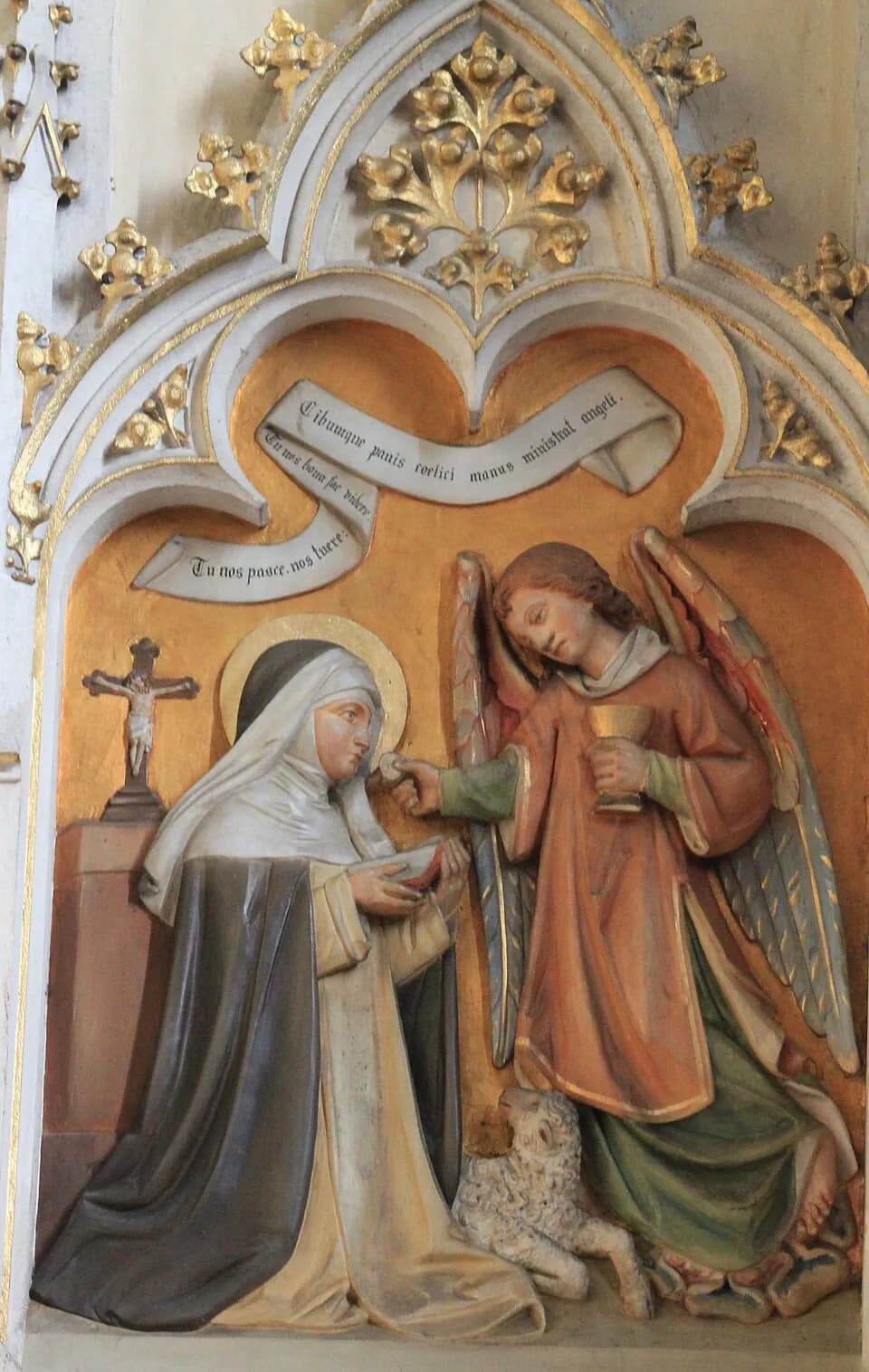
- Founded
- The Dominican convent at Montepulciano; 1306 by the Order of Preachers and the New Catholic Encyclopedia, 1298 by the 1907 Catholic Encyclopedia 123
- Patron saint of
- Montepulciano, by the New Catholic Encyclopedia; Catholic Culture lists the city of Siena 34
Saint Agnes of Montepulciano was a Tuscan nun who entered a convent at nine, was made prioress of a new community at fifteen, and returned to her home town to found the Dominican convent of Montepulciano, which she governed until her death in 1317. 123 Catherine of Siena called her a "glorious mother," to be followed "in doctrine and in the example of true humility," as the Order of Preachers records. 2 Her feast is April 20. 125
A child at the convent door
She was born around 1268 into the Segni family at Gracciano, near Montepulciano in Tuscany. 123 The Order of Preachers calls the family wealthy, and Vatican News calls it noble. 25 The Dominican Sisters of St. Cecilia, in the excerpt Catholic Culture prints, say she asked to visit the town's convents when she was small, and that her parents now and then gave in. 4
The same account has a story from one of those visits. Passing a house of ill repute with her mother, the little girl was set upon by a flock of crows, which her mother took for a sign of the powers of evil threatened by her innocence. 4 Years later, the sisters note, she would be asked to build a convent on that very spot. 4
At nine she entered a religious house at Montepulciano. 123 The New Catholic Encyclopedia and Catholic Culture both name it: the "Sisters of the Sack," called so for their rough clothes. 34 The Nashville account says instead that she joined "the Franciscans in Montepulciano." 4 She impressed the community, and the New Catholic Encyclopedia says she was made bursar at fourteen. 3
Prioress at fifteen
A new convent was founded at Proceno, near Viterbo, and Agnes went there. 23 The sources tell it differently. Edward Fitzgerald, in the 1907 Catholic Encyclopedia, says Pope Nicholas IV commissioned her at thirteen to help found it, and that she became its prioress at fifteen. 1 Her own order says that at fifteen, "by indult of the Supreme Pontiff, she was made prioress, against her will," of a house she had worked to establish. 2 The New Catholic Encyclopedia says she went with an older nun and was "soon elected abbess." 3 Catholic Culture has her serve as housekeeper first, then bursar, then superior. 4
As superior she grew stricter with herself. The New Catholic Encyclopedia says she fasted on bread and water and slept on the ground. 3 Her vita, it says, reports visions of the Virgin, the Christ Child and the angels, and showers of white, cross-shaped particles "like manna" that fell on her and the places where she prayed. 3 The Nashville sisters add that some of these are said to be preserved still, and that once, when Mary let her hold the Christ Child, she was very reluctant to give Him back. 4
Called home to Montepulciano
Her reputation reached her home town, and its people wanted her back. 124 The Order says she gave way to their prayers after twenty-two years. 2 The New Catholic Encyclopedia says the citizens offered to build her a convent where a house of ill fame had stood, and Catholic Culture says the premises had been brothels. 34 It is the same place as the crows in the Nashville story. 4
She founded the house in 1306, by the reckoning of the Order, the New Catholic Encyclopedia and Vatican News; Fitzgerald gives 1298. 1235 The Order says it began under the Rule of St. Augustine and some years later passed "fully and entirely" under the direction of the Order of Preachers, because she wanted to live under the Rule of St. Dominic. 2 Fitzgerald calls it "the celebrated convent of Dominican nuns at Montepulciano," and says she governed it until she died. 1
She was good at running it. The New Catholic Encyclopedia calls her "a competent administrator, often providing miraculously for the needs of her sisters." 3 Her standing reached beyond the walls. The Order says she used "the authority she held among the citizens" to urge them toward unity and peace. 2
Her own order sums up her inner life briefly. She venerated the Child Jesus and his Virgin Mother "with great devotion," it says, and, "strengthened by the gifts of the Holy Spirit, she became a shining lamp of prayer and charity." 2 The New Catholic Encyclopedia names "simplicity and ardor" as the keynotes of her spirituality. 3 Vatican News sums up the start of it in two facts: in religious life at nine, and superior of a new community by fifteen. 5
Illness and death
The New Catholic Encyclopedia says she died "after a painful illness." 3 The Nashville account says that toward the end she went to some famous springs for healing, was not healed herself, and that her prayers there brought back to life a child who had drowned. 4
She died at Montepulciano in 1317. 123 The Order gives the date as April 20, the day still kept as her feast; the New Catholic Encyclopedia gives April 4. 23 Catholic Culture says her relics are in the Church of St. Agnes in Montepulciano and that her body is said to be incorrupt. 4
Catherine of Siena
Her best-known admirer came after her death. The Order of Preachers records that Catherine of Siena called her a "glorious mother," to be followed "in doctrine and in the example of true humility." 2 The New Catholic Encyclopedia lists a life of Agnes by Raymond of Capua among its sources, and notes that in Italian art she is often shown with Catherine and with Rose of Lima. 3
Catholic Culture tells the story that goes with that. Catherine made a pilgrimage to her shrine, and when she bent to kiss the dead woman's foot, the foot rose to meet her. 4 Catholic Culture says it may be the thing Agnes is best known for. 4
Benedict XIII canonized her in 1726, on December 10 according to the Order. 123
What is Saint Agnes of Montepulciano the patron saint of?
Saint Agnes of Montepulciano's feast day
Praying with Saint Agnes of Montepulciano
She was put in charge of other people very young, and by her own order's account she did not want it. 2 The Order says she was made prioress at fifteen "against her will." 2 What followed was decades of administration, of buildings, money and nuns, which the New Catholic Encyclopedia says she did well. 3
Catholic Culture's account of her draws out one idea: that charity is the way to humility, and "there is no humility without charity; the one nourishes the other." 4 Catherine of Siena, a generation later, held up the same humility as the thing to imitate in her. 2
The convent she founded at Montepulciano stood where a brothel had been. 34 The town gave her the site, and she made it a house of prayer that the Order says helped bring a quarreling city toward peace. 2
The wonders told of her are many, and the sources pass them on as reported: the manna, the Christ Child in her arms, the child at the springs. 34 Underneath them is a plainer record of a woman who entered religious life at nine and spent the rest of it praying and governing. 123
Saint Agnes of Montepulciano, pray for us.
Sources
- 1.Edward Fitzgerald, "St. Agnes of Montepulciano," The Catholic Encyclopedia, Vol. 1 (New York: Robert Appleton Company, 1907).
- 2."S. Agnetis de Montepulciano," Saints of the Order, Order of Preachers, from the Proprium Officiorum Ordinis Praedicatorum (Rome, 1982).
- 3."Agnes of Montepulciano, St.," New Catholic Encyclopedia, via Encyclopedia.com.
- 4.Catholic Culture, Liturgical Year, April 20, 2026, with an excerpt from the Dominican Sisters of St. Cecilia Congregation.
- 5.Vatican News, Saint of the Day, April 20.
Saints to turn to next
Others in this collection who are turned to for some of the same things.
- Saint Andrew Avellino1521 - November 10, 1608DiscernmentWork and vocationPrayer
- Saint Benedict of Anianec. 750 - February 11, 821DiscernmentPrayerWork and vocation
- Saint Benedict of Nursiac. 480 - March 21, 547PrayerWork and vocationDiscernment
- Saint Carmen RendilesAugust 11, 1903 - May 9, 1977PrayerDiscernmentWork and vocation