Saint Clare of Montefalco
c. 1268 - August 1308
- Community
- Her sister's hermitage at Montefalco, given the Rule of Saint Augustine by the Bishop of Spoleto in 1290 13
Saint Clare of Montefalco was an Umbrian abbess who went to live in her sister's hermitage as a small child, became its abbess, and died at Montefalco in August 1308 at about forty. 13 She is also called Clare of the Cross, for a devotion to the Passion so complete that she told her nuns she carried the cross of Christ in her heart. 23 Pope Leo XIII canonized her in 1881, and her feast is August 17. 13
A hermitage in Montefalco
She was born at Montefalco, a small town in Umbria, about 1268. 12 Her older sister, whom the Italian sources call Giovanna and the American Augustinians call Joan, was already living in seclusion with a group of young women, in a house their own father had built for them. 23 The Maltese Augustinians say Clare joined them when she was six. 3
These were not yet nuns in the strict sense. Central Italy at the time had many such houses, where people shut themselves in a small space and gave their lives to prayer. 3 The 1908 Catholic Encyclopedia thinks it most likely that the sisters and their companions wore the habit of the Third Order of Saint Francis and kept a way of life in common "which their piety and fervour suggested." 1
When they wanted to take the three vows of religion, they asked the Bishop of Spoleto for an approved rule, and in 1290 he gave them the Rule of Saint Augustine. 13 The hermitage became a monastery under the bishop's authority, with the right to its own church and to have the sacraments celebrated there. 3
Franciscan or Augustinian?
Two orders have claimed her, and the encyclopedia opens its article with the quarrel. Wadding and the Franciscan biographers held that she was a Franciscan tertiary; Augustinian writers, with the Bollandists leaning their way, held that she belonged to them. 1 The encyclopedia's own answer is that both are partly right: a Franciscan tertiary as a girl, and from 1290 a nun under the Augustinian rule, because a regular Third Order of Saint Francis did not yet exist as an approved institute for the bishop to give them. 1
Her own order does not overstate the case. The Maltese Augustinians note that although she adopted the Rule of Saint Augustine, her monastery was formally associated with the Augustinian Order only much later. 3 The current Roman Martyrology counts her as a virgin of the Order of Hermits of Saint Augustine. 4
Abbess of Santa Croce
Her sister was the first superior. When she died, in 1295 by the encyclopedia's date, the nuns chose Clare to succeed her. 1 Clare refused. The encyclopedia says she gave way only at the command of the Bishop of Spoleto, and the Midwest Augustinians say the nuns kept insisting until she accepted. 12 She governed the monastery of Santa Croce, the Holy Cross, until her death. 13
She was easier on others than on herself. The encyclopedia describes her as kind and indulgent to her nuns while she multiplied her own fasts and vigils to the point that "at one time her life was even feared for." 1 The Maltese page lists some of it: she ate sour vegetables, made genuflections by the thousand, lived in extreme poverty, and would not look on the face of a man. It also admits that these choices "might seem extreme to us nowadays." 3
She was not at peace through all of it. The Midwest Augustinians tell of a long trial after her profession, in which prayer gave her no pleasure, and temptations pressed on her. "She wondered if God had abandoned her," they write, and they say it lasted eleven years. 2 The Maltese page speaks of a long spiritual dryness during which she thought herself the greatest of sinners. 3
The counselor
People came to her anyway. The Midwest Augustinians list bishops, priests, friars, theologians and judges among them, "educated and illiterate alike," and say her advice was drawn from Scripture and "almost always right on target." 2 The Maltese page adds cardinals, civil authorities and nobles, and calls her in effect a spiritual director to many, bishops and priests included. 3
She had never studied theology. Both Augustinian pages speak of a gift of knowledge that let her defend the faith, and the Maltese page gives the one concrete case: she exposed a leader of the sect "of the free spirit," a heretical movement of her day. 23 She left no writings. What is known of her comes from the testimony gathered for her canonization, much of it from her contemporaries. 3
The cross in her heart
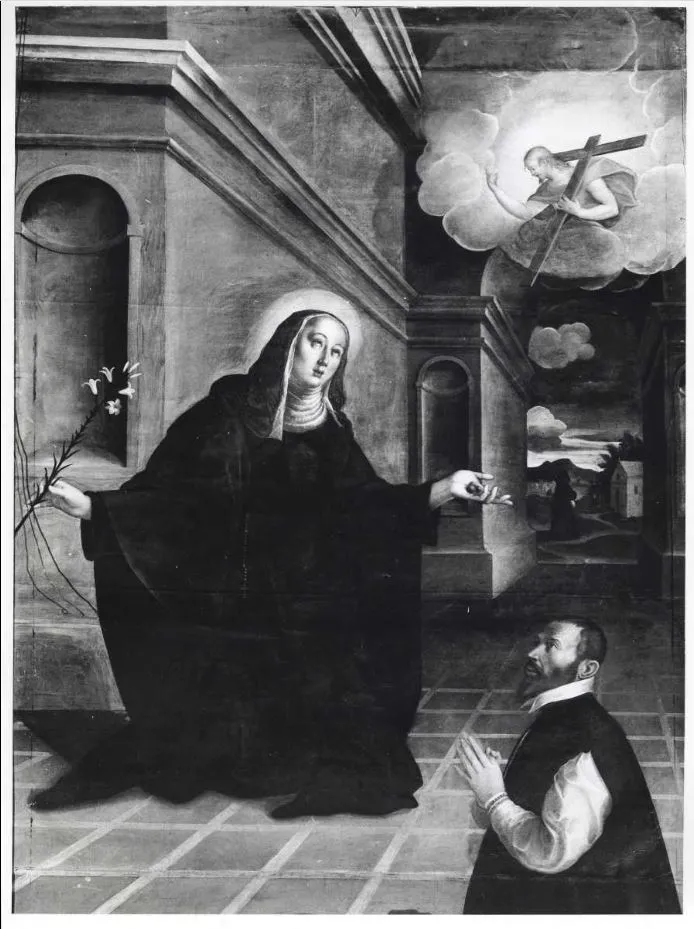
The story that gave her the name Clare of the Cross is told by the Augustinians and is not in the encyclopedia, which says only that the suffering of Christ was "the continual subject of her meditation." 1 In the Maltese telling, Christ appeared to her dressed as a pilgrim and carrying his cross, looking for a place to set it down, and she offered him her heart. For years afterward she told her nuns, "I have Christ's cross engraved in my heart." 3
After she died the nuns took her at her word. They opened her body, which the Maltese page admits was close to sacrilege and forbidden by law, and reported finding in her heart the shape of a cross and of the other instruments of the Passion. 3 The Midwest Augustinians put it more briefly: a post-mortem examination showed "a representation of the Cross and other symbols of Christ's suffering and death." 2 The Maltese page says three small stones of equal size were also found in her body and were read as a sign of the Trinity, and that a notary recorded the findings. 3
The bishop's vicar, Berengario di Donadio, arrived angry and meaning to punish the nuns. Having seen the evidence and heard them, he became the chief promoter of her cause. 3
A long road to canonization
An inquiry into her life and miracles began soon after her death. 1 The Maltese page dates the bishop's first process to sixteen months afterward, and says Berengario went to Pope John XXII at Avignon in 1316 to ask for her canonization, and that a papal investigation opened in September 1318. 3 It did not end in a canonization. The encyclopedia says only that the canonization came "several centuries later." 1
The Augustinian Order began a new process in 1850, and Leo XIII canonized her on December 8, 1881. 13 The Maltese page says he appears to have had a particular devotion to her, going back to his years in nearby Perugia, and that his episcopal ring can still be seen on one of her fingers. Her body is kept in the church of the Augustinian nuns at Montefalco. 3
What is Saint Clare of Montefalco the patron saint of?
Saint Clare of Montefalco's feast day
Her feast is August 17. The Maltese Augustinians give that date, the Roman Martyrology enters her on it, and the Vatican News calendar lists her that day as an Augustinian abbess. 345 It is also the day the Augustinians give for her death, where the 1908 encyclopedia has August 18. 123 Her monastery at Montefalco keeps a second feast on October 30, of the sign of the cross in her heart. 3
Praying with Saint Clare of Montefalco
She spent her life from childhood in one small house in an Umbrian town, and eleven years of it, by her order's account, wondering whether God had abandoned her. 23 The people who came to ask her advice were talking to someone who knew that state from the inside. 2
Her devotion had one object. The Martyrology remembers her in a single phrase, as a woman on fire with love for the Passion of Christ. 4 Everything else on the record, the fasting, the counsel, the name she took, follows from it. 13
The findings in her heart are hard to know what to do with now, and her own order tells the story without hiding that the nuns broke the law to make them. 3 What can be said plainly is that she claimed to carry the cross within her for years before anyone looked. 23
She did not want to be abbess, and had to be ordered to it. 1 She then did the work until she died. 12
Saint Clare of Montefalco, pray for us.
Sources
- 1.Stephen Donovan, "St. Clare of Montefalco," The Catholic Encyclopedia, vol. 4 (New York: Robert Appleton Company, 1908).
- 2."St. Clare of Montefalco," Midwest Augustinians, Province of Our Mother of Good Counsel.
- 3."Santa Clare from Montefalco - 17th August," Maltese Augustinian Province.
- 4."Santa Chiara della Croce, vergine," Santo del giorno, 17 agosto (from the Roman Martyrology), Conferenza Episcopale Italiana.
- 5."St. Clare of Montefalco, Augustinian Abbess," Saint of the Day, 17 August, Vatican News.
Saints to turn to next
Others in this collection who are turned to for some of the same things.
- Saint Bernardo TolomeiMay 10, 1272 - August 20, 1348DiscernmentPrayerSuffering and illness
- Saint Carmen RendilesAugust 11, 1903 - May 9, 1977PrayerDiscernmentSuffering and illness
- Saint Claude de la Colombiere1641 - February 15, 1682DiscernmentPrayerSuffering and illness
- Saint Francis CaraccioloOctober 13, 1563 - June 4, 1608PrayerDiscernmentSuffering and illness