Saint Francis Caracciolo
October 13, 1563 - June 4, 1608
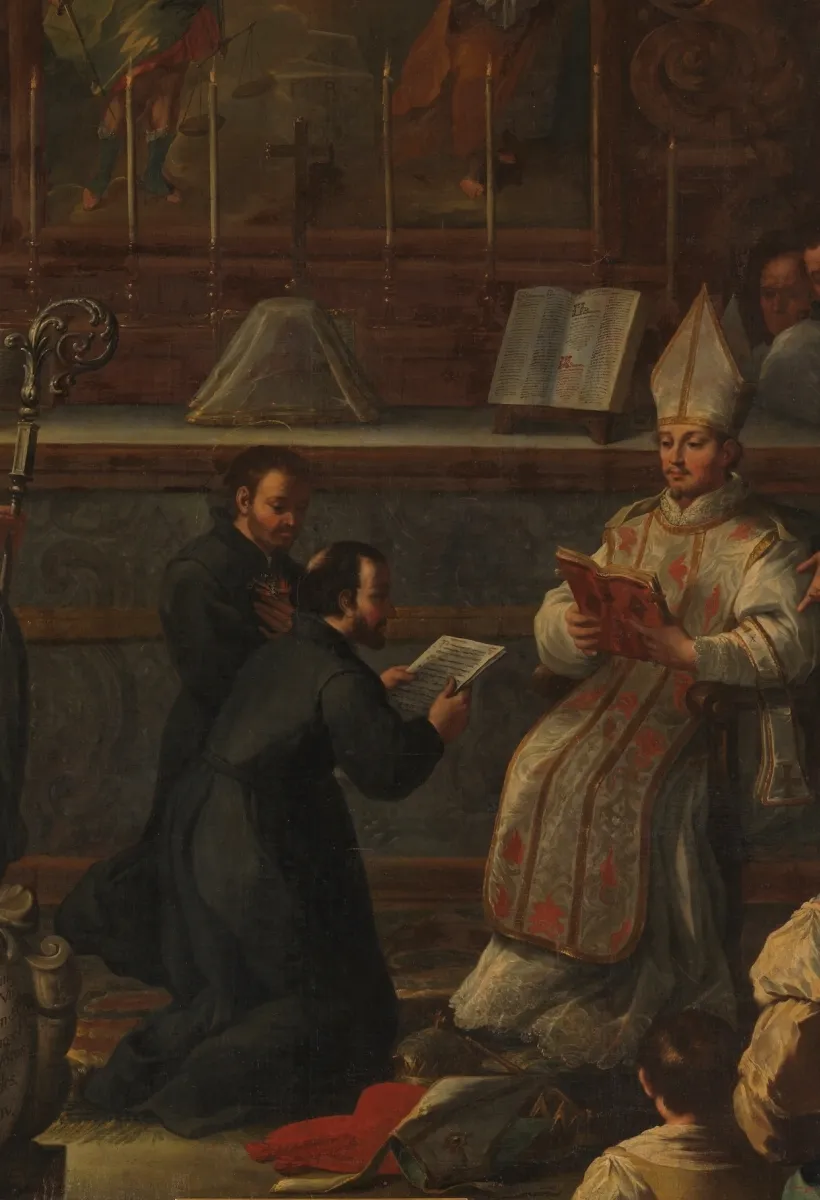
- Ordained
- 1587, at Naples 1
- Founded
- The Clerics Regular Minor, with John Augustine Adorno, approved by Sixtus V on July 1, 1588 14
- Patron saint of
- The city of Naples, chosen in 1838 1
- Died
- June 4, 1608, at Agnone (1913 Catholic Encyclopedia, Angelus, his order) or Loreto (Dicastery) 1245
Saint Francis Caracciolo was a son of the noble house of Caracciolo who was cured of a disfiguring disease at twenty-two, became a priest, and in 1588 co-founded the Clerics Regular Minor because a letter meant for another man of the same name was delivered to him. 12 His order kept perpetual adoration of the Blessed Sacrament and bound its members by a fourth vow never to seek church office, and he refused a bishopric himself. 124 He died on June 4, 1608, at forty-four, and June 4 is his feast. 123
Ascanio
He was born on October 13, 1563, at Villa Santa Maria in the Abruzzo, and baptized Ascanio. 12 The family was the noble house of Caracciolo, and Paoli, writing in the 1909 Catholic Encyclopedia, says he belonged to its Pisquizio branch and that his mother was related to Saint Thomas Aquinas. 14 Paoli remembers him as gentle and upright from childhood. 1 The Dicastery for the Causes of Saints adds that his devotion to the Eucharist began early, and that as a boy he wore the Carmelite scapular, prayed the rosary and fasted on Saturdays in honor of Mary. 2
At twenty-two he fell gravely ill. Paoli and Angelus call it leprosy; the Dicastery calls it a form of elephantiasis that disfigured his whole body. 124 He vowed that if he recovered he would give up his worldly wealth for good, and he did recover. 2 He gave his goods to the poor and went to Naples in 1585 to study theology. 1
The White Robes of Justice
He was ordained in 1587 and joined the Bianchi della Giustizia, the White Robes of Justice, a confraternity in Naples whose work was to help condemned prisoners die a holy death. 14 The Dicastery says he served in the hospitals and prisons too, and that some cures among the sick were attributed to him. 2
A letter for someone else
In 1588 a letter reached him that was not meant for him. 1 Paoli says it was from Giovanni Agostino Adorno, a Genoese priest, inviting another Ascanio Caracciolo to help found a new religious institute; Angelus calls the intended recipient a distant relative; the Dicastery says the letter came from Adorno and from Fabrizio Caracciolo, abbot of Santa Maria Maggiore in Naples, and was meant for a namesake in Ascanio's own confraternity. 124 All three agree on what he did with it. He took the mistake as a sign of God's will and answered. 124
He helped draw up the rule, and Sixtus V approved the new congregation on July 1, 1588. 14 The Dicastery says it was Ascanio who proposed adding a fourth vow to poverty, chastity and obedience: that members would not seek church dignities outside the order nor aspire to them within it. 12 Adoration of the Blessed Sacrament was kept up by the members in rotation, and Paoli describes the institute as both contemplative and active. 1 When the institute was approved he took the name Francis; Angelus says he chose it in honor of Francis of Assisi. 24
He and Adorno made their profession at Naples on Low Sunday, April 9, 1589, and Paoli says that is why the order took as its motto "Ad majorem Dei Resurgentis gloriam," to the greater glory of the risen God. 1
General of the order
Paoli says he was elected general against his will on March 9, 1593, in the order's first house in Naples; the Dicastery dates his election to 1591, as general for life, and says he accepted only out of obedience. 12 Adorno had died by then, according to the Dicastery, after a first journey to Spain in 1589 that failed. 2
Spain took up much of his generalate. Paoli counts three journeys there and three houses founded under the protection of Philip II and Philip III: the Holy Spirit at Madrid on January 20, 1599, Our Lady of the Annunciation at Valladolid on September 9, 1601, and Saint Joseph at Alcalá, for teaching, in 1601. 1 The Dicastery remembers it as hard going, and says that at Madrid Philip II threatened to close the Hospital of the Italians, where Francis was nursing the sick. 2 In Rome he secured the church of Saint Agnes in Piazza Navona in 1598 and San Lorenzo in Lucina in 1606. 1
He was general, but the Dicastery says he went on fasting, doing penance and taking the humblest jobs in the house, choosing the smallest room and sleeping and eating very little. 2 In the hospitals he made beds, swept and mended the patients' clothes. 2 It records three names people gave him: hunter of souls, father of the poor, and the man of bronze. 2 He was relieved of every office in 1607 and left free to pray. 2
Zeal for the house of God
His favorite saying, Paoli says, was "Zelus domus tuae comedit me," the psalm verse Angelus gives as "Zeal for thy house has consumed me." 14 Angelus adds that he was often found in ecstasy repeating it. 4 He wrote a book on the Passion, "Le sette stazioni sopra la Passione di N.S. Gesù Christo," printed in Rome in 1710. 1 Pope Paul V wanted to make him a bishop of an important see, and he refused. 1
The Dicastery calls him the saint of the Eucharist. 2 He urged other priests to celebrate Mass every day, and had the Blessed Sacrament exposed on the first Sunday of every month. 2
His death
Paoli says the Oratorians at Agnone, in the Abruzzo, invited him to turn their house into a college for his congregation, and that he fell ill during the negotiations and died there on the vigil of Corpus Christi, June 4, 1608. 1 Angelus says it was a severe fever and the feast itself. 4 The superior general of his order, preaching at Agnone in 2021, gave his last words as "let us go, let us go to the Father, in Heaven." 5 The Dicastery tells it differently: it says he died at Loreto, after a pilgrimage to the Holy House, calling on Saints Michael, Joseph and Francis of Assisi. 2
Paoli and the Dicastery agree that Clement XIV beatified him, on June 4, 1769 in Paoli's account and on September 10, 1770 in the Dicastery's. 12 Pius VII canonized him in St. Peter's Basilica on May 24, 1807. 12 His body was first buried at Santa Maria Maggiore in Naples and later moved to the church of Monteverginella. 1
What is Saint Francis Caracciolo the patron saint of?
Saint Francis Caracciolo's feast day
Praying with Saint Francis Caracciolo
His vocation arrived in the wrong envelope. 1 The letter was meant for someone else, and he could have sent it on. 12 He read it as addressed to him after all, and every source tells the story the same way in that respect. 124
He had first bargained with God from a sickbed, promising his wealth for his health, and then kept the promise. 2 The work he chose afterward was standing with men about to be executed. 14
The order he helped found built the refusal of honors into its vows, and he lived it, turning down a bishopric from Paul V. 1 As general he chose the smallest room and the humblest jobs, according to the Dicastery, and spent his last year with no office at all. 2
At the center of it was the Eucharist: adoration kept up by the members in turn, and a line from the psalms about being consumed by zeal for God's house. 124
Saint Francis Caracciolo, pray for us.
Sources
- 1.Francesco Paoli, "St. Francis Caracciolo," The Catholic Encyclopedia, Vol. 6 (New York: Robert Appleton Company, 1909).
- 2."Francesco Caracciolo (1563-1608)," Santi e Beati, Dicastery for the Causes of Saints (in Italian).
- 3."St. Francis Caracciolo, priest, Founder of the Regular Minimis," Saint of the Day, June 4, Vatican News.
- 4."Saint of the day: Francis Caracciolo," Angelus (Archdiocese of Los Angeles), June 4, 2026.
- 5."Father General's Homily on the Feast of St. Francis Caracciolo, June 4," Adorno Fathers (Clerics Regular Minor), June 2021.
Saints to turn to next
Others in this collection who are turned to for some of the same things.
- Saint Teresa of CalcuttaAugust 26, 1910 - September 5, 1997Poverty and simplicityDiscernmentSuffering and illnessPrayer
- Saint Agnes of Bohemiac. 1200-1205 - March 1281 or 1282Poverty and simplicityPrayerDiscernment
- Saint André BessetteAugust 9, 1845 - January 6, 1937PrayerSuffering and illnessPoverty and simplicity
- Saint Benedict Joseph Labre1748 - April 16, 1783Poverty and simplicityPrayerDiscernment