Saints Carpus, Papylus and Agathonica
d. c. 170 or 250
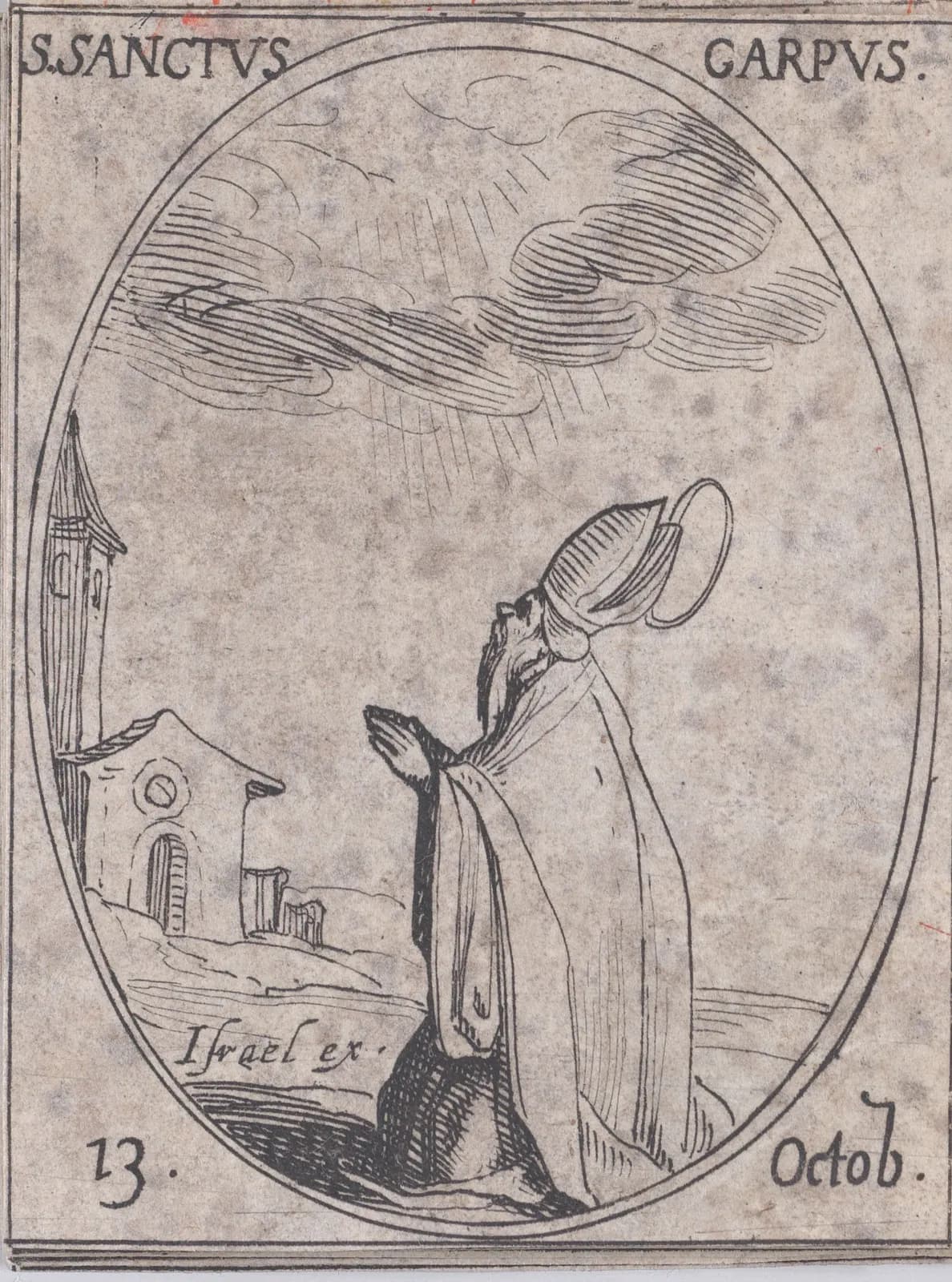
- Carpus, bishop of
- Thyatira, says the Roman Martyrology 3; Gurdos in Lydia, says the Latin text of the Acts 2
- Earliest witness
- Eusebius, Church History IV.15 1
- Our record
- The Acts of their trial, in Latin and Greek versions 2
Saints Carpus, Papylus and Agathonica were martyrs of Pergamum, a city of western Asia Minor. 13 Carpus was a bishop and Papylus a deacon, tried together before the Roman governor; Agathonica, says the record of their trial, was in the crowd when they died and gave herself up to die with them. 23 Eusebius knew the account in the fourth century, and the Norwegian bishops' saints database calls it one of the most reliable in Christian history. 12
Pergamum and Thyatira
Pergamum was an old Christian city. Siméon Vailhé, in the 1911 Catholic Encyclopedia, notes that the Book of Revelation names the martyr Antipas there, that Attalus, who died among the martyrs of Lyon, was a native of Pergamum, and that a large number of its people were Christian. 4 Thyatira was another of the seven churches of Revelation, and Vailhé cites Epiphanius for the claim that at the beginning of the third century almost all of it was Christian. 5
Eusebius, writing of the martyrs of the generation of Polycarp, adds at the end of the chapter that "there are also records extant of others that suffered martyrdom in Pergamus, a city of Asia." 1 He names "Carpus and Papylus, and a woman named Agathonice, who, after many and illustrious testimonies, gloriously ended their lives." 1 That record is the Acts of their trial, which survive in Greek and in Latin and were first published in 1881. 2
The Roman Martyrology calls Carpus bishop of Thyatira, Papylus a deacon, and Agathonica the sister of Papylus, and adds that many others died with them. 3 katolsk.no, which retells the Acts at length, says the Latin version makes Carpus bishop of Gurdos in Lydia, while other sources call him bishop of Thyatira, and that Papylus was a deacon of Thyatira. 2
Carpus before the proconsul
The Acts open in court at Pergamum. 2 Asked his name, Carpus answered that his first and chief name was Christian, and that in the world he was called Carpus. 2 The proconsul reminded him of the emperor's orders that the gods be worshiped and urged him to sacrifice. 2
Carpus said he worshiped Christ, the Son of God, who had come into the world for our salvation and freed us from the devil, and that he would not sacrifice to idols. 2 Told to sacrifice and hold his tongue, he asked whether the living should offer sacrifice to the dead. 2 When the proconsul asked whether he was calling the gods dead, Carpus answered that they had never lived, so they could not die, and that if they were brought to him they would be seen to be dust, while his God lives forever. 2
The proconsul had him put on the rack and scourged until his flesh was torn. 2 Through it Carpus kept crying out that he was a Christian, until his strength gave out and he could no longer speak. 2
Papylus
The proconsul turned to Papylus and asked whether he held any office. 2 Papylus said he was an ordinary citizen, from Thyatira. 2 Asked whether he had children, he said yes, many, in God. 2 Someone in the crowd explained that he meant it in the Christian sense, and when the proconsul accused him of lying, Papylus answered that in every province and city he had children in God. 2
katolsk.no wonders what he meant: whether he had brought many people to the faith, or whether he counted as his children the poor he served as a deacon. 2 Pressed to sacrifice, he said he had served God from childhood, had never sacrificed to idols, and knew nothing finer in life than to be a Christian. 2
He too was hung up and torn, and the Acts say he bore it without a sound. 2 Afterward he said that he felt no pain, because someone the onlookers could not see was suffering in him and comforting him. 2
At the stake
When both refused once more, the proconsul ordered them burned alive, and the Acts say they hurried to the amphitheater as if eager to leave the world behind. 2 Papylus was nailed to the stake first and died in prayer when the fire was lit. 2
Carpus was nailed up next, and the crowd saw him smile. 2 Asked why, he said he had seen the glory of the Lord and was glad. 2 As the fire was being laid he said that all of us are children of Eve and share the same frail flesh, but that we can endure when we keep the judgment in view. 2 His last words, as katolsk.no gives them, were a blessing of Jesus Christ, the Son of God, for sharing his glory with a sinner. 2
Agathonica
Among the onlookers was a woman named Agathonica. 2 Like Carpus, the Acts say, she saw the glory of the Lord, took it as a call, and cried out that she had seen it too. 2 The crowd shouted at her to think of her son and have pity on him. 2 She answered that almighty God, who is merciful, would care for him. 2
She was condemned on the same charge. 2 At the place of execution she took off her clothes and gave them to the guards, and the crowd wept and called the sentence inhuman. 2 She let herself be nailed to the stake singing, and when the flames reached her called on the Lord three times for help. 2 The Christians gathered the remains in secret and kept them safe. 2
katolsk.no notes the other reading: that Agathonica was not a bystander but Papylus's sister, which is how the Roman Martyrology names her. 23 It suggests the word may be meant as believers use it, since all the faithful are brothers and sisters in the Lord. 2
The Acts and their date
The year is uncertain. 2 Vailhé gives "March, 250," which falls under Decius, and in his article on Thyatira calls Papylus a martyr "about the year 250." 45 katolsk.no says the Latin Acts set the martyrdom under Decius, but that some date it about a century earlier, under Marcus Aurelius and Lucius Verus, about 170. 2 Eusebius himself names them in the same chapter as the martyrdoms of Polycarp and Pionius. 1
katolsk.no also reports a fuller tradition: that a great company of Christians who would not sacrifice were dragged in chains from Thyatira to Sardis, where a servant named Agathodorus died under the lash, and then to Pergamum, where Carpus, Papylus and Agathonica were beheaded. 2 It counts the Acts themselves among the most reliable in the history of Christianity, while noting that the Latin and Greek versions differ in their details. 2
What are Saints Carpus, Papylus and Agathonica the patron saints of?
Saints Carpus, Papylus and Agathonica's feast day
The feast of Saints Carpus, Papylus and Agathonica is April 13. 23 The current Roman Martyrology enters them on that day at Pergamum in Asia, in present-day Turkey, with many others who received the crown of martyrdom for their profession of faith. 3
Older and Eastern calendars keep them in October. Vailhé, in 1912, gives Papylus as "venerated 13 October," and katolsk.no says the Eastern churches keep them on October 13, adding that January 2, April 4 and October 12 are also found. 25
Praying with Saints Carpus, Papylus and Agathonica
The trial in the Acts is short and plain. Carpus gives his name as Christian before he gives his own. 2 Papylus, asked about his family, counts his children in God. 2 Neither argues for long; both say who they are and decline to sacrifice. 2
Agathonica came to the scene as a spectator. 2 What changed her, the Acts say, was seeing what Carpus saw, and the crowd's appeal to her was the hardest one: her own child. 2 Her answer was to entrust him to God. 2
Their record survived because the Christians of Pergamum wrote it down, and Eusebius knew it. 12 The three are kept together because they died together. 13
Saints Carpus, Papylus and Agathonica, pray for us.
Sources
- 1.Eusebius of Caesarea, Church History, Book IV, chapter 15, trans. Arthur Cushman McGiffert, Nicene and Post-Nicene Fathers, Second Series, Vol. 1 (Buffalo, NY: Christian Literature Publishing Co., 1890), via New Advent.
- 2."Den hellige Carpus av Pergamos og tre ledsagere (d. 250)," Den katolske kirke (katolsk.no), Catholic Diocese of Oslo (in Norwegian).
- 3.Roman Martyrology, entry for April 13, "Santi martiri Carpo, Pápilo e Agatoníca," as printed in "Santo del giorno," Conferenza Episcopale Italiana (in Italian).
- 4.Siméon Vailhé, "Pergamus," The Catholic Encyclopedia, Vol. 11 (New York: Robert Appleton Company, 1911).
- 5.Siméon Vailhé, "Thyatira," The Catholic Encyclopedia, Vol. 14 (New York: Robert Appleton Company, 1912).
Saints to turn to next
Others in this collection who are turned to for some of the same things.
- Saint Bernardo TolomeiMay 10, 1272 - August 20, 1348PrayerCourageSuffering and illness
- Saint Claude de la Colombiere1641 - February 15, 1682PrayerSuffering and illnessCourage
- Saint Dominic SavioApril 2, 1842 - March 9, 1857PrayerSuffering and illnessCourage
- Saint Hugh of Grenoble1053 - April 1, 1132CouragePrayerSuffering and illness