Saint Hugh of Grenoble
1053 - April 1, 1132
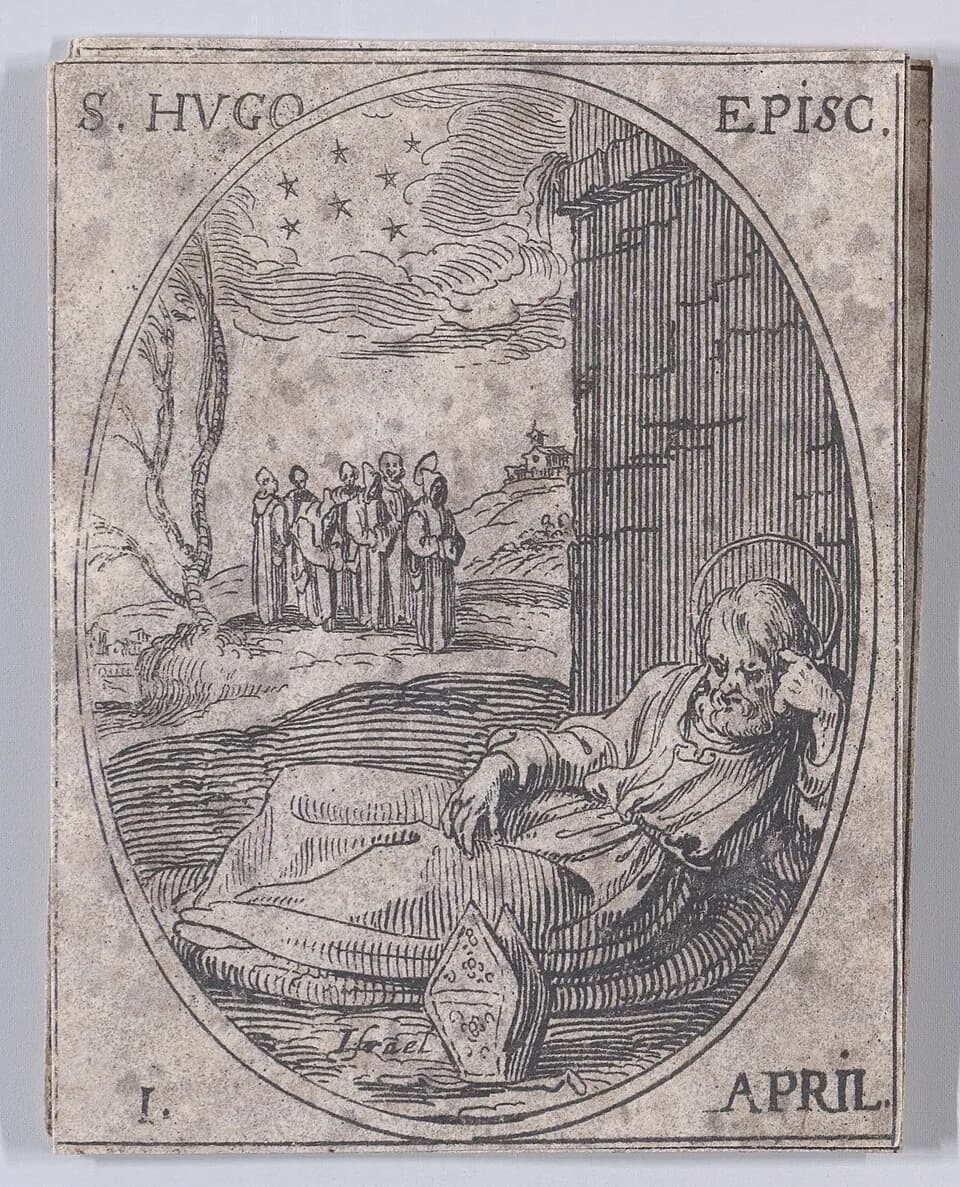
- Bishop of Grenoble
- 1080 to 1132; fifty-two years by Franciscan Media and CatholicCulture.org, fifty by Vatican News 1235
- Patron saint of
- Grenoble; invoked against headaches 3
- Died
- April 1, 1132 1
Saint Hugh of Grenoble was the reforming bishop who in 1084 led Saint Bruno and six companions into the mountains above his city and installed them in the wild place called the Chartreuse, where the Carthusian Order began. 4 He governed the diocese of Grenoble for some fifty years against simony, ignorance and lay control of church property, tried to resign and become a monk, and was held to his post by pope after pope. 123 He died in 1132, was canonized two years later, and is remembered on April 1. 123
A canon of Valence
He was born in 1053, near Valence in southern France; CatholicCulture.org's summary places his birth at Châteauneuf, which is why he is also called Hugh of Châteauneuf. 13 After his schooling he became a canon of the cathedral of Valence. 3
In his early twenties he met the Bishop of Die, who was impressed by his virtue and his gift for administration and gave him a post in his own diocese. 3 It was in that bishop's company that he went to a synod at Avignon in 1080. 3
Bishop of a troubled diocese
The diocese of Grenoble was then notorious, CatholicCulture.org says, for simony, usury, immorality and ignorance, and the synod at Avignon decided it needed a strict bishop. 3 Hugh, who had come as the Bishop of Die's companion, was unexpectedly and unanimously elected; he was ordained at twenty-seven and consecrated bishop by the pope. 3 Franciscan Media lists what he faced: the buying and selling of church offices, violations of clerical celibacy, lay control of church property, and religious indifference and ignorance. 1
Vatican News says he was chosen by Pope Gregory VII "to restore the customs of the clergy and teach the people." 2 The 1913 Catholic Encyclopedia's article on Grenoble remembers him for "his zeal in carrying out Gregory VII's orders concerning reform" and for his opposition to Guy of Burgundy, Bishop of Vienne, who later became Pope Callistus II. 5
For two years he preached, fasted and prayed, and then, thinking a new bishop might do better, he resigned and entered the novitiate of the Benedictine abbey of Chaise-Dieu. 3 He was there only a short time before Gregory VII ordered him back to his see. 13 "He wanted to be a monk," Vatican News puts it, "but for 50 years he governed the diocese of Grenoble." 2
The seven stars and the Chartreuse
In 1084 Bruno, formerly a professor and chancellor at Reims, came to Grenoble with six companions looking for a place of solitude. 4 Mougel's article on Bruno in the 1913 encyclopedia says Hugh had been, "according to some authors, one of his pupils," and that God had already shown him these men in a dream, "under the image of seven stars." 4 Hugh led them himself into a wild spot in the Alps of Dauphiné called Chartreuse, about four leagues from Grenoble, among precipitous rocks and mountains nearly always under snow, and installed them there. 4 CatholicCulture.org says he granted them the territory that gave the order its name. 3
The monks built a small monastery and lived in poverty, given over to prayer and study, and Mougel says they were often visited by Hugh, "who became like one of themselves." 4 CatholicCulture.org adds that he happily joined their exercises and did the most menial tasks among them. 3 A contemporary, Guibert of Nogent, described the house in a passage quoted in the encyclopedia's article on the Carthusians: thirteen monks, each in his own cell, bread and vegetables once a week, no gold or silver in the church but a single silver chalice, and "the Bishop of Grenoble acts as their abbot and provisor." 7
The men he led up the mountain were, by Mougel's list, Landuin, the two Stephens of Bourg and Die, canons of Saint Rufus, Hugh the Chaplain, "all, the most learned men of their time," and two laymen, Andrew and Guérin, who became the first lay brothers. 4 Guibert adds that lower down the mountain lived more than twenty lay brothers who worked for the monks, and that "although they observe the utmost poverty, they are getting together a very rich library." 7 Bruno himself stayed a little over six years. In 1090 Pope Urban II, another of his former pupils, called him to Rome, and though a letter shows Bruno meant to go back to his brethren in Dauphiné, the pope kept him in Italy. 4
Franciscan Media says he may be best known as the patron and benefactor of Bruno. 1 The encyclopedia records that Guigo, author of the first Carthusian customs, wrote a life of him. 7
Reformer and pastor
Back in Grenoble he fought the abuses more effectively the second time, CatholicCulture.org says, and the poor were his greatest concern: during one famine he sold his ornate gold chalice to buy them food. 3 Franciscan Media credits him with strong character as well as devotion. 1 In conflicts between church and state he was "an unflinching defender of the Church," he supported the papacy without fear, and he was an eloquent preacher. 1 He restored his cathedral, made improvements to the town, and lived through a short exile. 1
Vatican News says he was confirmed in office by seven successive popes. 2 CatholicCulture.org says that throughout his fifty-two years he wanted the contemplative life, and that because of the influence of his holiness pope after pope refused to release him. 3
He was still at work near the end. When the election of 1130 produced two rival popes, Innocent II and Anacletus II, Mershman's article on Innocent II records that bishops gathered at Puy-en-Velay "through St. Hugh of Grenoble" acknowledged Innocent's authority. 6
Death and canonization
What is Saint Hugh of Grenoble the patron saint of?
CatholicCulture.org lists Saint Hugh of Grenoble as a patron against headaches and as patron of Grenoble. 3 Among his emblems it lists a lantern, seven stars standing for the founders of the Carthusians, Saint Bruno beside him, and three flowers in his hand. 3 Franciscan Media suggests he "could be a patron" for anyone so overwhelmed by the world's problems that they do not know where to begin. 1
Saint Hugh of Grenoble's feast day
Praying with Saint Hugh of Grenoble
He wanted a cell, and he was given a diocese, for more than fifty years. 123 He tried once to leave and was sent back after a short time, and the sources say popes kept refusing to let him go. 3 Franciscan Media's summary is that he was effective "surely because of his devotion to the Church but also because of his strong character." 1
What he could not have for himself he gave to others. He led Bruno and his companions into the mountains, gave them the land, and went up to visit, taking his turn at the lowest work in the house. 34 When Guibert of Nogent visited the monks living the life Hugh had wanted, he found that the bishop acted as their abbot and provisor. 7
Grenoble got the rest: the reform, the preaching, a restored cathedral, and a gold chalice sold in a famine. 13 Franciscan Media's reflection asks for "the ability to rise above the fray and to see things in the light of faith," as he did. 1
Saint Hugh of Grenoble, pray for us.
Sources
- 1."Saint Hugh of Grenoble," Saint of the Day, April 1, Franciscan Media.
- 2."St. Hugh, Bishop of Grenoble," Saint of the Day calendar, April 1, Vatican News.
- 3."April 1," Liturgical Year calendar, CatholicCulture.org, quoting The Lives of the Saints for Every Day of the Year, Vol. 1.
- 4.Ambrose Mougel, "St. Bruno," The Catholic Encyclopedia, Vol. 3 (New York: Robert Appleton Company, 1908).
- 5.Georges Goyau, "Grenoble," The Catholic Encyclopedia, Vol. 7 (New York: Robert Appleton Company, 1910).
- 6.Francis Mershman, "Pope Innocent II," The Catholic Encyclopedia, Vol. 8 (New York: Robert Appleton Company, 1910).
- 7.Douglas Raymund Webster, "The Carthusian Order," The Catholic Encyclopedia, Vol. 3 (New York: Robert Appleton Company, 1908).
Saints to turn to next
Others in this collection who are turned to for some of the same things.
- Saint Titus BrandsmaFebruary 23, 1881 - July 26, 1942CourageWork and vocationSuffering and illnessPrayer
- Saint Aelred of Rievaulx1109 - January 12, 1166 (or 1167)PrayerWork and vocationSuffering and illness
- Saint Alphonsus Rodriguez1532 or 1533 - October 1617PrayerWork and vocationSuffering and illness
- Saint André BessetteAugust 9, 1845 - January 6, 1937PrayerSuffering and illnessWork and vocation