Saint Elizabeth of Hungary
1207 - November 17, 1231
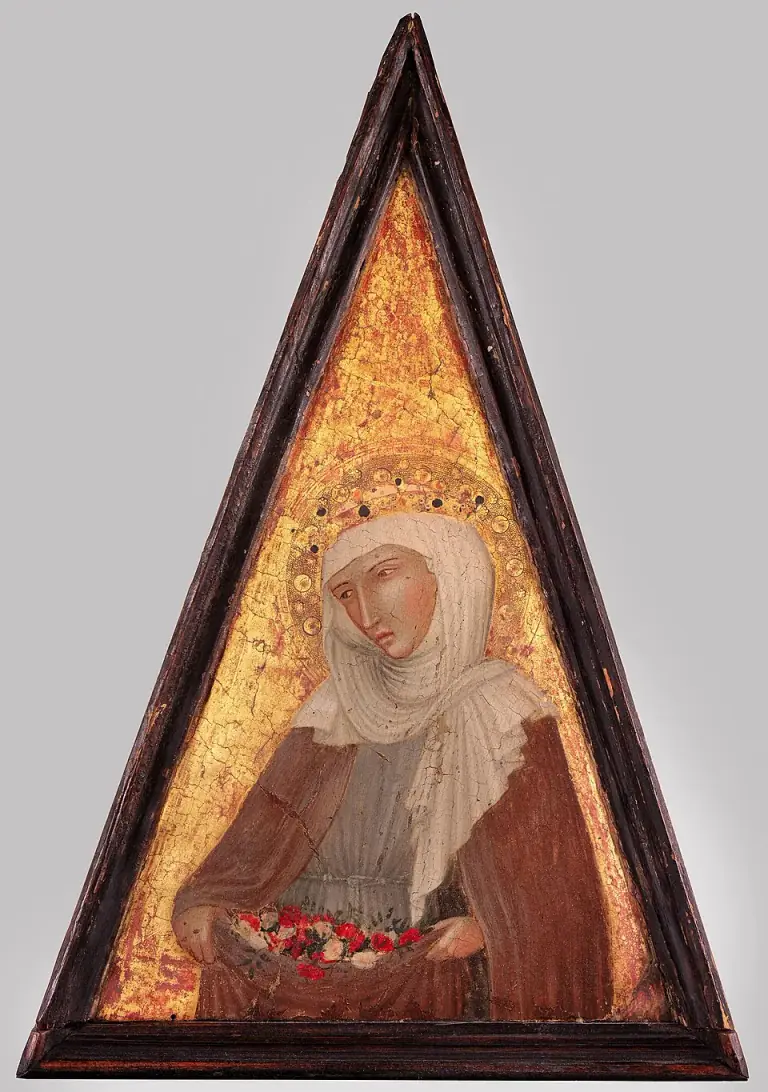
- Patron saint of
- Bakers, Catholic Charities, and the Secular Franciscan Order 3
- Widowed
- After six years of marriage, when Ludwig died on crusade 3
Saint Elizabeth of Hungary was a king's daughter, married at fourteen to a man she came to love, widowed at twenty, thrown out of her own castle by her husband's family, and dead before she was twenty-four. 13 In between she gave away so much of the household's money that her mother-in-law reprimanded her and her husband replied: "So long as she does not sell the castle, I am happy with her!" 1
Sent north at four
Elizabeth was born in 1207 to Andrew II, "the rich and powerful King of Hungary," and a German countess. Benedict XVI says she spent only the first four years of her childhood at the Hungarian court, where "she liked playing, music and dancing; she recited her prayers faithfully and already showed special attention to the poor." 1
Then knights arrived from Thuringia to take her to her new home. Her father had arranged for her to become a princess of one of the richest houses in Europe, and she left Hungary with a large dowry and an entourage - including two ladies-in-waiting who stayed with her to the end, and who are the reason we know anything about her childhood at all. 1
She was betrothed at Wartburg to Ludwig, the Landgrave's son, and while he learned the knightly profession she studied German, French, Latin, music, literature and embroidery. Benedict makes a point of what happened next, which was not arranged: "Despite the fact that political reasons had determined their betrothal, a sincere love developed between the two young people." 1 Franciscan Media says she married at fourteen "Louis of Thuringia, whom she deeply loved," and bore three children. 3
The crown she took off
She was not good at court life and did not try to be. Benedict says she "became the object of critical whispers because her behaviour was incongruous with court life," and that part of the money for her own wedding banquet went to the poor instead. 1
The scene he chooses is at Mass on the feast of the Assumption. Elizabeth took off her crown, laid it in front of the crucifix, covered her face and lay flat on the ground. Her mother-in-law reprimanded her, and she answered: "How can I, a wretched creature, continue to wear a crown of earthly dignity, when I see my King Jesus Christ crowned with thorns?" 1
The same scruple ran through the household accounts. The testimony of her four maids records that "she did not eat any food before ascertaining that it came from her husband's property or legitimate possessions," and that where people had suffered violence she tried to compensate them. 1 Benedict draws the conclusion for anyone in charge of anything: "the exercise of authority, at every level, must be lived as a service to justice and charity." 1
Bread, and roses
What she actually did, daily, is unglamorous and well attested. She fed and gave drink to whoever came to the door, found clothing, paid debts, nursed the sick and buried the dead. She went down from the castle with her ladies to the houses of the poor, carrying bread, meat and flour, handed the food out herself and checked their clothing and their mattresses. 1 Franciscan Media adds that she wore simple clothes to be closer to them, and took bread daily "to hundreds of the poorest in the land who came to her gate." 3
This got back to her husband, who did not mind. Benedict quotes his answer to her accusers: "So long as she does not sell the castle, I am happy with her!" 1
The famous story belongs here, and Benedict introduces it as belonging here: "The miracle of the loaves that were changed into roses fits into this context." She was going out with her apron full of bread; her husband asked what she was carrying; she opened it and it was full of roses. He notes that the symbol "often features in depictions of St Elizabeth" - as it does in the painting on this page. 1
Widowed and turned out
Ludwig died on crusade after six years of marriage, and Franciscan Media says simply that "Elizabeth was grief-stricken." 3 Her husband's family had regarded her almsgiving as squandering the royal purse; they mistreated her and finally threw her out of the palace. She was reinstated only when his allies returned from the Crusades, because her son was the legal heir. 3
The Franciscan connection had been forming for some time. She had helped the Friars Minor build a convent at Halberstadt, and it was through that link that her spiritual direction passed to Conrad of Marburg. 1 In 1228 she joined the Secular Franciscan Order, and Franciscan Media notes that she had already been living under the direction of a Franciscan friar - "a life of prayer, sacrifice, and service to the poor and sick," wearing simple clothing "seeking to become one with the poor." 3
She spent what was left of her life caring for the poor in a hospital she founded at Marburg in honor of Francis of Assisi. 3 A king's daughter, evicted by her in-laws, ended up running a hospital named for the man who had made poverty a vocation - and she was among the first generation to take up his way of life.
In November 1231 she caught a high fever. People came to see her when the news spread; after about ten days she asked for the doors to be shut so she could be alone with God, and she died in the night of 17 November. 1 She had not reached her twenty-fourth birthday. 3 Benedict notes what followed: "The testimonies of her holiness were so many and such that after only four years Pope Gregory IX canonized her," and the church built for her at Marburg was consecrated in the same year. 1
What is Saint Elizabeth of Hungary the patron saint of?
Franciscan Media names her patron of bakers, of Catholic Charities, and of the Secular Franciscan Order. 3 The first comes from the bread she carried down from the castle every day; the second from what her almsgiving became; the third from the order she joined in 1228. 13
Franciscan Media also gives the reason her name traveled so far so fast: "The daughter of the King of Hungary, Elizabeth chose a life of penance and asceticism when a life of leisure and luxury could easily have been hers. This choice endeared her in the hearts of the common people throughout Europe." 3
Saint Elizabeth of Hungary's feast day
The feast of Saint Elizabeth of Hungary is November 17, the day she died at Marburg in 1231. 13 The encyclopedia is careful about the date, giving it as "17 November (not 19 November), 1231" - correcting an old error rather than stating the feast, which it never does. 2
She was canonized by Gregory IX four years after her death. 1 She is also called Saint Elizabeth of Thuringia. 1
Praying with Saint Elizabeth
She was handed over at four, married at fourteen, and it turned into a real marriage anyway. 13 That is not a recommendation of the arrangement; it is what happened inside one. Ludwig defended her when his own court complained about her, which is the most attractive thing anybody says about him.
The crown on the floor in front of the crucifix is the image to keep. 1 She was not renouncing the position - she went back to being landgravine afterward - she was refusing to wear it comfortably in that particular room. Most people's version of this is smaller and just as awkward.
When her husband died the protection went with him and his family put her out of the house. 3 Six years of feeding the poor at the gate bought her no goodwill from the people who had been paying for it. She was twenty, widowed, with three children and a reputation for extravagance toward the wrong people.
She got four more years and spent them in a hospital she built. 3 Benedict's summary of the whole life is a line about anyone with authority: it is to be lived "as a service to justice and charity, in the constant search for the common good." 1 She had authority for about six years and this is what she did with it.
Saint Elizabeth of Hungary, pray for us.
Sources
Saints to turn to next
Others in this collection who are turned to for some of the same things.
- Saint Ida of Herzfeldc. 766 - September 4, 825Poverty and simplicityMarriage and family
- Saint Agnes of Assisi1197 or 1198 - November 16, 1253Poverty and simplicityMarriage and family
- Saint Alexius of RomeFifth century, by traditionPoverty and simplicityMarriage and family
- Saint CunegundeDied March 3, 1040Marriage and familyPoverty and simplicity