Saint Agnes of Assisi
1197 or 1198 - November 16, 1253
Saint Agnes of Assisi was the younger sister of Saint Clare, and followed her into religious life almost at once: sixteen days after Clare slipped out of their father's house in 1212, Agnes, about fourteen, joined her at a Benedictine convent below Monte Subasio. 123 Her family sent armed men to bring her back, and failed. 13 She spent the next forty years among the Poor Ladies, most of them as abbess at Monticelli near Florence, and died at San Damiano three months after Clare, on November 16, 1253. 12
A household in Assisi
She was born at Assisi in 1197 or 1198, according to the Catholic Encyclopedia of 1907; the Norwegian bishops' saints database, katolsk.no, gives 1198 and says she was baptized Caterina. 12 Her father was Count Favorino Scifi, her mother Blessed Hortulana, of the noble Fiumi family. 12 Butler calls the parents people who "held the first rank at Assisium for their birth and riches." 3 Their cousin Rufino was one of the three companions of Saint Francis. 12
Butler counts three daughters, Clare, Agnes and Beatrice; katolsk.no adds an eldest sister, Penenda. 23 The encyclopedia says Agnes grew up between her father's palace in the town and his castle of Sasso Rosso on Monte Subasio. 1 katolsk.no adds that the family spent the years 1198 to 1203 in exile in Perugia, during the civil war between Assisi's nobles and its townsmen, and that apart from this little is known of her childhood. 2
Sixteen days
On the night of Palm Sunday, Clare left the house and went to Francis at the Portiuncula. 35 Butler and katolsk.no date it March 18, 1212, as does the encyclopedia's article on Agnes; the same encyclopedia's article on Clare says March 20, 1212. 1235 Benedict XVI, followed by this site's page on Saint Clare, places it on Palm Sunday 1211. 6 Francis lodged her for a time with Benedictine nuns and then moved her to another Benedictine convent, Sant'Angelo in Panzo, on the slope of Subasio. 235
Agnes joined her there sixteen days after Clare's flight, on April 3, 1212, by katolsk.no's reckoning, resolved, in the encyclopedia's words, "to share her sister's life of poverty and penance." 12 Butler and katolsk.no both say she was fourteen. 23
The men at Sant'Angelo
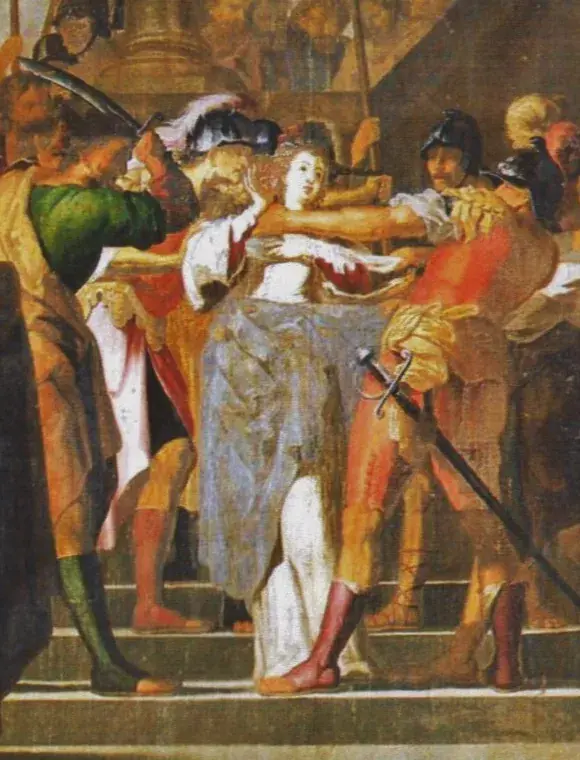
At this, the encyclopedia says, the father's fury "knew no bounds," and he sent his brother Monaldo with relatives and armed followers to bring Agnes home, by force if persuasion failed. 1 Butler and katolsk.no number them at twelve. 23 Butler says they "abused Agnes both with words and blows," and dragged her along the ground to the door while she cried out to Clare: "Help me, sister; permit me not to be separated from our Lord Jesus Christ, and your loving company." 3
The fullest account is the one the encyclopedia takes from the "Chronicles of the Twenty-four Generals." 1 Monaldo, it says, drew his sword to strike her, and his arm dropped to his side, withered and useless; the others pulled her out of the convent by the hair, beating and kicking her. 1 Then Clare came to her rescue, and Agnes's body became so heavy that the men could not carry her. They dropped her, half dead, in a field near the convent and withdrew. 1 katolsk.no tells the story more briefly, crediting the miracle to Clare, and observes that none of it appears in the bull of 1255 by which Alexander IV canonized Clare. 2
Francis, the encyclopedia says, was overjoyed at her resistance. He cut off her hair and gave her the habit, and katolsk.no says it was he who gave her the name Agnes. 12 Butler: "Her constancy proved at last victorious." 3
San Damiano
Soon afterward Francis settled the two sisters in a small, rough house beside the chapel of San Damiano, which he had helped to rebuild with his own hands. 1 katolsk.no dates the move to 1215; Butler says Francis made Clare superior there. 23 Other women joined them, noble ladies of Assisi and three of the Ubaldini family of Florence among them, and this was the beginning of the Order of Poor Ladies, later called the Poor Clares. 123 In time their mother Hortulana came too, and the youngest sister, Beatrice. 125
Of Agnes herself in these years the encyclopedia records one judgment, from the women who lived with her: she seemed "to have discovered a new road to perfection known only to herself." 1
Abbess at Monticelli
Young as she was, Francis chose her to found and govern a community of the Poor Ladies at Monticelli, near Florence: in 1219, says the encyclopedia, in 1220, says katolsk.no. 12 It grew, the encyclopedia says, almost as famous as San Damiano. 12 As abbess, it adds, "she ruled with loving kindness and knew how to make the practice of virtue bright and attractive to her subjects." 1 The same encyclopedia, writing on Clare, says that the rule Cardinal Ugolino wrote about 1219, on the basis of the Rule of Saint Benedict, was meant for the Clares at Monticelli, and that Clare resisted it because it let the sisters hold property in common. 5
A letter Agnes wrote to Clare after leaving still survives, which the encyclopedia calls "touchingly beautiful in its simplicity and affection." 1 What the encyclopedia found most striking in her, though, was "her undying loyalty in upholding the latter in her lifelong and arduous struggle for Seraphic Poverty." 1 katolsk.no says the same in fewer words: she supported her sister's fight for poverty in the order. 2
From Monticelli she founded further houses in northern Italy, at Mantua, Venice and Padua, according to the encyclopedia and katolsk.no. 12 Butler lists Padua, Venice and Mantua among the monasteries founded by Clare. 3
The last months
In August 1253, word reached Monticelli that Clare was dying, and Agnes came back from Florence in time. 125 Butler tells what passed between them. Agnes begged her sister with many tears to take her along and not leave her behind; Clare comforted her, told her it was God's will that she should not go yet, and "bade her be assured she should shortly come to her, and so it happened." 3 Clare died on August 11, and katolsk.no says Agnes arranged the funeral. 25
Agnes died at San Damiano on November 16, 1253, three months later. 124 Her mother and Beatrice were already dead. 12 katolsk.no says she was buried first at San Damiano and in 1260 moved to lie near Clare in the new church of Santa Chiara, where the encyclopedia places her beside her mother and sisters. 12 Butler, in a note on Hortulana, puts the mother's body in the church of Saint George, "in the same tomb with her two daughters, St. Clare, and Agnes." 3 Numerous miracles were reported at her tomb. 12
What is Saint Agnes of Assisi the patron saint of?
None of the sources consulted for this page names a patronage for Saint Agnes of Assisi. 1234 katolsk.no describes how artists show her: as a young Poor Clare in a brown or gray habit and black veil, holding a book; sometimes beside Clare; and sometimes being dragged by the hair from her sister's convent. 2 António de Oliveira Bernardes's painting for the Church of Saint Clare at Évora, shown here, is of the third kind, though it is catalogued as her arrival at the convent.
Saint Agnes of Assisi's feast day
Saint Agnes of Assisi's feast day is November 16, the day she died. 24 The current Roman Martyrology, as the Italian bishops print it, remembers her on that day at the convent of San Damiano in Assisi as a virgin who, in the flower of her youth, followed in the footsteps of her sister Saint Clare and embraced poverty with all her heart under the guidance of Saint Francis. 4
The encyclopedia says Benedict XIV permitted the Franciscan order to celebrate her feast, kept on November 16. 1 katolsk.no dates that permission to 1752, and notes that she is not listed in the Index ac status causarum, the Congregation for the Causes of Saints' register of canonizations and beatifications since 1588. 2
Praying with Saint Agnes of Assisi
Agnes made her choice at fourteen, in Clare's footsteps, and kept to it while her own kinsmen beat her and dragged her across the ground. 123 What she called out, by Butler's account, was a plea not to be separated: from Christ, and from her sister. 3
For most of the forty years that followed she lived without Clare, sent by Francis to govern a house of her own near Florence. 1 What the encyclopedia singles out in her is loyalty, kept from a distance, to what Clare was fighting for. 1
At the end she came back, and asked not to be left behind. 3 Clare told her she would follow soon, and three months later she did. 13
Saint Agnes of Assisi, pray for us.
Sources
- 1.Paschal Robinson, "St. Agnes of Assisi," The Catholic Encyclopedia, Vol. 1 (New York: Robert Appleton Company, 1907).
- 2."Den hellige Agnes av Assisi (1198-1253)," Den katolske kirke, the saints database of the Catholic Church in Norway, katolsk.no (in Norwegian).
- 3.Alban Butler, "St. Clare, Virgin, Abbess," August 12, in The Lives of the Fathers, Martyrs, and Other Principal Saints, Vol. VIII (London: J. Murphy, 1812), Internet Archive.
- 4.Roman Martyrology, entry for November 16, "Santa Agnese d'Assisi, vergine," Santo del giorno, Conferenza Episcopale Italiana (in Italian).
- 5.Paschal Robinson, "St. Clare of Assisi," The Catholic Encyclopedia, Vol. 4 (New York: Robert Appleton Company, 1908).
- 6.Pope Benedict XVI, General Audience of 15 September 2010: Saint Clare of Assisi. The Holy See.
Saints to turn to next
Others in this collection who are turned to for some of the same things.
- Saint John Chrysostomc. 347 - September 14, 407CourageMarriage and familyPoverty and simplicity
- Saint Adelaide931 - December 16, 999Marriage and familyCourage
- Saint Adrian of Nicomediad. c. 304-306CourageMarriage and family
- Saint Alexius of RomeFifth century, by traditionPoverty and simplicityMarriage and family