Saint Alexius of Rome
Fifth century, by tradition
- Earliest account
- A Syriac legend written at Edessa between 450 and 475, which does not give his name 1
- The legend
- A Roman noble who left his bride, begged in Edessa, and died unrecognized under the stairs of his father's house 123
- Historical record
- The encyclopedia: "How far this account is based on historical tradition is hard to determine" 1
- Church
- Sant'Alessio (Saints Boniface and Alexius) on the Aventine in Rome 1
- Patron saint of
- Alexians, beggars, belt makers, nurses, pilgrims and travelers 2
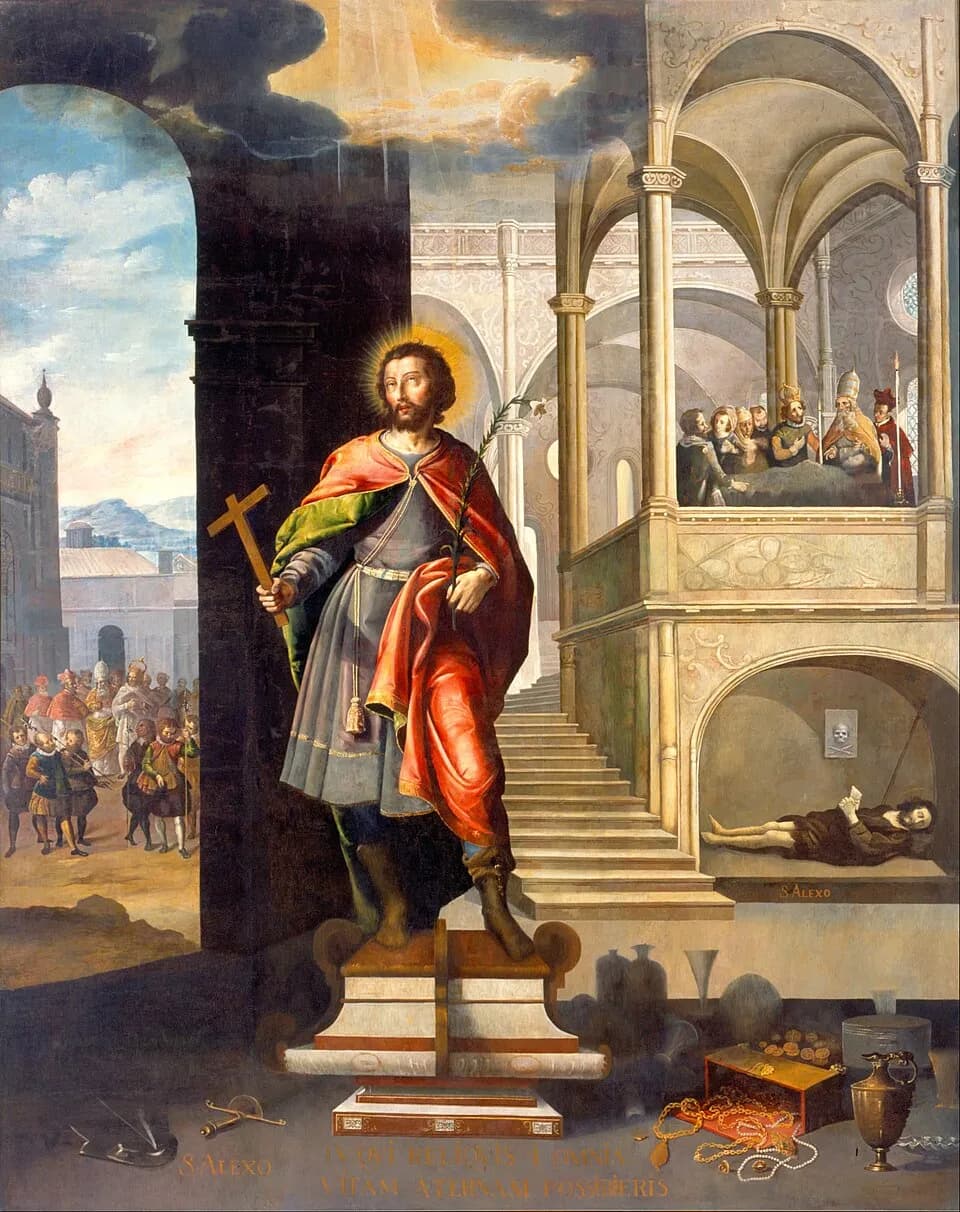
Saint Alexius is the "Man of God" of an old Eastern legend: a rich young Roman who walked away from his own wedding, lived as a beggar in Syria, and in the best-known version came home to die unrecognized under his father's staircase. 13 The Catholic Encyclopedia traces the story to a fifth-century account from Edessa in which the beggar has no name and never returns to Rome at all, and it doubts how much history lies behind even that. 1 His feast in the West is July 17. 123
The Man of God of Edessa
The oldest form of the story, according to Johann Peter Kirsch in the 1907 Catholic Encyclopedia, is a Syriac legend composed at Edessa between 450 and 475. It does not mention the name Alexius. Its subject is simply the "Man of God," who lived in Edessa while Rabula was bishop there, from 412 to 435, "as a poor beggar, and solicited alms at the church door." 1
What he was given he shared with the other poor, "after reserving barely enough for the absolute necessities of life." He died in the hospital and was buried in the common grave of the poor. 1 Before he died he told one of the church servants that he was the only son of distinguished Roman parents. The servant told the bishop, and the grave was opened, "but only his pauper's rags were now found therein." 1
That is the whole of the early account: a holy beggar, a secret about his family, and an empty grave. There is no staircase in it and no return to Rome. 1
The legend that reached Rome
A Greek version, older than the ninth century, turned this into the story most people know, and Kirsch calls it "the basis of all later versions." It gives the saint a name and a father, a distinguished Roman called Euphemianus. On the night of his marriage Alexius secretly leaves his father's house and travels to Edessa, where he lives as an ascetic for seventeen years. When his holiness begins to be talked about he leaves, returns to Rome, and for another seventeen years lives "as a beggar under the stairs of his father's palace, unknown to his father or wife." 1
After his death, which the legend puts in 417, a document is found on his body in which he says who he is. He is honored at once as a saint, and his father's house is made into a church. 1 The earliest place this expanded story appears is a hymn by the Greek hymnographer Josephus, who died in 883. 1
Catholic Culture tells the same legend with much more detail. His mother is named Aglais. On the wedding night he gives his bride his ring and his belt with the words, "Keep these things, Beloved, and may the Lord be with us until His grace provides us with something better." 2 In Edessa his father's servants, sent to look for him, hand him alms without knowing him, and he thanks God for letting him receive alms from his own slaves. An icon of the Mother of God speaks to the sacristan and calls the beggar in the portico a "Man of God." 2
To escape the attention he takes ship for Tarsus, and a storm lands him in Italy. Back in Rome his father, not recognizing him, gives him a cell beneath the stairs and food from the table, and the household servants mock him. 2 On the day of his death a voice is heard at Mass saying, "Seek the Man of God in the house of Euphemianus." He is found dead with a letter clasped in his hand. 2 Catholic Culture gives the year of his death as 404. 2
What the encyclopedia concludes
Kirsch does not treat any of this as established. Of the early Syriac account he writes, "How far this account is based on historical tradition is hard to determine. Perhaps the only basis for the story is the fact that a certain pious ascetic at Edessa lived the life of a beggar and was later venerated as a saint." 1
The later, fuller legend he explains as literature. Its Greek author, he suggests, "probably had in mind also the events related in the life of St. John Calybata, a young Roman patrician, concerning whom a similar story is told." 1 Vatican News is as cautious in its own way. Its entry begins, "Several legends revolve around the figure of St Alexius," and tells the staircase story with the words "He is said to have." 3
How an Eastern saint became a Roman one
The surprising thing in the encyclopedia's account is how late Alexius arrived in the city the legend calls his home. "In the West we find no trace of the name Alexius in any martyrology or other liturgical book previous to the end of the tenth century; he seems to have been completely unknown." 1
He came with a group of monks. On the Aventine Hill stood an old church of Saint Boniface, attached to a house for the care of the Roman poor. In 972, Kirsch writes, Pope Benedict VII gave the nearly abandoned church to Sergius, the exiled Greek metropolitan of Damascus, who built beside it a monastery for Greek and Latin monks. The name of Alexius was soon added to that of Boniface as patron of both church and monastery. 1 "It is evidently Sergius and his monks who brought to Rome the veneration of St. Alexius." 1
Rome took to him quickly. A saint who was, by his legend, a native of the city "was soon very popular with the folk of that city," and by the end of the eleventh century scenes from his life were painted in the basilica of Saint Clement, now the lower church of San Clemente. 1 From Rome his veneration "spread rapidly throughout western Christendom." 1 In the church on the Aventine, renovated since but still holding medieval monuments, the visitor is shown what the encyclopedia carefully calls "the alleged stairs of the house of Euphemianus." 1
What is Saint Alexius of Rome the patron saint of?
Saint Alexius of Rome's feast day
Praying with Saint Alexius
The legend is a hard one, and it does not get easier on rereading. A man leaves a wife on their wedding night and lets his parents search the world for him, then lives for years within earshot of his wife's weeping and says nothing. Catholic Culture's telling has him write a note before he dies "begging for forgiveness" for the pain he caused them. 2 The story itself seems to know what it cost.
The older account from Edessa asks less of the reader, and it is the one the encyclopedia thinks may rest on fact. Its beggar at the church door keeps almost nothing of what he is given and passes the rest to others who are poor. He dies in a hospital and goes into a common grave. 1 If Kirsch is right that a real ascetic of that kind stands behind the legend, then what the Church first remembered was a man nobody had noticed. 1
Catholic Culture draws out the theme of hiddenness: Alexius could have ended his humiliation at any moment by saying his name, and did not. 2 Both versions turn on that silence. In one the secret is told to a church servant at the very end; in the other it is found in a dead man's hand. 12
Saint Alexius of Rome, pray for us.
Sources
Saints to turn to next
Others in this collection who are turned to for some of the same things.
- Saint CunegundeDied March 3, 1040Marriage and familyPoverty and simplicityPrayer
- Saint Germaine Cousin1579 - 1601Marriage and familyPoverty and simplicityPrayer
- Saint Hedwig of Silesiac. 1174 - October 1243Marriage and familyPoverty and simplicityPrayer
- Saint Isidore the Farmerc. 1070 - May 15, 1130PrayerPoverty and simplicityMarriage and family