Saint Hedwig of Silesia
c. 1174 - October 1243
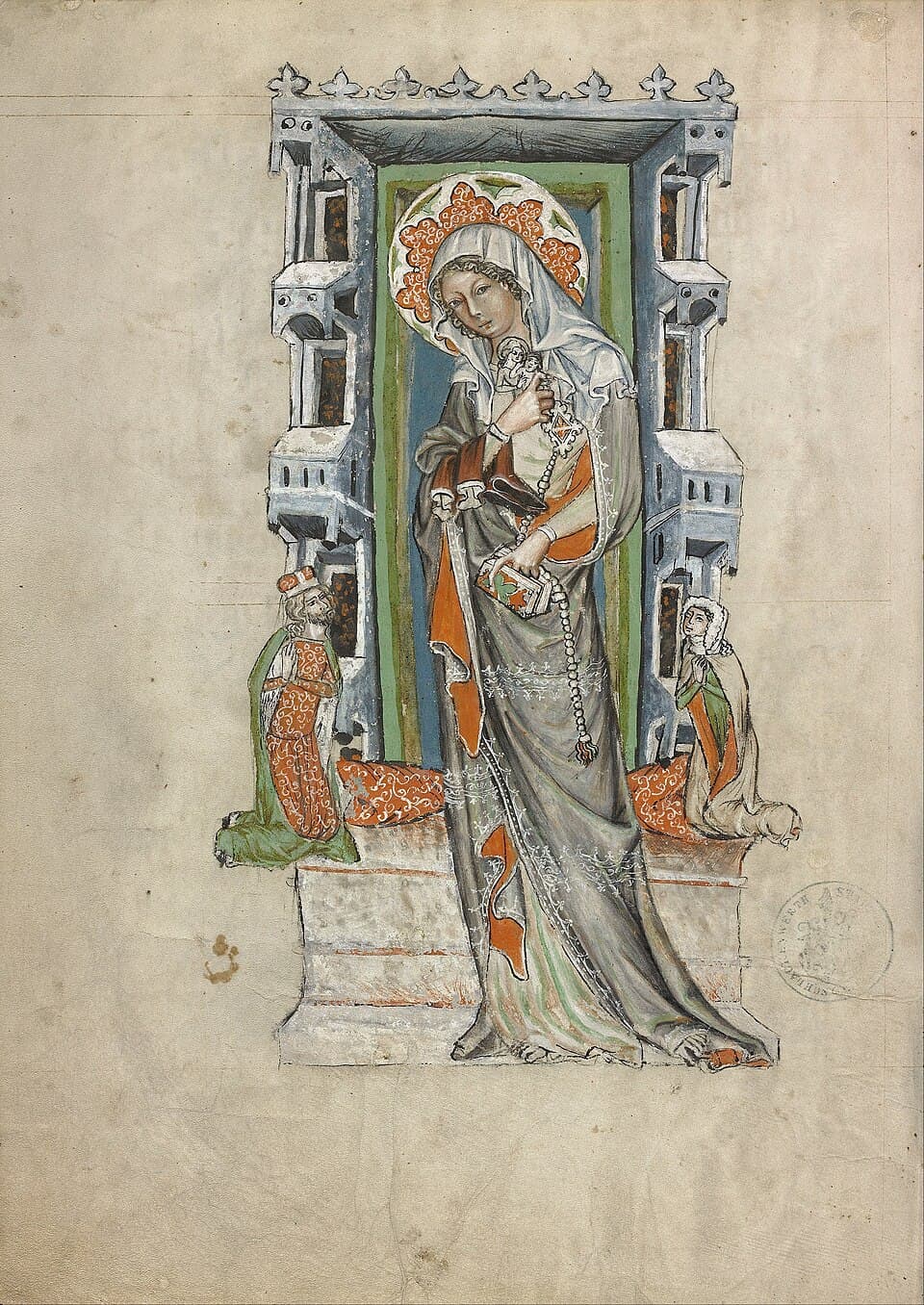
- Patron saint of
- Silesia, according to the 1910 Catholic Encyclopedia; John Paul II called her "the patroness of reconciliation between the neighbouring countries" 13
- Feast day
- October 16 according to Vatican News and John Paul II; October 17 in the 1910 Catholic Encyclopedia 123
- Born
- About 1174, at the castle of Andechs 1
- Died
- At Trebnitz (Trzebnica), October 12 or 15, 1243 according to the encyclopedia; October 15 according to Vatican News 12
- Buried
- In the church of the Cistercian convent at Trebnitz, which she had asked her husband to found 1
Saint Hedwig of Silesia was a Bavarian count's daughter, married at about twelve to a Silesian duke, who outlived her husband and all but one of her children and spent her last years at the convent she had asked him to build at Trebnitz. 1 She dressed in used clothing and old shoes, and Vatican News records her saying of the poor that "they are our masters." 2 She died in October 1243 and is kept on October 16. 123 She is a different saint from Queen Jadwiga (Hedwig) of Poland, who died young and was canonized by John Paul II at Krakow in 1997, almost six hundred years after her death. 6
A daughter of Andechs
She was born about 1174 at the castle of Andechs, one of eight children of Berthold IV, Count of Andechs and Duke of Croatia and Dalmatia. 1 It was a family that married into thrones and gave bishops to the Church. Two of her brothers became bishops, of Bamberg and of Aquileia; one sister, Mechtilde, became abbess of Kitzingen, where Hedwig herself was educated. 1 Another sister, Gertrude, married King Andrew II of Hungary, and their daughter was Saint Elizabeth of Hungary, which made Hedwig Elizabeth's aunt. 15
An old biography quoted by the 1910 Catholic Encyclopedia puts her marriage in 1186, when she was twelve, to Henry of Silesia, who was about six years older and succeeded his father Boleslaw as duke in 1202. 1 Vatican News calls him Duke of Lower Silesia; the encyclopedia simply Duke of Silesia. 12 Both sources know him as Henry the Bearded. 12
A duchess in the government of Silesia
The encyclopedia describes Henry as an energetic prince who extended his duchy and drew settlers and customs from the German lands to the west, "so that Silesia became German in language and customs." 1 Vatican News tells it from the other side: Hedwig was German, but she stayed close to her people and learned Polish from them. 2 Both may be true at once, and this page does not try to weigh them.
She was not a decorative consort. According to the encyclopedia, her "prudence, fortitude, and piety won for her great influence in the government of the land," and Vatican News says she "stood by her husband and assisted him in his duty of governing." 12 Much of that influence went into religious houses. The couple endowed the Cistercians at Leubus and houses of Premonstratensians and Augustinian canons at Breslau, and founded others at Naumburg on the Bober, Heinrichau and Kamenz. 1 Hedwig brought the Dominicans to Bunzlau and Breslau and the Franciscans to Goldberg and Krossen. 1 Henry founded the Hospital of the Holy Ghost at Breslau in 1214, and Hedwig nursed the leper women in the hospital at Neumarkt herself. 1
The foundation that mattered most to her came first. At her urging Henry built and endowed a convent of Cistercian nuns at Trebnitz in 1202, on his own land and at his own cost, and the first nuns arrived from Bamberg early in 1203. 1 It was the first house of religious women in Silesia. 1 Vatican News credits the foundation to Hedwig herself. 2
Children, and a vow
The sources do not agree on how many children she had. The encyclopedia counts seven and names most of them: Boleslaw, Sophia and Agnes, who died young; Henry, who succeeded his father; Conrad, killed in a fall from his horse around 1214; Gertrude, who became a nun; and a son baptized on Christmas Day, 1208. 1 Vatican News says six, and calls Gertrude the youngest. 2
After that last birth, at Hedwig's suggestion, she and Henry took a vow of chastity before the Bishop of Breslau in 1209. 1 Henry took the tonsure and let his beard grow like a Cistercian lay brother, which, the encyclopedia says, is where "the Bearded" came from. 1 From then on Hedwig spent much of her time at Trebnitz, where her daughter Gertrude would later be abbess. 1
Vatican News describes the young duchess as looking to her subjects "like a beautiful queen," not because of anything she wore but because of how quickly she gave. 2 She put aside the fashions her rank expected, wore secondhand clothes and old shoes, and did not want to stand out from the poor, "because, she said, 'they are our masters.'" 2 Vatican News adds that she said this to Gertrude. 2
Wounds, a prison, and Legnica
In 1227 Henry and Duke Lesko of Sandomir were attacked by Swantopolk of Pomerania. Lesko was killed and Henry badly wounded, and Hedwig went at once to Gonsawa to nurse him. 1 The war that followed over Cracow went against Conrad of Masovia, but in 1229 Conrad seized Henry while he was at Mass and carried him off to Plock. 1 Hedwig went at once to help him. The encyclopedia says "her very appearance made such an impression on Conrad of Masovia that he released the duke." 1
Henry died in 1238, and Hedwig moved to Trebnitz for good. 1 Three years later her son Henry II died fighting the Tatars, at the battle the encyclopedia calls Wahlstatt and John Paul II calls Legnica. 134 John Paul II, preaching at Legnica in 1997, said the battle was lost but stopped the invaders' advance westward, and that Henry gave his life "for the people entrusted to his rule" and for his faith. 4 At Jasna Gora in 1979 he spoke of the mother behind the son: "Behind the heroic son was his mother, who gave him courage and recommended to the Crucified Christ the battle of Legnica. Her heart paid with the death of her son for the peace and security of the lands subject to her." 3
Of all her children, the encyclopedia says, only Gertrude outlived her. 1 Vatican News puts it as the death of three sons and two of her three daughters, and says she bore it "with composure," out of her time's attitudes and her own faith. 2
At Trebnitz
As a widow she took the gray Cistercian habit, but, according to the encyclopedia, she "was not received into the order as a religious, that she might retain the right to spend her revenues in charities." 1 Vatican News describes her as taking "the religious habit of a lay sister" and lists her as a religious. 2 She gave the abbey her own inheritance of Schawoine. 1 The encyclopedia records severe penance, care of the sick, support of the poor, and a life of prayer given to "meditation on supernatural things." 1
She died at Trebnitz in October 1243: on the 12th or the 15th by the encyclopedia's reckoning, on the 15th according to Vatican News. 12 "No one had any doubts," Vatican News says; "it was the death of a saint." 2 She was buried in the convent church. Clement IV canonized her on March 26, 1267, and her remains were raised to the altar that August. 1
In 1848 a canon of Breslau gathered women and girls into an association under her patronage, and from it came the Sisters of St. Hedwig, founded in 1859 to educate orphaned and abandoned children. 1 That is the nearest any source here comes to linking her with orphans, and it is a congregation's work rather than a patronage.
What is Saint Hedwig of Silesia the patron saint of?
The 1910 Catholic Encyclopedia says she is "honoured as the patroness of Silesia." 1 John Paul II, in 1979, called her "the patroness of reconciliation between the neighbouring countries," and asked the Silesian pilgrims at Jasna Gora to pray with him for "reconciliation between the nations, of which reconciliation we see one mediating in the figure of Saint Hedwig." 3 No source consulted names her patron of brides, duchesses, difficult marriages or orphans, so this page does not either.
Saint Hedwig of Silesia's feast day
Vatican News gives her feast as October 16, and John Paul II said that "on 16 October the Church in Poland celebrates Saint Hedwig." 23 The 1910 Catholic Encyclopedia gives October 17. 1 October 16, 1978 was also the day John Paul II was elected pope, and he gave that as his reason for sending a votive offering to her shrine at Trzebnica. 3
Praying with Saint Hedwig
Most of what the sources record about her happened inside a marriage arranged when she was twelve. 1 She helped govern, founded houses, nursed a wounded husband, and walked into an enemy's court to get him back. 12 Holiness here is not something she withdrew to find. It ran through ordinary duties of rank and household for more than fifty years.
She buried almost all her children. 12 Vatican News says she bore it with composure, and John Paul II says her heart "paid with the death of her son." 23 Neither source pretends that the second was a small price, and nothing in her story explains the losses away.
Her charity was the kind that cost her something she could have kept. She wore old shoes, nursed leper women with her own hands, and stayed outside the order at Trebnitz so that her income could keep going to the poor. 12 What she is recorded as saying about them, that "they are our masters," was said to her own daughter. 2
She came from a Bavarian family, learned the language of the people she ruled, and made Trzebnica what John Paul II called "the new homeland that she chose for herself." 23 In 1979 he saw in her a figure of reconciliation between neighboring nations and asked the Silesian pilgrims to pray for it with him. 3 He did not claim she had brought it about; he sent his offering to Trzebnica and asked for it in her name, and left it there.
Saint Hedwig of Silesia, pray for us.
Sources
- 1.Johann Peter Kirsch, "St. Hedwig," The Catholic Encyclopedia, Vol. 7 (New York: Robert Appleton Company, 1910).
- 2."St. Hedwig, Duchesse of Polonia, Religious," Saint of the Day, Vatican News.
- 3.John Paul II, Homily to the pilgrims from Lower Silesia and Silesia, Jasna Gora, June 5, 1979.
- 4.John Paul II, Homily at the Airport of Legnica, June 2, 1997.
- 5.Benedict XVI, General Audience on Saint Elizabeth of Hungary, October 20, 2010.
- 6.John Paul II, Homily for the Canonization of Blessed Queen Hedwig, Krakow, June 8, 1997.
Saints to turn to next
Others in this collection who are turned to for some of the same things.
- Saint André BessetteAugust 9, 1845 - January 6, 1937PrayerSuffering and illnessPoverty and simplicity
- Saint Bridget of Swedenc. 1303 - July 23, 1373PrayerMarriage and familySuffering and illness
- Saint Charles de FoucauldSeptember 15, 1858 - December 1, 1916PrayerPoverty and simplicitySuffering and illness
- Saint Elizabeth of Portugal1271 - July 4, 1336Marriage and familySuffering and illnessPrayer