Saint Cunegunde
Died March 3, 1040
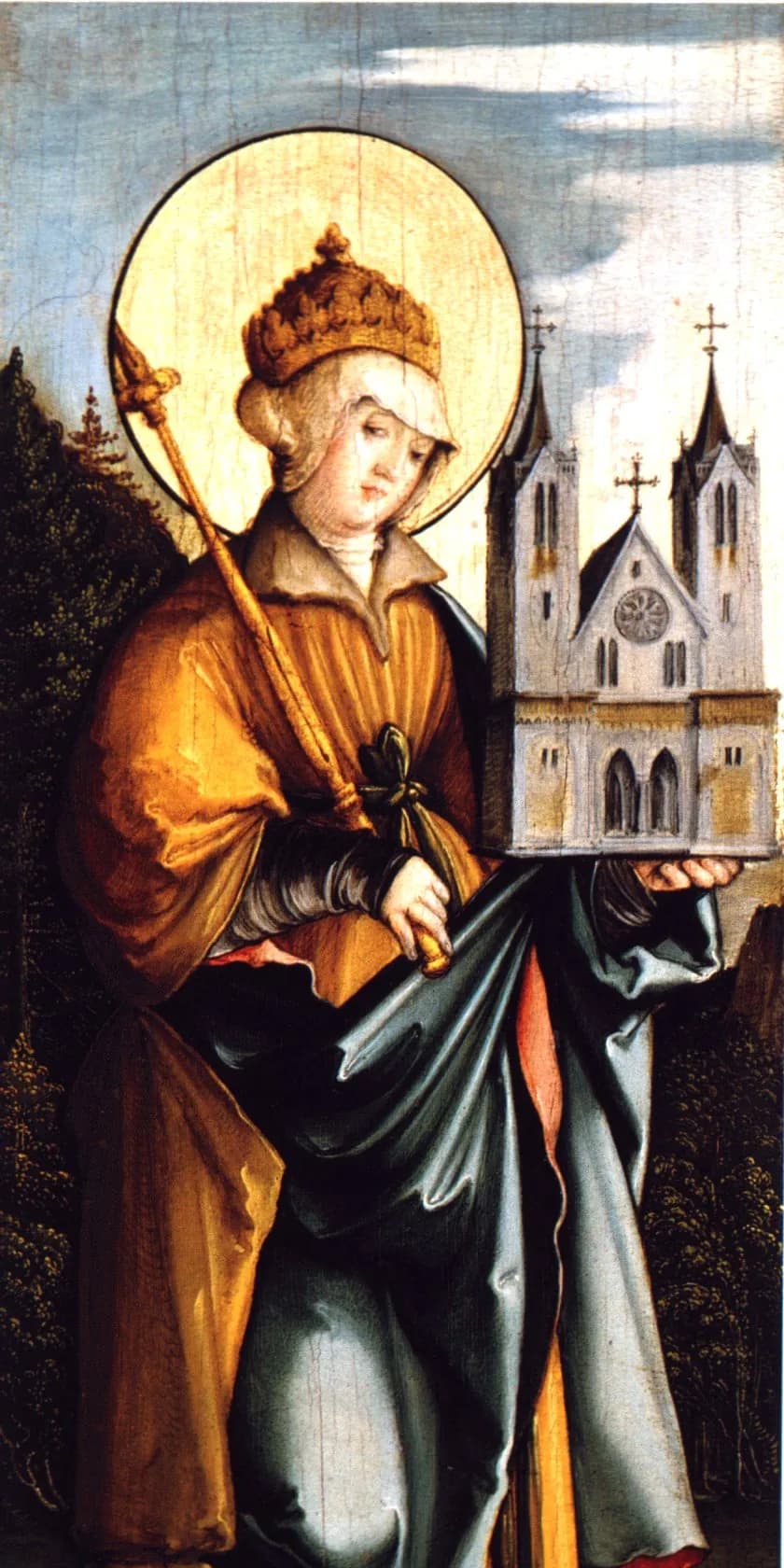
- Patron saint of
- The city and Archdiocese of Bamberg, Lithuania, Luxembourg and Poland, as Catholic Culture lists them 1; with Henry, the Diocese of Bamberg, in Benedict XVI's words 8
- Parents
- Siegfried, first Count of Luxembourg, and Hadeswige, according to Butler 1
- Died
- March 3, 1040, at Kaufungen, according to Butler 1
Saint Cunegunde was the wife of the Emperor Henry II, crowned with him in Rome in 1014, and a year after he died she put off her imperial robes and became a nun in a convent she had founded. 14 She helped found the diocese of Bamberg, spent her last fifteen years at Kaufungen caring for sick sisters and taking the humblest work, and was buried beside Henry in Bamberg Cathedral. 125 She is best known for a story that she walked over red-hot plowshares to prove herself innocent of adultery, which comes to us from Alban Butler and from no older source consulted here. 1 Her feast is March 3. 12
A count's daughter from Luxembourg
Butler's Lives of the Saints, in the excerpt Catholic Culture prints, makes her the daughter of Siegfried, the first Count of Luxembourg, and his wife Hadeswige, and says they brought her up in piety "from her cradle." 1 She was married to Henry, Duke of Bavaria. 1 When the Emperor Otto III died, Henry was chosen king and crowned on June 6, 1002; Cunegunde was crowned at Paderborn on the feast of Saint Lawrence. 1
In 1014 the two went to Rome and received the imperial crown together from Pope Benedict VIII. 1 The 1910 Catholic Encyclopedia dates Henry's coronation as emperor to February 14 of that year. 4
Marriage into the royal house did not settle her family's loyalties. Franz Kampers, writing Henry's article in that encyclopedia, records that the Counts of Luxembourg, "brothers-in-law of the king," were "the heart and soul of the disaffection" in Lorraine. 4 One of them, Adalbero, made himself Bishop of Trier "by uncanonical methods" in 1003, and another, Theodoric, had himself elected Bishop of Metz. 4 Henry would not favor his wife's brothers at the empire's expense, and the royal authority in the northwest "suffered greatly" for it. 4 The sources say nothing about what Cunegunde made of this.
Bamberg
Bamberg was a family inheritance, and the 1907 encyclopedia's article on the diocese says that "the Emperor Henry II and his pious wife Kunigunde decided to erect a separate bishopric" there, to relieve the oversized diocese of Würzburg and to give Christianity a firmer footing in Franconia. 5 Its author, Joseph Lins, has the boundaries settled in 1008 and confirmed by Pope John XVIII that year, the cathedral consecrated on May 6, 1012, and "the emperor and his wife" endowing the see with large estates. 5 He calls her the "joint foundress with the emperor Henry II of the see." 5
The same encyclopedia, in Kampers's article on Henry, tells it differently: Bamberg was "entirely his own scheme," pushed through in 1007 against the Bishop of Würzburg. 4 The two articles are given here side by side. Vatican News, more simply, says she "built numerous monasteries and churches, and was known for her care for the poor." 2
A childless marriage
Henry and Cunegunde had no children, and the sources read that fact in three ways. Butler says she had made a vow of virginity before the marriage, "by St. Henry's consent." 1 Catholic Culture's own summary says the couple "guarded perpetual virginity in their marriage." 1 Vatican News, writing about Henry, calls the mutual vow of chastity a belief that grew out of their childlessness, "although some historians dispute this." 3 Kampers is the bluntest: "the highly varied theme of his virgin marriage to Cunegond has certainly no basis in fact." 4
On one point Vatican News is plain. "Contrary to a common medieval practice," Henry did not put away his childless wife, and his decision to stay with her "contributed in no small part to his reputation for sanctity." 3
The ordeal of the plowshares
Butler tells the story in two sentences. "Calumniators afterwards made vile accusations against her, and the holy empress, to remove the scandal of such a slander, trusting in God to prove her innocence, walked over red-hot ploughshares without being hurt. The emperor condemned his too scrupulous fears and credulity, and from that time they lived in the strictest union of hearts." 1 He names no accuser, gives no date, and does not say how many plowshares there were.
Butler writes it as history. None of the other sources consulted for this page tells it at all, and the Catholic Encyclopedia, which has no article on her, never mentions it. 45 Its article on Henry does say that "later ecclesiastical legends" gave him ascetic traits, some of which "certainly cannot withstand serious criticism," and the virgin marriage, which in Butler is the setting for the slander, is the example it chooses. 14
What such an ordeal was is set out in the encyclopedia's article on ordeals by Johann Peter Kirsch. The accused "must pass barefooted over red-hot ploughshares (usually nine)," and was held innocent if unhurt; the test was a judgment of God, prepared for by confession and fasting. 6 Kirsch adds that "the popes were always opposed" to ordeals, and that in 1215, at the Council of the Lateran, Innocent III forbade anyone to receive the Church's blessing before the test of hot water or of the glowing iron. 6 It was Innocent III who had canonized Cunegunde fifteen years earlier. 1
Kaufungen
According to Butler, she fell dangerously ill while on retreat in Hesse and vowed that if she recovered she would found a monastery at Kaufungen, near Kassel. 1 She built it and gave it to Benedictine nuns. 1 Henry died in 1024, before it was finished. 14
Butler says she had already spent most of her wealth on bishoprics, monasteries and the poor. 1 On the first anniversary of Henry's death, in 1025, a great number of prelates came to dedicate the church at Kaufungen. After the Gospel she laid a relic of the true cross on the altar, took off her imperial robes and put on a plain habit; her hair was cut, and the bishop gave her a veil and a ring. 1
From then on, in Butler's words, "she seemed entirely to forget that she had been empress." 1 She prayed, read, worked with her hands and visited the sick. 1 Vatican News says she devoted herself "to caring for her sick sisters, and taking on the humblest tasks." 2
Death and canonization
She lived fifteen years at Kaufungen. 1 When her strength failed she saw the sisters preparing a gold-fringed cloth to lay over her body; she "changed color and ordered it to be taken away," Butler writes, and would not rest until they promised to bury her in her habit as a poor religious. 1 She died on March 3, 1040. 1
Her body was taken to Bamberg and buried near Henry's. 1 Pope Innocent III canonized her in 1200, and Lins credits Thiemo, Bishop of Bamberg, with obtaining it. 145 Their monument in the cathedral is by Tilman Riemenschneider, and Lins says it is considered his masterpiece. 5 Benedict XVI, writing to Bamberg for the cathedral's thousandth anniversary in 2012, asked its people to pause before "the extraordinary funerary monument of St Henry and St Kunigunda" and called them "Christians, to us exemplary." 8
What is Saint Cunegunde the patron saint of?
Catholic Culture lists her as patron of the city and the Archdiocese of Bamberg, of Luxembourg, of Lithuania and of Poland. 1 Benedict XVI names "Henry and Kunigunda" together as "the holy patron saints" of the diocese of Bamberg. 8
Readers checking Poland and Lithuania should know of a second saint with nearly the same name. The 1908 Catholic Encyclopedia gives those two countries to Blessed Cunegundes, a Hungarian princess who became a Poor Clare and died in 1292, and who was made "chief patroness of Poland and Lithuania" in 1695. 7 None of the other sources here connects the empress with either country. Catholic Culture's list is recorded as Catholic Culture's.
Saint Cunegunde's feast day
Praying with Saint Cunegunde
Most of what is told about her is told by Butler, and the most famous part of it, the walk over burning iron, has no older witness among the sources here. 14 Set beside the other sources, the outline is plainer: a marriage without children that her husband did not end, a share in founding a diocese, a convent built after an illness, and fifteen years as a nun. 1235
The day she entered Kaufungen she did it in public, in front of the prelates who had come to dedicate her church, on the anniversary of Henry's death. 1 Butler describes her taking off the imperial robes at the altar. He does not describe her afterward as doing anything remarkable. She read, prayed, worked with her hands and looked after the sick. 12
The one scene Butler gives from her last days is the gold-fringed cloth, which she saw being prepared for her burial and sent away. 1 She was buried in her habit, and then carried to Bamberg to lie beside an emperor under Riemenschneider's carved monument. 15 The sources record both, and do not try to reconcile them.
Saint Cunegunde, pray for us.
Sources
- 1."St. Cunegundes," Liturgical Year, March 3, 2026, Catholic Culture, with an excerpt from Alban Butler, Lives of the Saints (Benziger Bros., 1894).
- 2."Saints of the Day: 3 March," Saint of the Day, Vatican News.
- 3."St. Henry II, Emperor," Saint of the Day, Vatican News.
- 4.Franz Kampers, "St. Henry II," The Catholic Encyclopedia, Vol. 7 (New York: Robert Appleton Company, 1910).
- 5.Joseph Lins, "Bamberg," The Catholic Encyclopedia, Vol. 2 (New York: Robert Appleton Company, 1907).
- 6.Johann Peter Kirsch, "Ordeals," The Catholic Encyclopedia, Vol. 11 (New York: Robert Appleton Company, 1911).
- 7.Stephen Donovan, "Blessed Cunegundes," The Catholic Encyclopedia, Vol. 4 (New York: Robert Appleton Company, 1908).
- 8.Benedict XVI, Letter on the occasion of the Millennium of the Cathedral of Bamberg, May 3, 2012.
Saints to turn to next
Others in this collection who are turned to for some of the same things.
- Saint Germaine Cousin1579 - 1601Marriage and familyPoverty and simplicityPrayer
- Saint Hedwig of Silesiac. 1174 - October 1243Marriage and familyPoverty and simplicityPrayer
- Saint Isidore the Farmerc. 1070 - May 15, 1130PrayerPoverty and simplicityMarriage and family
- Saint Margaret of Scotlandc. 1045 - November 16, 1093Marriage and familyPrayerPoverty and simplicity