Saint Germaine Cousin
1579 - 1601
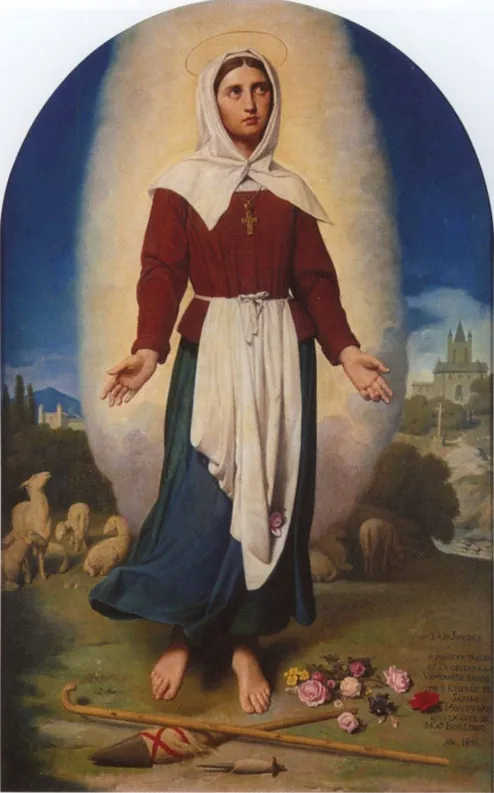
- Patron saint of
- Child abuse victims, disabled people and the abandoned, according to Aleteia 4
- Also known as
- Germana Cousin, in the Vatican News calendar 2
- Died
- Early summer of 1601, at Pibrac, aged 22 1
- Beatified
- May 7, 1854, by Pope Pius IX 1
- Shown in art
- With a shepherd's crook or a distaff, a watchdog or a sheep, or flowers in her apron 1
Saint Germaine Cousin was a shepherdess from Pibrac, a village near Toulouse, who was born in 1579 with a deformed hand and scrofula, lost her mother as a small child, and was driven out of her own home by her stepmother. 13 She slept in the stable or on a heap of vine branches, tended the family's sheep, went to Mass every day, and gave away the bread she was allowed. 1 She was found dead on that bed of twigs at 22. 1 Forty-three years later her body was found incorrupt, and after two centuries of cures reported at her relics, Pius IX canonized her in 1867. 13
A child sent out of the house
Germaine was born at Pibrac in 1579 to poor parents; CNA says her father was a farmer. 13 Cornelius Mulcahy, writing in the Catholic Encyclopedia in 1909, says that "from her birth she seemed marked out for suffering." 1 She had a deformed hand and scrofula, which CNA calls a tubercular condition and Aleteia describes as abscesses across her neck. 134 CNA describes the deformity as affecting her right arm and hand, and Aleteia as a right arm that was partly paralyzed. 34
Her mother died while Germaine was an infant, according to Mulcahy and CNA. 13 Aleteia says she was four, and that her mother died of the plague. 4 Her father soon married again. 1 Aleteia names him as Laurent Cousin and the second wife as Armande de Rajols. 4
The sources do not soften what followed. Mulcahy says the stepmother "treated Germaine with much cruelty." 1 Using the scrofula as her reason, "under pretence of saving the other children from the contagion," she persuaded the father to keep Germaine away from the house, and so the child was put to work almost from infancy as a shepherdess. 1 At night she slept in the stable, or on a litter of vine branches in a garret. 1 CNA says the stepmother was disgusted by Germaine's condition, tormented and neglected her, and taught the other children to do the same, and that Germaine, starving and sick, ended up sleeping on leaves and twigs under the stairs of the barn. 3
Mulcahy lists what she lived with: poverty, illness, "the rigours of the seasons," and "the lack of affection from those in her own home." 1 To all of that, he says, she added penances of her own, living on bread and water. 1
The shepherdess at Mass
What the sources remember about her days is mostly prayer. She went to Mass every morning. When the bell rang, Mulcahy writes, "she fixed her sheep-hook or distaff in the ground, and left her flocks to the care of Providence while she heard Mass." 1 CNA says she left them in the care of her guardian angel, and Aleteia that she counted on the angels to guard them. 34 All three agree that the pasture lay near a forest with wolves in it and that the flock came to no harm. 134
The rosary was her only book, according to Mulcahy, and she would kneel at the first sound of the Angelus bell even if she was in the middle of crossing a stream. 1 She went often to confession and Communion, and was seen to grow more devout as each feast of Our Lady came near. 1 He also reports that she is "said to have practised many austerities as a reparation for the sacrileges perpetrated by heretics in the neighbouring churches," a reminder that she lived through France's wars of religion. 1 When she could, she gathered the village children and taught them about Jesus and Mary. 13
She had very little, and gave part of it away. Mulcahy says that "notwithstanding her poverty she found means to help the poor by sharing with them her allowance of bread." 1 CNA adds that she was barely fed and visibly emaciated when she did it. 3
The stream, and the flowers in the apron
The villagers at first laughed at her piety, Mulcahy says, until certain signs changed their minds. 1 To reach the church she had to cross a stream that in winter, after heavy rain or snowmelt, could not be forded. On several occasions, he writes, "the swollen waters were seen to open and afford her a passage without wetting her garments." 1 CNA and Aleteia tell the same story. 34
The best-known story about her is not in the encyclopedia. Mulcahy mentions only that artists show her "with flowers in her apron." 1 CNA tells it like this: one winter day her stepmother chased her, accusing her of stealing bread, and when Germaine opened her apron, fresh summer flowers fell out, which she offered to her stepmother as a sign of forgiveness. 3 In Aleteia's version she was carrying bread she had saved for the poor, and her stepmother made her open the apron in front of the townspeople to shame her as a thief. 4 Aleteia also gives her words, introduced with "it was reported": "Mother, God sends these to you as a sign of His forgiveness." 4 Neither source says where the story was first recorded, and it is told here as the story it is.
Her death, and what was found in 1644
The sources disagree about her father. Mulcahy says he "at last came to a sense of his duty," forbade the stepmother to treat her harshly, and wanted to bring Germaine back into the house with the other children, but she asked to stay where she was. 1 CNA says both parents offered her a place, which she declined. 3 Aleteia says that her father "never defended or protected her." 4
One morning in the early summer of 1601, when she had not got up at the usual hour, her father went to call her and found her dead on her pallet of vine twigs. She was 22. 1 She was buried in the parish church of Pibrac, in front of the pulpit. 1
In 1644 the grave was opened to bury a relative, and her body was found, in Mulcahy's words, "fresh and perfectly preserved." 1 A noblewoman, the wife of François de Beauregard, gave a lead casket for it in thanksgiving after she was cured of an ulcer of the breast and her infant son recovered; Mulcahy calls this the first of a long series of cures at the relics. 1 The vicars-general of Toulouse examined the body again in 1661 and 1700 and recorded that it was intact, and medical witnesses testified that it had not been embalmed. 1 In 1793, during the Revolution, a tinsmith named Toulza and three others took the remains out of the casket and buried them in the sacristy under quicklime and water. Afterward the body was found still intact, except where the lime had reached it. 1
An attempt at beatification in 1700 came to nothing. 1 The cause was taken up again in 1850, with more than 400 miracles or graces documented and letters of support from thirty French bishops and archbishops. 1 The cures attested were of every kind, Mulcahy says, including blindness both from birth and from disease, and diseases of the hip and spine. 1 The documents also recorded a multiplication of food for the struggling community of the Good Shepherd at Bourges in 1845, which Aleteia mentions as well. 14 Private devotion to her had continued without a break from the finding of her body in 1644. 1 Pius IX beatified her on May 7, 1854, and canonized her on June 29, 1867. 14
What is Saint Germaine Cousin the patron saint of?
Aleteia calls her "the patron saint of child abuse victims, disabled people, and the abandoned." 4 The 1909 encyclopedia and CNA do not name any patronage for her. 13 Lists elsewhere often add shepherds, the sick and the poor, but no source used for this page says so, and they are not repeated here.
Saint Germaine Cousin's feast day
Praying with Saint Germaine Cousin
Her story is, first of all, the story of a child who was hurt by the adults responsible for her. A sick girl was sent out of the house, made to sleep with the animals, and given too little to eat, and the sources record that her father went along with it for most of her life. 134 Whatever came after does not make that acceptable, and none of the sources treats it as if it did.
What they do record is what she did with her days. She prayed the rosary because it was the only book she had, went to Mass when the bell rang, taught the village children what she knew, and shared bread she could not spare. 13 Mulcahy says the village at first treated her piety with "mild derision." 1
The flowers in the apron are a story told about her, not a fact recorded by her first historian, and the sources tell it differently. 134 In both versions the point is the same: she is accused of theft by the woman who has starved her, and she answers with forgiveness. 34
She died at 22 on a bed of twigs, and was found there by her father. 1 Her recognition came long after, through the cures reported at her grave. 1 Aleteia names her patron of child abuse victims, of disabled people, and of the abandoned, which is to say of people in the situations she lived through herself. 14
Saint Germaine Cousin, pray for us.
Sources
- 1.Cornelius Mulcahy, "St. Germaine Cousin," The Catholic Encyclopedia, Vol. 6 (New York: Robert Appleton Company, 1909).
- 2."St. Germana Cousin, Virgin," 15 June, Saint of the Day, Vatican News.
- 3."Faithful to celebrate feast of St. Germaine Cousin," Catholic News Agency, June 13, 2010.
- 4.Larry Peterson, "Meet a 'Cinderella saint,' a powerful intercessor for abused children," Aleteia, February 24, 2019.
Saints to turn to next
Others in this collection who are turned to for some of the same things.
- Saint Hedwig of Silesiac. 1174 - October 1243Marriage and familyPoverty and simplicitySuffering and illnessPrayer
- Saint André BessetteAugust 9, 1845 - January 6, 1937PrayerSuffering and illnessPoverty and simplicity
- Saint Bridget of Swedenc. 1303 - July 23, 1373PrayerMarriage and familySuffering and illness
- Saint Charles de FoucauldSeptember 15, 1858 - December 1, 1916PrayerPoverty and simplicitySuffering and illness