Saint Adrian of Nicomedia
d. c. 304-306
- Died
- At Nicomedia, on March 4, about 304, under Diocletian 1; about 306, under Galerius, according to the 1910 Catholic Encyclopedia 2; March 4, 306, according to Catholic Culture 4
- Historical record
- His grave was venerated at Constantinople; the records of his martyrdom are "legendary and unverified" 2
- His church in Rome
- The old Senate house in the Forum, made a church by Pope Honorius I: Sant'Adriano 135
Saint Adrian of Nicomedia was a Roman officer who, according to his Acts, watched Christians being tortured, was so impressed that he declared himself one of them before he was even baptized, and was put to death with them at Nicomedia in Asia Minor in the persecution of the early fourth century. 12 His grave was honored early, his relics reached Rome, and Pope Honorius I turned the old Senate house in the Forum into a church in his name. 13 The story of his wife Natalia, who nursed the prisoners and held his limbs while they were broken, is the part the sources trust least and the part that made him famous. 12
What is known
Not much. Johann Peter Kirsch, writing in the 1910 Catholic Encyclopedia, begins with the one fact he will vouch for: "The Christians of Constantinople venerated the grave of this victim of Diocletian's persecution." 2 Everything else, he says, comes from "legendary and unverified records, which have been preserved in Greek and Latin." 2
The Norwegian bishops' saints database, which gathers the older scholarship, is blunter. It says the stories about him grew out of confusion, merging, guesswork and legend, and that the Bollandists and the old Roman Martyrology proposed two different martyrs named Hadrian who died in different persecutions at Nicomedia, both of whose remains were taken to Argyropolis near Byzantium. 1 It calls the best-known version an evidently invented story, and notes that it nevertheless had an enormous appeal. 1
The cult itself is real and early. A strong cult grew up at Byzantium soon after his relics were brought there from Nicomedia, modern Izmit in Turkey. 1 In the seventh century relics went to Rome, and in the twelfth his veneration spread through northern France and the Low Countries. 1
The officer and the prisoners
The Acts make Adrian a pagan in the emperor's service. Kirsch summarizes them: he was "an officer in the bodyguard of Emperor Galerius," and was present with the emperor "at the trial and torture of twenty-two Christians in Nicomedia." 2 katolsk.no gives twenty-three, whipped in front of the emperor during Diocletian's persecution of 304, and notes that some sources place it under Maximian in 290. 1
Catholic Culture tells the moment of his conversion. While presiding over the torture, Adrian asked the prisoners what reward they expected from God, and they answered: "Eye hath not seen, nor ear heard, neither have entered into the heart of man, the things which God hath prepared for them that love him." 4 He confessed his faith publicly on the spot, "though he had not himself yet been baptised," and was thrown into prison with them. 42
Natalia
His wife is the real subject of the story. Kirsch says only that Natalia "had secretly become" a Christian herself and "cheered and ministered to her husband and his fellow-prisoners." 2 katolsk.no gives the whole thing. They had been married barely thirteen months. When she heard he had been arrested she wept and tore her clothes; when she heard why, she ran to the prison, kissed his chains and called him blessed, and saw to it that he was instructed in the faith. 1
Then comes a scene that is hard to forget. Knowing he would be executed, Adrian bribed the jailer to let him go home and say goodbye. Natalia assumed he had bought his freedom by denying Christ and shut the door in his face. He explained that the other prisoners were standing surety for his return, and the two of them went back to the prison together. 1 She stayed a week dressing the prisoners' wounds. When the emperor barred women from the prison, she cut her hair, put on men's clothes and bribed her way in. 1 Catholic Culture says she came "dressed as a boy" to ask for his prayers when he reached heaven. 4
The anvil
The prisoners were sentenced to have their limbs broken. In katolsk.no's telling, Natalia asked that her husband go first, so that he would be spared watching the others suffer, and she knelt beside the block while his limbs were crushed and cut off, hiding one of his hands in her clothes. 1 Catholic Culture says his limbs were struck off on an anvil and that he was then beheaded, "dying in the arms of Natalia." 4 Kirsch keeps to the bare outline: "Their members were first broken, after which they were delivered up to the flames." 2
A heavy rain put out the fire, and Christians carried the remains to Argyropolis on the Bosporus, near Byzantium. 1 Catholic Culture adds that lightning killed several of the executioners and that Natalia had to be held back from throwing herself into the flames. 4 Kirsch says she brought her husband's body to Constantinople. 2 She refused a pagan official who wanted to marry her a few months later, moved to Argyropolis with Adrian's hand, died there in peace, and was buried among the martyrs. 14
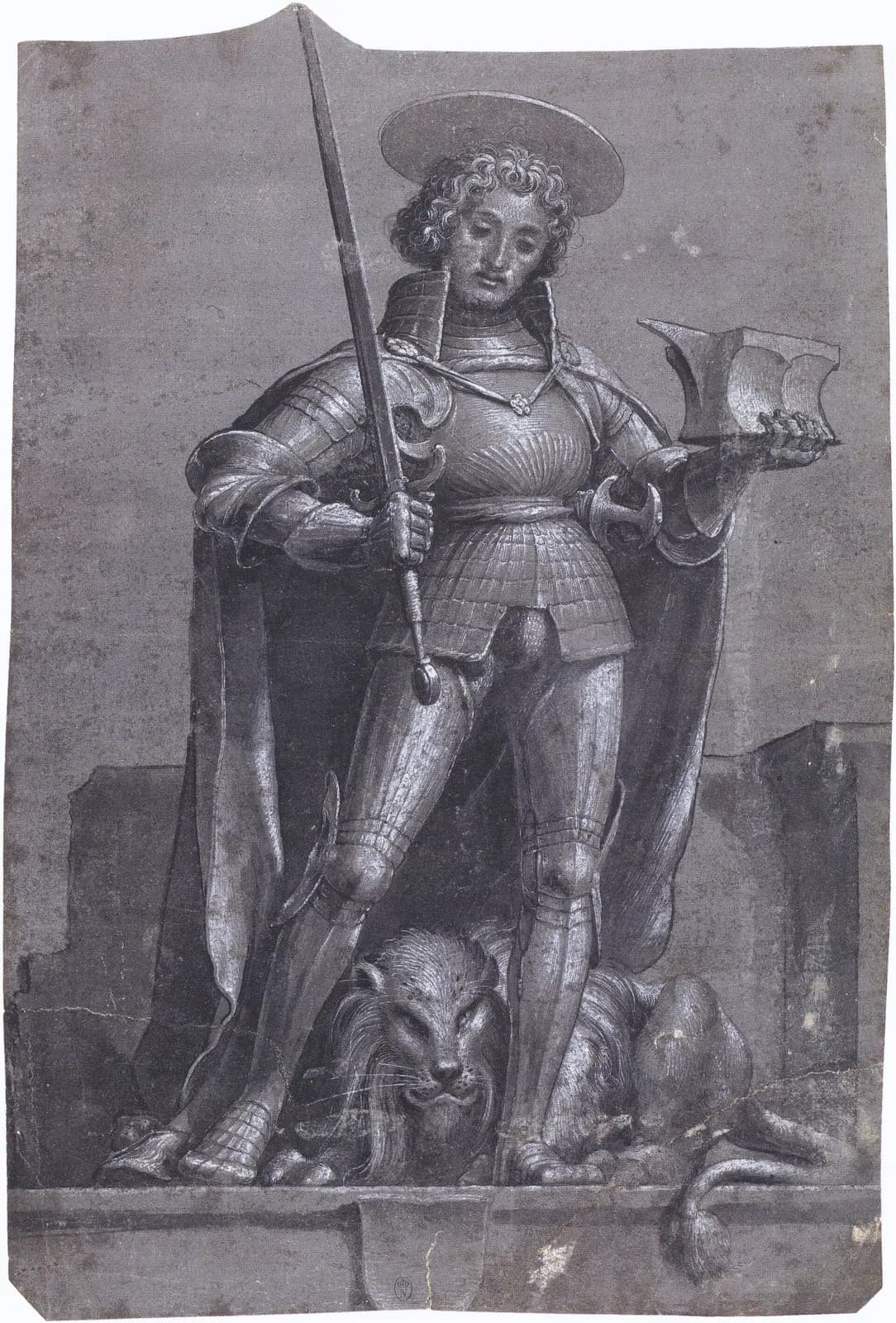
Hence the anvil, which artists put in his hands or at his feet, and the severed hand that sometimes goes with it. 14 Holbein's drawing at the top of this page gives him both a sword and an anvil, and dresses him in the armor of a sixteenth-century knight.
Two Hadrians
katolsk.no describes a second Hadrian of Nicomedia, said to be a son of the emperor Probus, who rebuked Licinius for persecuting Christians and was executed for it. His uncle Domitius, a bishop of Byzantium, buried him outside Argyropolis, and the old Roman Martyrology entered him on August 26. 1 katolsk.no considers this story as untrustworthy as the first, if less gripping. 1 Kirsch reads it differently: "Though different in detail, the story deals with the same person." 2
The church in the Forum
In Rome, Adrian's name is fixed to one of the most recognizable buildings in the Forum. The Roman Martyrology commemorates him on September 8 as the martyr of Nicomedia in whose honor Pope Honorius I turned the Curia, the meeting hall of the Roman Senate, into a church. 35 katolsk.no dates that pope's reign to 625-38. 1 Kirsch notes that the remains of Saint Adrian were later laid in that church, "which church (S. Adriano al Foro) is standing at the present day." 2
September 8 was the dedication day of Sant'Adriano, and it is also the feast of the Nativity of Mary, so the church became the starting point of the Roman processions on Marian feasts. 1 Catholic Culture recalls the same custom: Our Lady's birthday in Rome once included a procession from the church of Saint Adrian in the Forum. 4
North of the Alps he became something else again. Catholic Culture calls him "the chief military saint of Northern Europe for many ages, second only to St. George," and says he is "much revered in Flanders, Germany and the north of France." 4 Catholic.net notes that relics said to be his are kept at an abbey that bears his name in Flanders. 5
What is Saint Adrian the patron saint of?
Saint Adrian is the patron saint of soldiers. 14 katolsk.no lists him as patron of Lisbon, where many were saved from a plague through his intercession, and of Grammont; of butchers, brewers, smiths, messengers and jailers; and as a saint invoked against sudden death, plague and marital infertility. 1 Catholic Culture adds arms dealers and guards, and epilepsy. 4
Saint Adrian's feast day
Saint Adrian's feast day is September 8. The Roman Martyrology commemorates him on that day, and Kirsch explains why: it is the feast of the translation of his relics, which "in the Roman Church is the principal feast of this martyr and of his companions." 32 The older Martyrology also kept him on March 4, the date given for his death, and Natalia on December 1. 12 In the 1969 reform of the calendar his memorial was removed from the universal calendar and left to local ones. 1 The Orthodox and the Copts keep him on August 26. 12
Praying with Saint Adrian
The details are legend, and the sources say so. What is left once they are set aside is a shape that recurs in the early martyrs: an official on the wrong side of the room, looking at people who would not give way, and deciding that he would rather be one of them. 12 He had not been baptized. Natalia saw to it that he was instructed in prison, and there was very little time for it. 1
Natalia is the reason the story lasted. Her first reaction to the news of his arrest is grief, and her first reaction to seeing him free is to slam the door, because she assumes the worst. 1 Neither is saintly in a stained-glass way. Both are what a frightened wife would do. The story lets her be wrong about him for a moment, and then lets her walk back to the prison at his side.
The Martyrology now commemorates Adrian alone, but the story never really separated the two of them; the old calendar kept a common feast of Adrian and Natalia on September 8. 1 What holds them together in it is not romance. It is a woman who kept showing up, in disguise if she had to, until there was nothing left to show up for, and then took his hand home with her. 1
Saint Adrian of Nicomedia, pray for us.
Sources
- 1."Den hellige Hadrian av Nikomedia (d. 304?)," Den katolske kirke (katolsk.no), Catholic Diocese of Oslo (in Norwegian).
- 2.Johann Peter Kirsch, "Hadrian," The Catholic Encyclopedia, Vol. 7 (New York: Robert Appleton Company, 1910).
- 3.Roman Martyrology, entry for September 8, "Sant'Adriano, martire," as printed in "Santo del giorno," Conferenza Episcopale Italiana (in Italian).
- 4."September 8," Liturgical Year calendar, Catholic Culture (Trinity Communications), with the entry for Saint Adrian.
- 5.Felipe Santos, "Adrián y Natalia, Santos," with the Roman Martyrology entry for September 8, Catholic.net (in Spanish).
Saints to turn to next
Others in this collection who are turned to for some of the same things.
- Saint Margaret of AntiochUnknown; probably the third or early fourth centuryCourageMarriage and family
- Saint Adelaide931 - December 16, 999Marriage and familyCourage
- Saint EustaceMartyred at Rome, in 118 by tradition; other accounts give 140 or 188CourageMarriage and family
- Saint Gianna Beretta MollaOctober 4, 1922 - April 28, 1962Marriage and familyCourage