Saint Margaret of Antioch
Unknown; probably the third or early fourth century
- Also called
- Marina, the name under which the Greek Church honors her 1
- Patron saint of
- Women who are pregnant 1; women in childbirth 3. Catholic Culture's fuller list adds expectant mothers, nursing mothers, sterility, the dying, escape from devils, exiles, the falsely accused, nurses, peasants and kidney disease 2, and she is invoked against backache 3
- Historical record
- Her Acts place her death under Diocletian, but "even the century to which she belonged is uncertain" 1. Catholic Culture gives c. 257 3 and "probably" the third century 2
- Home
- Pisidian Antioch, in Asia Minor 1
- Emblems
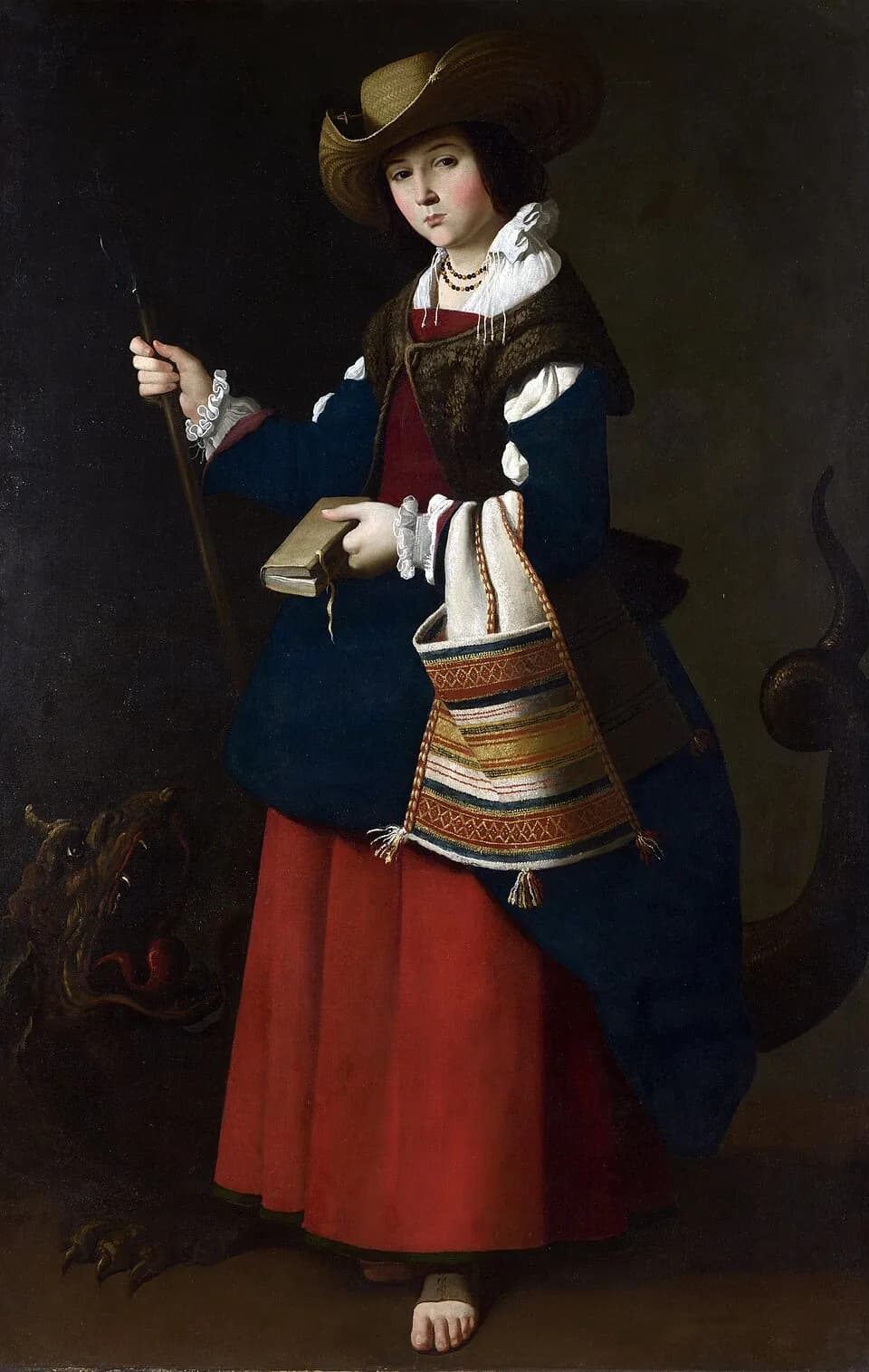
- A shepherdess, a chained dragon, a small cross or a girdle, a large vessel recalling the cauldron 1
Saint Margaret of Antioch, called Marina in the East, is a virgin martyr of the early Church whose life comes down to us only through her Acts, and the 1910 Catholic Encyclopedia says that "even the century to which she belonged is uncertain." 1 What is certain is how widely she was loved. She was invoked for centuries by women in childbirth, she was counted among the Fourteen Holy Helpers, and Saint Joan of Arc named her as one of the voices that spoke to her. 135 Her day in the Latin Church is July 20. 12
What her Acts tell
Joseph MacRory, writing the encyclopedia article, summarizes the account. Margaret belonged to Pisidian Antioch in Asia Minor, where her father was a pagan priest. Her mother died soon after she was born, and she was nursed by a devout woman who lived five or six leagues outside the city. 1 When Margaret became a Christian and consecrated her virginity to God, her father disowned her, and the nurse adopted her. 1
One day, while she was watching her foster mother's flocks, a Roman prefect named Olybrius saw her and wanted her as his concubine or his wife. 1 Neither flattery nor threats moved her, so he had her tried in public at Antioch. She refused to worship the gods of the empire. An attempt was made to burn her, but the flames, "we are told in her Acts, left her unhurt." 1 She was bound hand and foot and thrown into a cauldron of boiling water, and at her prayer the bonds broke and she stood up uninjured. At last the prefect ordered her beheaded. 1
The encyclopedia does not vouch for any of this as history. The Acts set her death in the persecution of Diocletian, between 303 and 305, "but in fact even the century to which she belonged is uncertain." 1 Catholic Culture is no more confident. Its notes on the Holy Helpers say she was beheaded at Antioch in Pisidia around 257 and that "not much is known about her," and its calendar describes her as "probably a virgin martyr of the third century." 23
The dragon, and what the Golden Legend said of it
The story most people know about Margaret is not in the encyclopedia's summary at all. It comes from the Golden Legend, the collection of saints' lives compiled by Jacobus de Voragine, archbishop of Genoa, in 1275. 4 His version differs in its details. Her father is named Theodosius, "patriarch and prince of the idols," she is fifteen when Olybrius sees her keeping sheep, and he is a provost rather than a prefect. 4
In prison, the Golden Legend says, she asked God to let her see the enemy she was fighting. A "horrible dragon" appeared and tried to devour her, and when she made the sign of the cross it vanished. 4 Then Jacobus adds a second version: "in another place it is said that he swallowed her into his belly," and that the belly burst open and she came out unharmed. He does not endorse it. In the Caxton translation the next sentence reads: "This swallowing and breaking of the belly of the dragon is said that it is apocryphal." 4
Catholic Culture also tells it as legend: she met the devil "in the shape of a dragon," was swallowed, and escaped because the cross she carried irritated the creature's insides. 3 The dragon became her emblem anyway. MacRory notes that artists show her leading a chained dragon, as well as dressed as a shepherdess, holding a small cross or a girdle, or standing beside a large vessel that recalls the cauldron. 1
The Golden Legend ends with a prayer it puts in her mouth before the sword fell. She asks that any woman in labor who calls on her be kept from danger, "and that the child may be delivered from her belly without any hurt of his members." 4 A voice from heaven, it says, answered that her prayers were granted. 4
The voice Joan of Arc heard
Margaret's most famous appearance in recorded history is in another woman's life. Herbert Thurston, writing on Joan of Arc for the same encyclopedia, says that in the summer of 1425, at about thirteen and a half, Joan began to hear what she called her "voices" or her "counsel." 5 She came to recognize the speakers individually as Saint Michael, Saint Margaret, Saint Catherine and others. 5
Christopher Check, writing for Catholic Answers, names them more precisely as Saint Michael the Archangel, Saint Margaret of Antioch and Saint Catherine of Alexandria, says they revealed themselves to her over the next four years, and that in time they told her she was to lead the army that would free France from the English. 6 Joan was reluctant to describe them, Thurston writes, and refused at her trial to be drawn into details of how they looked, but she told her judges: "I saw them with these very eyes, as well as I see you." 5 Catholic Culture likewise counts Margaret among the saints who "appeared and spoke to St. Joan of Arc." 2
What is Saint Margaret of Antioch the patron saint of?
Above all, women who are expecting a child. MacRory, writing in 1910, found it curious: "Curiously enough this virgin has been widely venerated for many centuries as a special patron of women who are pregnant." 1 Catholic Culture calls her "patron for women in childbirth" and connects the association to the legend of the dragon, from which she emerged safely. 3 The Golden Legend's closing prayer for women in labor points the same way. 4
The calendar entry at Catholic Culture quotes Dom Prosper Guéranger's The Liturgical Year on how seriously this was once taken in England. Before the break with Rome under Henry VIII, he writes, her feast was kept there as a double of the second class, and "women alone were obliged to rest from servile work, in gratitude for the protection afforded them by St. Margaret at the moment of childbirth." 2 That favor, he says, is what ranked her among the saints called helpers. 2
Catholic Culture gives a longer list of patronages: expectant mothers and women in labor, against sterility, nursing mothers who have lost their milk, the dying, escape from devils, exiles, the falsely accused, nurses, peasants and kidney disease. 2 Its Holy Helpers page adds that she is invoked against backache. 3 These come from popular devotion rather than any formal act of the Church, and are given here as the source gives them.
Saint Margaret of Antioch's feast day
Her feast in the Latin Church is July 20, and in the Greek Church, where she is honored as Marina, it is July 13. 1 The Golden Legend preserves both readings: she died "the thirteenth kalends of August, as is founden in her story; and it is read in another place that it was the third ides of July," which is to say July 20 or July 13. 4
July 20 is no longer her feast in the universal calendar. Catholic Culture says it "has been suppressed because there is not much historical information about her life," and that devotion to her was great, "especially during the Middle Ages." 2 She is still listed on July 20 as a commemoration in the Roman Martyrology, alongside the optional memorial of Saint Apollinaris, and the calendar notes that her veneration "spread from the East to the West at the time of the Crusades." 2 The Fourteen Holy Helpers, whom she belongs to, were also once honored together on August 8, a collective feast dropped in the 1969 reform of the Roman calendar. 3
MacRory adds that relics said to be hers are venerated in many parts of Europe, among them Rome, Montefiascone, Bruges, Paris and Troyes. 1
Praying with Saint Margaret of Antioch
The honest place to begin is with how little is known. The encyclopedia cannot say which century she lived in, and the most famous scene of her life was doubted by the very collection that made it famous. 14 Yet for centuries Christians from England to the East kept her day, gave their daughters her name, and called on her when a child was coming. 2
Her Acts, read as the story the Church received, are about a girl who lost her father's house for the faith and was taken in by the woman who had nursed her. 1 She was then pressed by a powerful man who wanted her, and threatened with fire and boiling water, and she would not worship his gods. 1 The story does not soften what that refusal cost her.
The devotion around her has been a practical one. Women called on her in labor, and in medieval England they were given rest from work on her feast. 2 During the Black Death people grouped her with thirteen other saints and asked them for help in trials and sufferings. 3 Those who pray to her now are making the same kind of request, and doing it while knowing how little of her life can be checked.
Joan of Arc, a girl from a farming village on the French frontier, named Margaret as one of the voices that spoke to her from the age of thirteen. 56 At her trial she refused to describe them in detail, and said only that she had seen them with her own eyes. 5
Saint Margaret of Antioch, pray for us.
Sources
- 1.Joseph MacRory, "St. Margaret," The Catholic Encyclopedia, Vol. 9 (New York: Robert Appleton Company, 1910).
- 2."July 20," Liturgical Calendar, Catholic Culture (Trinity Communications), with an excerpt from Prosper Guéranger, The Liturgical Year.
- 3."Fourteen Holy Helpers," Catholic Activity, Catholic Culture (Trinity Communications).
- 4.Jacobus de Voragine, "The Life of S. Margaret," The Golden Legend, Vol. 4, trans. William Caxton (1483), ed. F. S. Ellis (London: Temple Classics, 1900), Medieval Sourcebook, Fordham University.
- 5.Herbert Thurston, "St. Joan of Arc," The Catholic Encyclopedia, Vol. 8 (New York: Robert Appleton Company, 1910).
- 6.Christopher Check, "Peasant Girl to Battlefield Commander," Catholic Answers Magazine, May 1, 2007.
Saints to turn to next
Others in this collection who are turned to for some of the same things.