Saint Januarius
Died c. 305
- Patron saint of
- Naples, and of blood banks and blood donors, per Franciscan Media 2
- Feast day
- September 19 2
- What is known of his life
- Thurston: "we know next to nothing" 1
- Killed with him
- Festus and Desiderius; Socius, Proculus, Eutyches and Acutius - the Martyrology names all seven 1
- The relic
- A dark mass in a sealed glass phial in Naples cathedral, which liquefies about eighteen times a year 2
Saint Januarius was a bishop beheaded near Naples around the year 305, and almost nothing else about him can be established. 1 What has made him famous is a sealed glass phial in Naples cathedral, said to hold his blood, which liquefies on his feast and about seventeen other times a year - a thing the Catholic Encyclopedia, writing in 1910, would neither explain nor dismiss. 12
The little that is known
Thurston opens with the identification and then with the gap: "Martyr, Bishop of Beneventum. St. Januarius is believed to have suffered in the persecution of Diocletian, c. 305. With regard to the history of his life and martyrdom, we know next to nothing." 1
The reason is the documents. "The various collections of 'Acts', though numerous, are all extremely late and untrustworthy." 1 Franciscan Media says the same: "Little is known about the life of Januarius." 2
What does survive early is the entry in the Roman Martyrology, which Thurston traces back through Bede to a document of around 733. 1 It names the whole group, which is worth reproducing because the men who died with him are usually dropped: "At Pozzuoli in Campania [the memory] of the holy martyrs Januarius, Bishop of Beneventum, Festus his deacon, and Desiderius lector, together with Socius deacon of the church of Misenas, Proculus deacon of Pozzuoli, Eutyches and Acutius, who after chains and imprisonment were beheaded under the Emperor Diocletian." 1
Seven men, from four different churches, killed together. The entry continues: "The body of St. Januarius was brought to Naples, and there honourably interred in the church, where his holy blood is kept unto this day in a phial of glass, which being set near his head becomes liquid and bubbles up as though it were fresh." 1
Thurston flags that last part immediately: "the reference to the miracle of the liquefaction is an addition of much later date." 1 The old entry recorded the martyrdom; somebody added the blood centuries afterward.
The story the Breviary tells
A fuller account appears in the Breviary, and Thurston presents it as an account rather than as history, since it comes from the same late Acts he has just set aside. 1
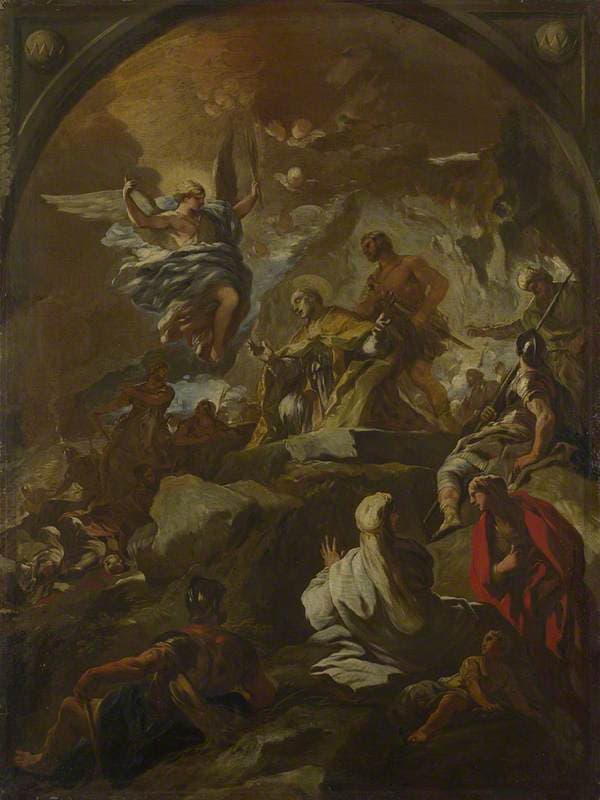
In it, Timotheus, President of Campania, condemns the martyrs. Januarius is thrown into a fiery furnace and the flames will not touch him. He and his companions are exposed to wild beasts in the amphitheater "without any effect." Timotheus declares this magic and orders them beheaded, and is struck blind - whereupon Januarius cures him, and five thousand people are converted before the executions proceed. 1
Franciscan Media gives a shorter version of the same: "Legend has it that Januarius and his companions were thrown to the bears in the amphitheater of Pozzuoli, but the animals failed to attack them. They were then beheaded." 2 Note the opening words - legend has it.
The Breviary then describes a competition for the bodies: "the cities of these coasts strove to obtain their bodies for honourable burial, so as to make sure of having them advocates with God." 1 The relics of Januarius went from Pozzuoli to Beneventum, from Beneventum to Monte Vergine, and at last to Naples. 1
And at Naples they became associated with the mountain. Among the miracles claimed, the Breviary says, "is remarkable the stopping of eruptions of Mount Vesuvius, whereby both that neighbourhood and places afar off have been like to be destroyed." 1 A city living under a volcano acquired a patron and asked him about the volcano.
The phial
Then Thurston turns to the thing everyone wants to know about, and he takes it seriously enough to argue about it rather than to assert.
Franciscan Media quotes this same encyclopedia for the physical description: "A dark mass that half fills a hermetically sealed four-inch glass container, and is preserved in a double reliquary in the Naples cathedral as the blood of St. Januarius, liquefies 18 times during the year... Various experiments have been applied, but the phenomenon eludes natural explanation." 2
Thurston's own contribution is to close off the simplest explanation, and to do it with evidence. "Let it at once be said that the supposition of any trick or deliberate imposture is out of the question, as candid opponents are now willing to admit." 1
His reasoning is practical rather than pious. "For more than four hundred years this liquefaction has taken place at frequent intervals. If it were a trick it would be necessary to admit that all the archbishops of Naples, and that countless ecclesiastics eminent for their learning and often for their great sanctity, were accomplices in the fraud, as also a number of secular officials; for the relic is so guarded that its exposition requires the concurrence of both civil and ecclesiastical authority." 1
The relic cannot be taken out without both the Church and the city present. Four centuries of both would have had to be in on it.
That is as far as this page goes, and as far as the sources go. Thurston rules out deliberate fraud and does not claim to have ruled in a miracle; Franciscan Media, quoting him, says the phenomenon eludes natural explanation. 12 Neither says it is inexplicable in principle. Readers who want a verdict will not find one here, because the sources this library uses do not offer one.
What is Saint Januarius the patron saint of?
Saint Januarius is the patron saint of Naples, and of blood banks and blood donors. 2
Naples is the oldest and the deepest of these. His relics were brought to the city and the city has treated him as its own ever since, invoking him against the eruptions of Vesuvius that have repeatedly threatened it. 1 When the phial is exposed in the cathedral, the crowd that gathers is not an audience of pilgrims from elsewhere; it is the city.
The patronage of blood donors is modern and obvious, and it is better than a pun. A man remembered for four hundred years because of a vessel of blood that is brought out and watched has become the patron of people who give theirs away so that it can be brought out and used. 2
Saint Januarius's feast day
The feast of Saint Januarius is September 19. 2 It is one of the days on which the phial is exposed in the cathedral at Naples, which is why the date is known far beyond Campania. 2
On the year of his death, Thurston gives "c. 305" and ties it to the persecution of Diocletian; Franciscan Media says 305 outright. 12 The Martyrology places the execution at Pozzuoli, near Naples, and names the six men who died with him. 1
The seven are commemorated together, though only Januarius is generally remembered. Festus, Desiderius, Socius, Proculus, Eutyches and Acutius are in the entry, and a reader looking him up in an older martyrology will find them there. 1
Praying with Saint Januarius
He is an unusually honest test of what devotion rests on. The biography is gone - Thurston says so in his second sentence - and the miracle is not certified. 1 What remains is a city that has kept faith with a bishop for seventeen hundred years and turns out in thousands to watch a glass phial three times a year. Whatever is happening in the reliquary, that is happening in Naples, and it is not nothing.
The way Thurston handles the question is worth more than the answer would be. He does not defend the miracle and he does not sneer at it. He examines the one hypothesis he can actually test - deliberate fraud - explains precisely why it fails, and stops. 1 Most arguments about the supernatural would be improved by that discipline: establish what can be ruled out, say so, and decline to fill the rest with confidence you do not have.
The companions deserve a thought. Six other men were beheaded that day, from four different churches - a lector, three deacons, two laymen - and the Martyrology still names every one. 1 Nobody keeps a phial for Desiderius. They died the same death and the Church has not forgotten their names, which is its own kind of fidelity.
And there is the volcano. Naples has lived under Vesuvius for two thousand years, in full knowledge of what it can do, and it has a saint it asks about it. 1 That is not superstition so much as the ordinary human refusal to be merely at the mercy of a thing. People who live somewhere dangerous need somebody to talk to about it.
Saint Januarius, pray for us.
Sources
Saints to turn to next
Others in this collection who are turned to for some of the same things.