Saint Agatha
c. 230 - c. 251
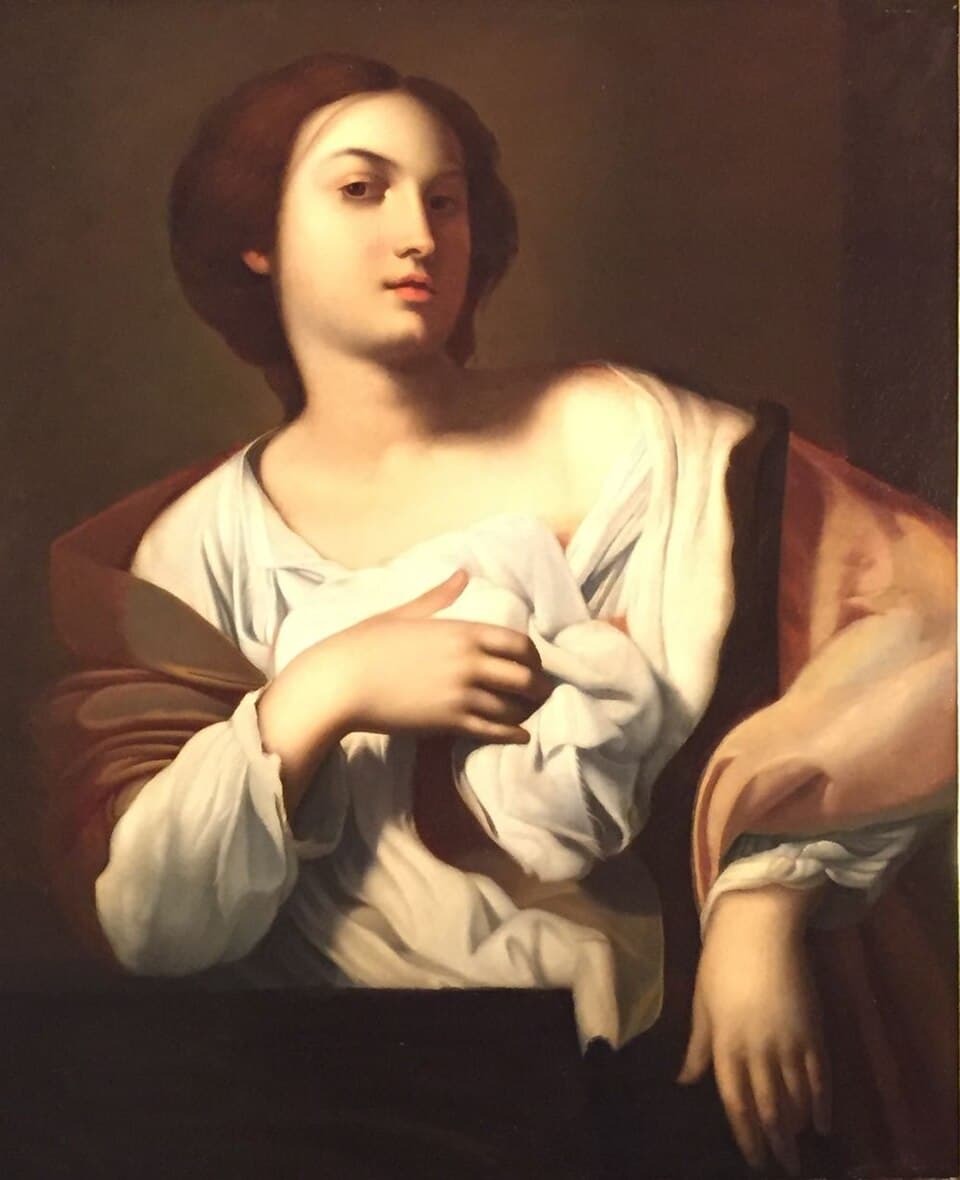
- Patron saint of
- Healing from diseases of the breast, and nurses, per Franciscan Media 2
- What is certain
- Kirsch: "Historic certitude attaches merely to the fact of her martyrdom and the public veneration paid her in the Church since primitive times" 1
- The Acts
- Survive in Latin and Greek, no older than the sixth century. Kirsch says neither "can lay any claim to historical credibility" 1
- Also claimed by
- Palermo and Catania both claim her as patroness 2
Saint Agatha is one of the most venerated martyrs of Christian antiquity and almost nothing about her is known. 12 Her name was being read in Sicily and North Africa on the fifth of February before the year 600, and the story everybody tells about her - the senator, the brothel, the mutilation - comes from Acts the encyclopedia says have no claim to historical credibility at all. 1 What is certain is that she was killed at Catania for being a Christian.
What the evidence actually supports
Kirsch opens by calling her "one of the most highly venerated virgin martyrs of Christian antiquity, put to death for her steadfast profession of faith in Catania, Sicily." 1 Then he draws the line most accounts never draw: "Historic certitude attaches merely to the fact of her martyrdom and the public veneration paid her in the Church since primitive times." 1
The veneration is very well attested, and Kirsch lists the evidence rather than asserting it. Her name is in the Martyrologium Hieronymianum and in the ancient Martyrologium Carthaginiense of the fifth or sixth century, both under 5 February. 1 Venantius Fortunatus names her in a sixth-century poem on virginity among the celebrated Christian virgins and martyrs. 1 A letter of Pope Gelasius, who reigned from 492, refers to a Basilica of Saint Agatha. 1 Gregory the Great's letters mention a church of hers in the Subura at Rome with a deaconry attached, in existence by the fifth century. 1
That church has a history of its own worth a sentence. Ricimer enriched it with a mosaic in the latter half of the fifth century, then gave it to the Arian Goths, and Gregory the Great restored it to Catholic worship. 1 A building can change hands twice and still be named after the same woman.
On when she died, Kirsch is careful. It is uncertain in which persecution it happened, though he is willing to accept "as probably based on ancient tradition" the evidence of her legendary life putting it under Decius, between 250 and 253. 1 Franciscan Media gives 251 outright. 2
The story, and what it is worth
The narrative everyone knows comes from the Acts, which survive in a Latin and a Greek version that disagree with each other. 1 Kirsch's verdict is worth quoting in full because it is unusually blunt for an encyclopedia: "Neither of these recensions, however, can lay any claim to historical credibility, and neither gives the necessary internal evidence that the information it contains rests, even in the more important details, upon genuine tradition. If there is a kernel of historical truth in the narrative, it has not as yet been possible to sift it out from the later embellishments." 1
The Latin Acts in their present form are no older than the sixth century - three hundred years after the events. 1 Kirsch adds Allard's judgment, that they are the work of a later author "who was more concerned with writing an edifying narrative, abounding in miracles, than in" recording what happened. 1
With all that attached, here is what they say. Agatha was the daughter of a distinguished family and notably beautiful. The Senator Quintianus pursued her; she refused him; he committed her to the charge of a woman whose business was seduction, and got nowhere. 1 He then had her tortured, and Kirsch names the detail that mattered most to later centuries: "Especially inhuman seemed his order to have her breasts cut off, a detail which furnished to the Christian medieval iconography the peculiar characteristic of Agatha." 1 The Acts have Peter appear to her in a vision and heal her. She died under repeated cruelties. 1
Franciscan Media tells a shorter version and frames it the same way - "Legend has it that Agatha, like Agnes, was arrested as a Christian, tortured, and sent to a house of prostitution to be mistreated" - and opens by saying that almost nothing about her is historically certain. 2 Two independent sources, both refusing to vouch for the story they are relating.
Sicily, and the mountain
Both Palermo and Catania claim her as patroness. 2 The claim is old and the rivalry is real; she was killed at Catania, and Palermo has held that she was born there.
Franciscan Media records what happened the year after her death, and it is the origin of the other thing she is invoked for. An eruption of Mount Etna stopped, and the stilling of it was attributed to her intercession. 2 "As a result, apparently, people continued to ask her prayers for protection against fire." 2 The word apparently is Franciscan Media's own, and it is the right word: a chain of reasoning from a volcano in the third century to a devotion that lasted.
Etna has erupted many times since, and the veil of Saint Agatha has been carried out against it more than once. Neither source makes a claim about the results, and neither will this page.
What is Saint Agatha the patron saint of?
Franciscan Media lists Saint Agatha as patroness of healing from diseases of the breast, and of nurses. 2 The connection to the first is the mutilation in the Acts - which is to say that the best-known patronage of one of Christianity's most ancient martyrs rests on a detail from a document the encyclopedia says has no claim to historical credibility. 12 That is worth knowing and is not an argument against the devotion. Women facing breast cancer have prayed to her for centuries, and what they are asking of her does not depend on whether a sixth-century author invented the reason she was thought to understand.
Saint Agatha's feast day
The feast of Saint Agatha is February 5. 12 It is among the best-attested dates in this library. Kirsch does not simply state it; he points to the Martyrologium Hieronymianum and to the Martyrologium Carthaginiense, which dates from the fifth or sixth century, both recording her name under that day. 1 Franciscan Media gives the same date now. 2 Whatever is unknown about her, the day has not moved in roughly fourteen hundred years.
Praying with Saint Agatha
She is a test case for what veneration is actually resting on. Strip out everything Kirsch refuses to vouch for and what remains is a woman killed at Catania for refusing to stop being a Christian, and a name that congregations kept saying every February for fourteen centuries. 1 That is not much of a biography and it turns out to be enough.
The famous detail is worth being honest about rather than quietly dropping. The reason women with breast cancer pray to Agatha is a torture described in a sixth-century document that the Church's own reference work says cannot be trusted. 1 It does not follow that the devotion is false. It follows that the devotion grew out of a story rather than out of a record, which is true of a great deal that is genuinely old.
What the early evidence does show is that people who had no story still kept her name. The martyrologies, the basilica, the poem, the church in the Subura that changed hands between Catholics and Arians and kept her name through both - all of that predates the Acts that made her famous. 1 They venerated her before anybody had written down why.
Then the volcano. Franciscan Media's "apparently" is the most honest word in either source: a mountain stopped, somebody connected it to her, and a devotion against fire followed. 2 People in danger have gone on asking, which is what they do, and the Church has gone on letting them.
Saint Agatha, pray for us.
Sources
Saints to turn to next
Others in this collection who are turned to for some of the same things.