Saint Sebastian
Died c. 286
- Feast day
- January 20. Loffler states it outright 1
- What can be proved
- Loffler: "little more than the fact of his martyrdom can be proved" 1
- The arrows
- Not in the earliest image of him. A mosaic of about 682 shows a bearded man in court dress, no arrow 1
Saint Sebastian is one of the most painted figures in European art, and the Catholic Encyclopedia will vouch for almost none of it. 1 The arrows are a Renaissance invention - the oldest surviving image of him, a mosaic of about 682, shows a bearded man in court dress with no arrow anywhere. 1 What can be proved is a grave on the Appian Way, a mention in a Roman calendar of 354, and Ambrose saying he came from Milan. 12
The provable part
Loffler's first sentence sets the limit: "Roman martyr; little more than the fact of his martyrdom can be proved about St. Sebastian." 1 Franciscan Media says the same: "Almost nothing is historically certain about Sebastian except that he was a Roman martyr, was venerated in Milan even in the time of Saint Ambrose and was buried on the Appian Way." 2
But the little that is provable is unusually early and unusually solid.
The "Depositio martyrum", a Roman list compiled by the chronologer of 354, records that Sebastian was buried on the Via Appia. 1 That is a civic document from within living memory of the persecutions, naming the place.
Ambrose, writing later in the same century, "states that Sebastian came from Milan and even in the time of St. Ambrose was venerated there." 1 A bishop of Milan, who had every opportunity to know, says the man was a Milanese already honored in his own city.
And in 367 "a basilica which was one of the seven chief churches of Rome was built over his grave." 1 Within a generation of Constantine, one of the seven great pilgrimage churches of Rome went up on that spot. Franciscan Media notes he is "mentioned in several martyrologies as early as 350." 2
The present church on the site was finished in 1611 by Cardinal Scipione Borghese, and part of the relics had been taken north in 826, to Soissons. 1
The story, and the verdict on it
The narrative everybody knows comes from Acts "probably written at the beginning of the fifth century and formerly ascribed erroneously to Ambrose." 1 Two centuries after the death, under a borrowed name.
In them, Sebastian is an officer of the imperial bodyguard who "had secretly done many acts of love and charity for his brethren in the Faith." Discovered to be a Christian in 286, he was handed over to the Mauretanian archers, "who pierced him with arrows; he was healed, however, by the widowed St. Irene. He was finally killed by the blows of a club." 1
Franciscan Media tells the same and adds the detail that makes the picture: he was "left for dead. But he was found still alive by those who came to bury him. He recovered, but refused to flee." Then he waited where the emperor would pass, denounced him to his face, and was beaten to death. 2
Loffler's judgment on all of it is seven words: "These stories are unhistorical and not worthy of belief." 1
Franciscan Media is only slightly gentler, and identifies the same soft spot: "Scholars now agree that a pious fable has Sebastian entering the Roman army because only there could he assist the martyrs without arousing suspicion." 2 The whole premise of the story - the secret Christian inside the guard - is the part scholars call invented.
Where the arrows came from
This is the most interesting thing in Loffler's article and it is rarely repeated.
"The earliest mosaic picture of St. Sebastian, which probably belongs to the year 682, shows a grown, bearded man in court dress but contains no trace of an arrow. It was the art of the Renaissance that first portrayed him as a youth pierced by arrows." 1
For the first thousand years he was shown as what the Acts actually make him: a grown man, bearded, in the dress of the imperial court. The beautiful young man bound to a column, half-naked and full of arrows, is a development of the fifteenth and sixteenth centuries - and it is now so completely identified with him that the earlier image looks wrong.
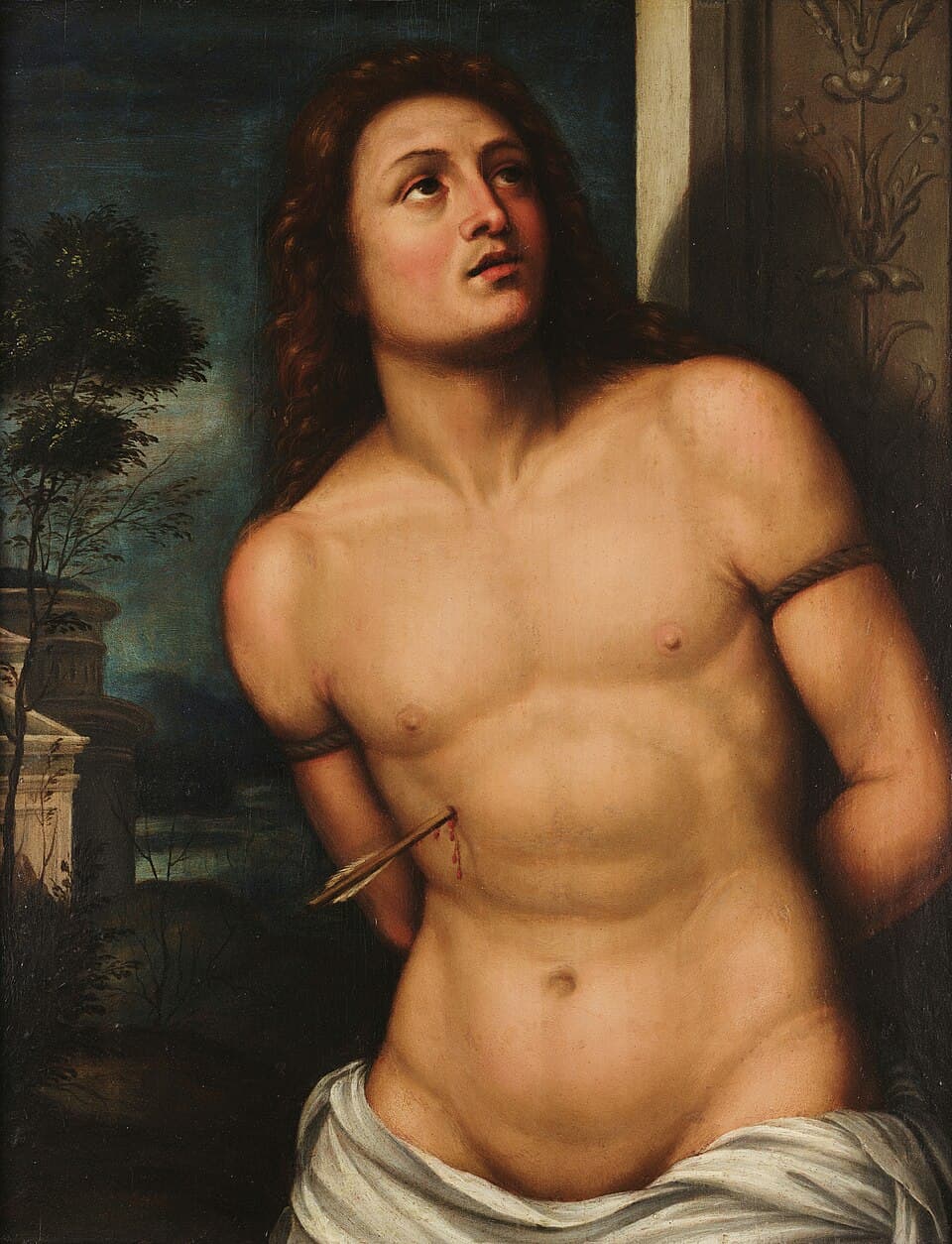
The painting on this page is one of those later ones: a beardless youth, roped to a pillar, a single arrow in his side, looking up. It is a fine picture and it is not a portrait of anything anybody witnessed. Franciscan Media makes the point in its own way: "The legend of Saint Sebastian is important in art, and there is a vast iconography." 2 The art is the legend's afterlife, not evidence for it.
The plague
What he was actually used for, across centuries, was not arrows but epidemics. Loffler: "Sebastian is considered a protector against the plague." 1
And he names three occasions when a city believed he had answered: "Celebrated answers to prayer for his protection against the plague are related of Rome in 680, Milan in 1575, and Lisbon in 1599." 1
Note the dates. Rome in 680 - within the same decade as that earliest mosaic. Milan in 1575, the plague that Charles Borromeo walked through barefoot with a rope around his neck. Lisbon in 1599. Three cities, nine hundred years apart, in the worst weeks they ever had, asking the same man.
Loffler does not vouch for the outcomes any more than he vouches for the arrows. He records that the cities believed it, which is a different and verifiable thing.
What is Saint Sebastian the patron saint of?
Franciscan Media lists Saint Sebastian as patron of athletes. 2 Loffler assigns no patronage but records the older and deeper one: he "is considered a protector against the plague." 1
The athletes come from the images rather than from the record - the Renaissance made him a young man of conspicuous physical beauty, and the patronage followed the pictures. 12 That is worth knowing and is not an argument against it; patronages grow where people put them.
The plague patronage is the one with history behind it, and it is the reason his name is on churches across southern Europe. 1 Anyone praying in an epidemic is in a very long line.
He is also, by the story rather than the record, a patron of soldiers and of people whose faith has to be kept quiet in the place they work. 12
Saint Sebastian's feast day
The feast of Saint Sebastian is January 20. Loffler states it in his closing line. 1
He shares the day with Saint Fabian, the pope martyred in 250, and the two are kept together in the Roman calendar - which is why a reader will sometimes find the entry headed with both names. 1
On the year of his death, the Acts say 286 and Loffler reports that without endorsing it, since he has already said the Acts are not worthy of belief. 1 What the fourth-century evidence supports is that he was martyred at Rome and buried on the Via Appia; the year is a detail of a story rather than a fact of a record.
Praying with Saint Sebastian
He is the clearest case in this library of a saint whose fame has almost nothing to do with what is known about him. Strip out the Acts - as his own encyclopedia does, in one sentence - and what remains is a Milanese who died for the faith at Rome and was buried beside a road, and whose grave drew one of the seven great churches of the city within a century. 1 That is enough to build a basilica on and it is not enough to build a story on.
The arrows are worth thinking about as a case study in how devotion works. For a thousand years he was pictured as a bearded official in court dress. Then the Renaissance wanted a different kind of image and made one, and the new picture was so powerful that it replaced the old one everywhere. 1 Nothing about the man changed. Everything about how he was seen did.
What the centuries actually asked him for was protection in epidemics, and the dates Loffler lists - 680, 1575, 1599 - are the dates of catastrophes. 1 People in Rome, Milan and Lisbon, during the worst months of their lives, turned to a fourth-century soldier whose story they could not verify and whose face they had never seen. That is not a decorative devotion. It is what people do when there is nothing else to do.
And there is the one element of the legend that survives as a shape even if none of it happened: the man who was left for dead, recovered, and went back. 2 Whether or not Sebastian did that, it is a thing people have always needed a name for - the second refusal, made after the first one has already cost everything and failed to kill you.
Saint Sebastian, pray for us.
Sources
Saints to turn to next
Others in this collection who are turned to for some of the same things.