Saint Blaise
Died c. 316
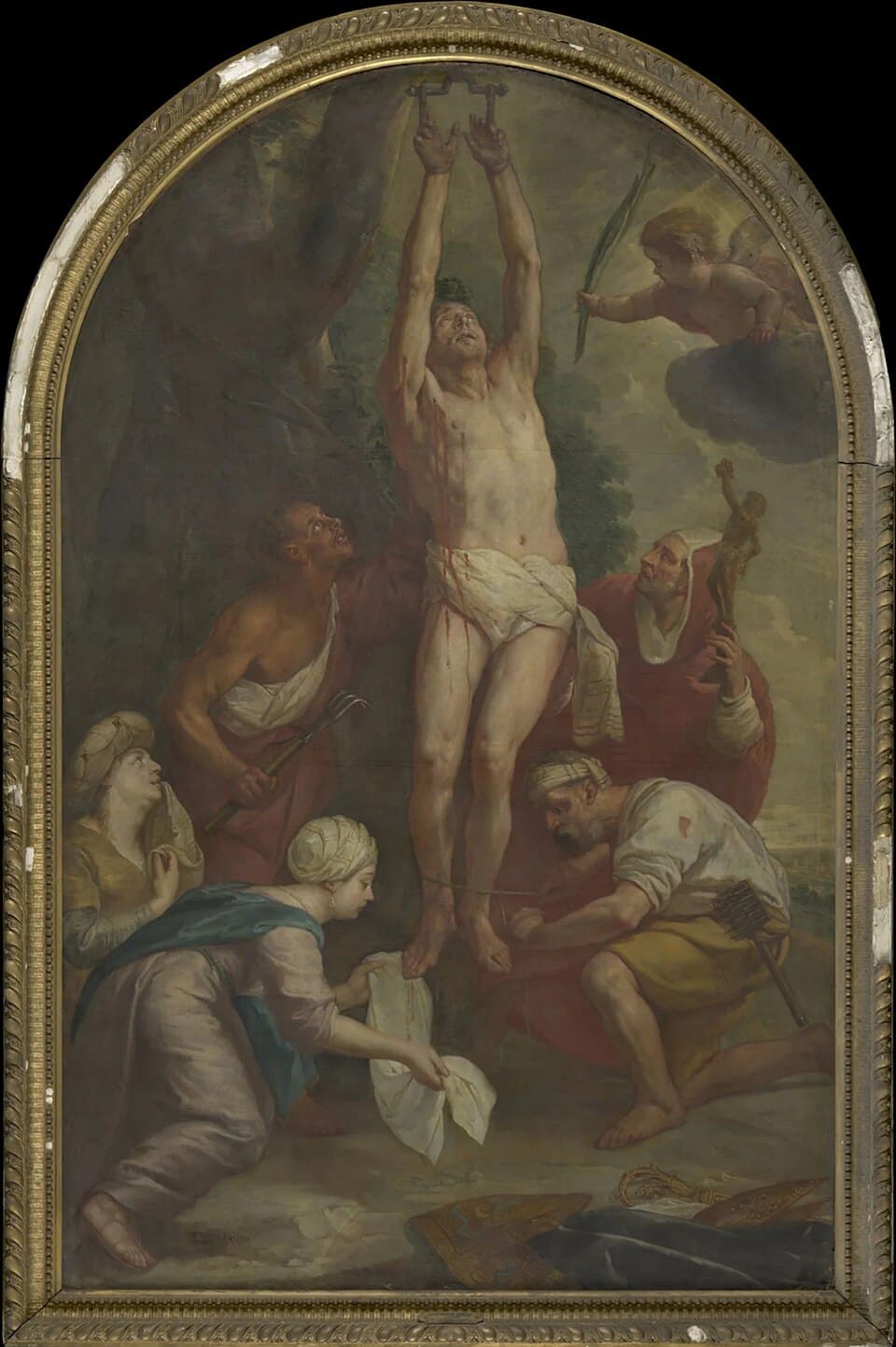
- Patron saint of
- Relief from throat ailments, and English wool combers, per Franciscan Media 2
- Feast day
- February 3 in the Latin Church; February 11 in the Eastern Churches 1
- What is certain
- Kirsch will allow only that he was a bishop and suffered martyrdom at the beginning of the fourth century 1
- The Acts
- Legendary, written roughly four hundred years after his death, and surviving in several disagreeing versions 12
- Also
- One of the Fourteen Holy Helpers 1
Saint Blaise is known to millions of American Catholics from about fifteen seconds a year: two candles crossed at the throat on the third of February. 1 Almost nothing else about him can be verified. 12 He was a bishop at Sebaste in Armenia and he was killed for it around 316, and everything else - the cave, the animals, the boy with the fishbone - comes from Acts written four centuries later that his own encyclopedia says have no claim to historical worth. 1
What can actually be said
Franciscan Media opens with the admission most accounts save for the end: "We know more about the devotion to Saint Blaise by Christians around the world than we know about the saint himself." 2
Kirsch sets out the evidence and then measures it. The ninth-century martyrologies of Europe list "St. Blasius, Bishop of Sebaste and martyr" on 15 February; the Greek synaxaria have him on 11 February. 1 But his name is absent from the oldest known recension of the martyrology of St. Jerome and appears only in the later, enlarged catalogues - and the historical notices in all of them "rest on the legendary Acts." 1 That is, the early lists are not independent witnesses. They are repeating the same story.
What Kirsch is willing to grant is carefully bounded: the accounts agree that Blasius was bishop of Sebaste in Armenia and mostly place his martyrdom under Licinius about 316, and since these reports "may rest on old traditions which are bound up with the veneration of the saint in the Church liturgy, they are not to be absolutely rejected. It can perhaps be assumed that St. Blasius was a bishop and that he suffered martyrdom at the beginning of the fourth century." 1
Then the line that governs everything else on this page: "All the particulars concerning his life and martyrdom which are found in the Acts are purely legendary and have no claim to historical worth." 1 Franciscan Media dates those Acts for us - they "were written 400 years later." 2
The story the Acts tell
With that established, the legend can be told for what it is, and it is a good one.
Blaise was a physician before he was made bishop. 1 Franciscan Media sets the scene: the Edict of Toleration of 311 had granted freedom of worship across the Roman Empire, but persecution still raged in Armenia, and Blaise was forced to flee to the back country, where he lived as a hermit. 2 There he "made friends with the wild animals." 2
Hunters looking for animals for the amphitheater found his cave. Franciscan Media describes what they walked into: "The bishop was kneeling in prayer surrounded by patiently waiting wolves, lions and bears." 2 They took him prisoner at the command of the governor, Agricolaus. 12
On the way to prison - this is the episode that made him - a mother brought her son, who had a fish bone lodged in his throat. At Blaise's command the child coughed it up. 2 Kirsch places the same cure inside the prison: "while in prison he performed a wonderful cure of a boy who had a fishbone in his throat and who was in danger of choking to death." 1
Agricolaus tried to make him sacrifice to the idols. The first refusal earned him a beating; the second, suspension from a tree while his flesh was torn "with iron combs or rakes"; the third, beheading. 2 Kirsch adds that the Acts relate the martyrdom of seven women alongside his. 1
Two candles at the throat
The devotion is the documented half of this saint, and Kirsch describes the rite in the present tense, as something done rather than something remembered. 1
On his feast "two candles are consecrated, generally by a prayer, these are then held in a crossed position by a priest over the heads of the faithful or the people are touched on the throat with them." 1 Elsewhere oil is consecrated, a candle wick dipped in it, and the throats touched with the wick. 1 The blessing itself is printed: "Per intercessionem S. Blasii liberet te Deus a malo gutteris et a quovis alio malo" - may God at the intercession of St. Blasius preserve you from throat troubles and every other evil. 1 Some dioceses add "in nomine Patris et Filii et Spiritus" while the priest makes the sign of the cross. 1
Franciscan Media records how far this reaches: his feast is observed as a holy day in some Eastern Churches, the Germans and Slavs hold him in special honor, and "for decades many United States Catholics have sought the annual Saint Blaise blessing for their throats." 2 In 1222 the Council of Oxford prohibited servile labor in England on his feast - a working holiday, by law, for a fourth-century Armenian bishop. 2
Kirsch, having explained the devotion, declines to explain why it grew so large: "The actual reason for the unusual veneration has not yet been made clear." 1 His best guess is that the legend made him a physician and cures were ascribed to him, "for this reason the faithful sought his help and intercession when ill." 1 Numberless churches and altars were dedicated to him, and Taranto, Ragusa and the Abbey of St. Blasius in the Black Forest all claimed relics. 1
What he looks like
Kirsch gives the two standard images, and both are about how he is used rather than who he was. He is shown holding two crossed candles - that is, performing the blessing - or in the cave surrounded by wild beasts as the hunters found him. 1
The iron combs of the legend produced the other patronage. Wool combers worked with a tool of the same name and shape, and English wool combers took him as their patron on the strength of it. 2 A trade guild chose a saint because the instrument of his torture was the instrument of their work.
What is Saint Blaise the patron saint of?
Saint Blaise is the patron saint of relief from throat ailments, and of English wool combers. 2 The first comes from the boy with the fishbone, the second from the iron combs used on him. 12 Both rest on the legendary Acts rather than on any record, which is worth knowing and is not much of an objection: the blessing of throats is a real rite, performed every February in parishes across the United States, and what people bring to it is a real fear. A sore throat is small; choking is not, and neither is a diagnosis. The devotion has outlived every attempt to verify its origin.
Saint Blaise's feast day
The feast of Saint Blaise is February 3. Kirsch states both calendars in one sentence: "In the Latin Church his feast falls on 3 February, in the Oriental Churches on 11 February." 1 Franciscan Media presents him on February 3. 2
A third date sits in the record and is worth noting, because it shows how far back the keeping of him goes. The ninth-century martyrologies of Europe give him under 15 February, and the Greek synaxaria under 11 February. 1 The Latin date has since settled on the third. Three days across three traditions, for a bishop nobody can document.
On the year he died, both sources give about 316, in the reign of Licinius, though Kirsch is careful to say only that "most of the accounts" place it there. 12
Praying with Saint Blaise
He is the clearest case in this library of a devotion that does not depend on its own history. Strip out everything Kirsch refuses to vouch for and what is left is a bishop of Sebaste who was killed for being one, early in the fourth century. 1 That is not a story. It did not stop the Council of Oxford legislating about his feast nine hundred years later, or stop American parishes crossing candles at throats this February.
There is something worth noticing in what the devotion asks for. It is not a great petition. It is throats - the fishbone, the sore throat, the thing in the windpipe, and by extension the diagnosis nobody wants. The formula asks God to preserve the person "from throat troubles and every other evil," and the order of those two is the whole of it. 1 You come with the small specific fear, and the prayer quietly widens to cover everything else.
The legend, read as legend, is still saying something. A bishop in hiding, keeping company with animals because the people had become more dangerous than the wolves; a man on his way to prison who stopped for one choking child; a refusal repeated three times under escalating torture. 12 Nobody can prove any of it happened. People have found it worth retelling for sixteen centuries, and Kirsch, who would not certify a word of it, still wrote it all down.
Franciscan Media's framing is the honest one to end on: we know the devotion better than we know the man. 2 For most of the people who will ever stand in that line on the third of February, that has always been true and has never mattered.
Saint Blaise, pray for us.
Sources
Saints to turn to next
Others in this collection who are turned to for some of the same things.