Saint George
Died c. 303
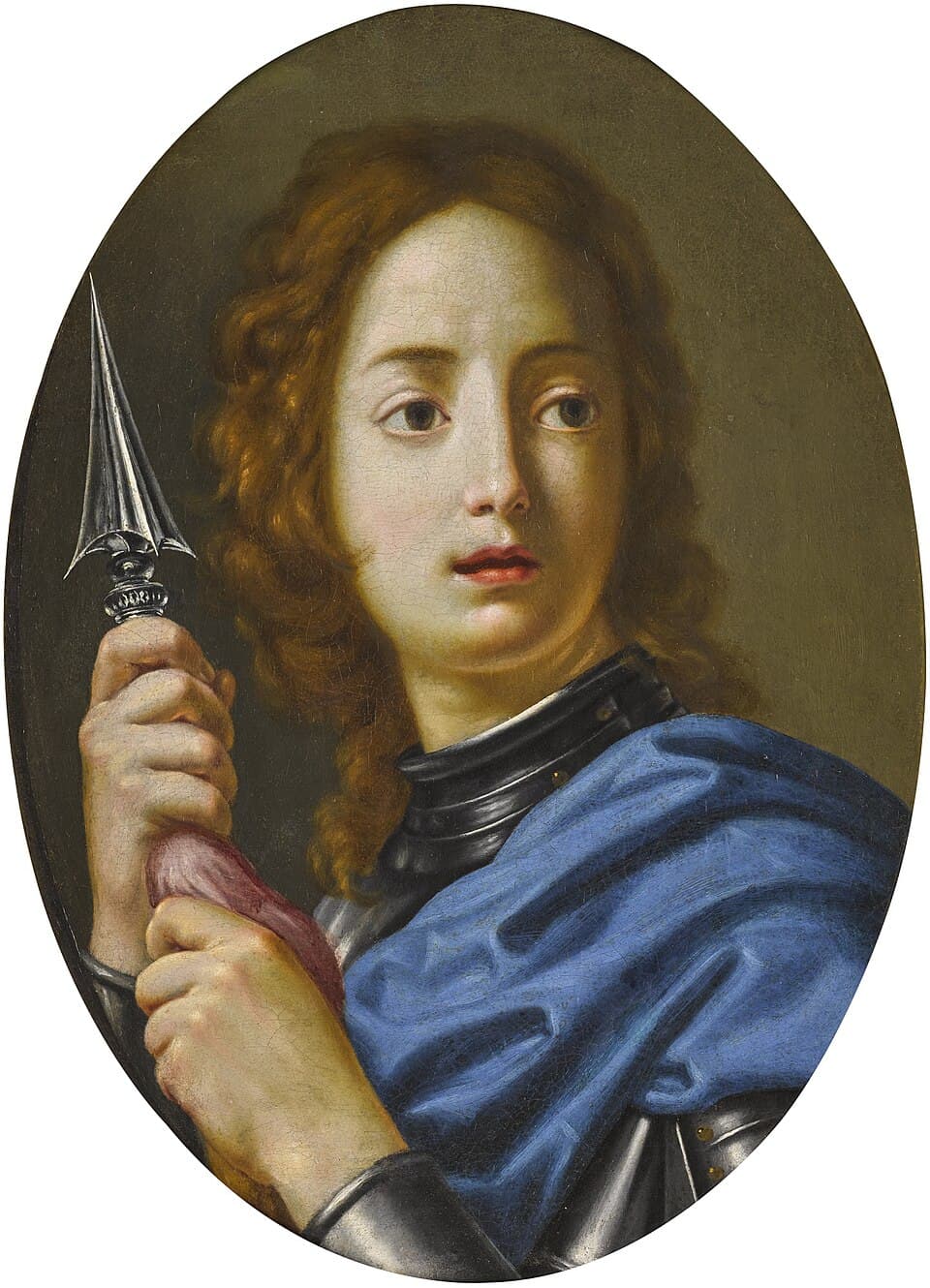
- Patron saint of
- England, Portugal, Germany, soldiers and the Boy Scouts, per Franciscan Media 2
- What can be affirmed
- Thurston: that sentence "sums up all that can safely be affirmed about St. George", following Delehaye 1
- The dragon
- A twelfth-century Italian fable, per Franciscan Media - some eight hundred years later 2
- Named in 495
- The Gelasian decree lists him among saints "whose names are justly reverenced among men, but whose actions are only known to God" 1
Saint George is one of the most famous saints in the world and almost nothing is known about him. 12 He was a martyr, he died at Lydda in Palestine, and it was probably before Constantine - that is the whole of what the encyclopedia will certify. 1 The dragon arrived eight centuries later. 2 And yet the case for his existence is stronger than the case for many saints with fuller biographies, for a reason worth understanding. 1
What the Acts contain
Thurston is writing in 1909, immediately after Delehaye's study of the military saints, and he does not soften the findings. The earliest narrative we have, fragments of which survive in a fifth-century palimpsest, "is full beyond belief of extravagances and of quite incredible marvels." 1
The inventory is worth reading, because it explains why no historian works from these texts. "Three times is George put to death - chopped into small pieces, buried deep in the earth and consumed by fire - but each time he is resuscitated by the power of God. Besides this we have dead men brought to life to be baptized, wholesale conversions, including that of 'the Empress Alexandra', armies and idols destroyed instantaneously, beams of timber suddenly bursting into leaf, and finally milk flowing instead of blood from the martyr's severed head." 1
There is a tamer version, and Thurston closes that exit too. The older Bollandists gave it some protection, but "even this abounds both in marvels and in historical contradictions", and modern critics approaching from different directions agree that the tame version came from the wild one "by a process of elimination and rationalization, not vice versa." 1 Somebody sanded the story down later; there is no early sober account underneath.
His conclusion is flat: the Acts "afford absolutely no indication at all for arriving at the saint's authentic history." 1
The dragon is not even in them. Franciscan Media dates it precisely: "The story of Saint George's slaying the dragon, rescuing the king's daughter, and converting Libya is a 12th-century Italian fable." 2 The single most famous thing about him is a medieval invention, and his own Church's reference works have said so for over a century.
Why he is nonetheless real
Here Thurston turns, and the turn is the most useful thing on this page. "This, however, by no means implies that the martyr St. George never existed. An ancient cultus, going back to a very early epoch and connected with a definite locality, in itself constitutes a strong historical argument." 1
An old devotion attached to a specific place is evidence. People do not generally start venerating a grave in a particular town for no reason, and the reason is usually that somebody was buried there.
And the evidence for the cult is unusually good. The early pilgrims - Theodosius, Antoninus and Arculphus, writing between the sixth and eighth centuries - all name Lydda, or Diospolis, as the seat of his veneration "and as the resting-place of his remains." 1 Inscriptions on ruined churches in Syria, Mesopotamia and Egypt show how early and how widely he was being honored, and some authorities put the church of St. George at Thessalonica in the fourth century. 1
Then the decree. The "De Libris recipiendis", attributed to Pope Gelasius in 495, shows that apocryphal Acts of George were already circulating - and lists him among those saints "whose names are justly reverenced among men, but whose actions are only known to God." 1 By the end of the fifth century the Church already knew it had a saint whose story it could not vouch for, said so in writing, and went on honoring him.
Franciscan Media reaches the same place in plainer words: "The Church adheres to his memory, but not to the legends surrounding his life. That he was willing to pay the supreme price to follow Christ is what the Church believes. And it is enough." 2
How he became England's
He was an Eastern saint first. Franciscan Media notes he was "a favorite patron saint of crusaders, as well as of Eastern soldiers in earlier times." 2 Soldiers going east met a soldier-martyr already venerated there and brought him home.
And not only to England. Franciscan Media gives the list: "He is a patron saint of England, Portugal, Germany, Aragon, Catalonia, Genoa, Milan and Bologna." 2 A martyr from a Palestinian town nobody in medieval Europe had seen ended up on the flag of one country and the arms of several cities.
The red cross on white that English readers know is his, and so is the Genoese banner that carried the same design centuries before the English adopted it. Thurston calls him "patron of England" in his opening line as a settled fact of 1909. 1
What is Saint George the patron saint of?
Franciscan Media lists Saint George as patron of England, Germany, Portugal, soldiers, and the Boy Scouts. 2 Thurston names England. 1
The soldiers are the oldest of these and the only one that connects to anything the sources will affirm. He was venerated by Eastern soldiers long before the crusaders adopted him, and whatever he actually was, he was remembered as a man who died rather than give way. 12
The Boy Scouts are the most recent and the most obviously downstream of the dragon: a movement built around courage and service picked the knight. 2 There is no harm in that as long as everyone knows the knight was invented in the twelfth century and the martyr was not. 2
Saint George's feast day
The feast of Saint George is April 23. 12 It is kept in East and West alike, which is itself part of the argument Thurston makes: his renown was "pre-eminent... both in East and West" from a very early period. 1
On the year, neither source commits. Thurston says only "probably before the time of Constantine", and Franciscan Media repeats the same phrase. 12 Constantine's edict came in 313, so the martyrdom belongs to the persecutions before that, with the Diocletian persecution of 303 the usual guess.
Praying with Saint George
He is the best illustration in this library of a distinction worth having: the difference between doubting a document and doubting a person. Thurston throws out every word of the Acts and then argues, on entirely separate grounds, that the man was real. 1 Those are two different operations, and confusing them is how people end up thinking that scholarship has taken their saints away from them. It has taken the stories. It has not taken George.
What is left when the dragon and the resurrections and the milk are gone is a soldier who was killed at Lydda for being a Christian, and a town that remembered where he was buried. That is not much. Franciscan Media says, correctly, that it is enough. 2
The Gelasian decree deserves a moment on its own. In 495 the Church looked at a saint whose legend it could not certify and drew the line exactly where an honest person would: his name is rightly honored, and what he actually did is known only to God. 1 Fifteen hundred years later that is still the most accurate sentence anybody has written about him.
There is something fitting in a patron of soldiers whose deeds are lost. Most people who have died for something are in the same position - remembered by a place and a name, their particular courage unrecorded. George is the patron of all of them, and it turns out that the missing biography is not a defect in him. It is the thing he has in common with almost everyone he is asked to pray for.
Saint George, pray for us.
Sources
Saints to turn to next
Others in this collection who are turned to for some of the same things.