Saint Michael the Archangel
Archangel
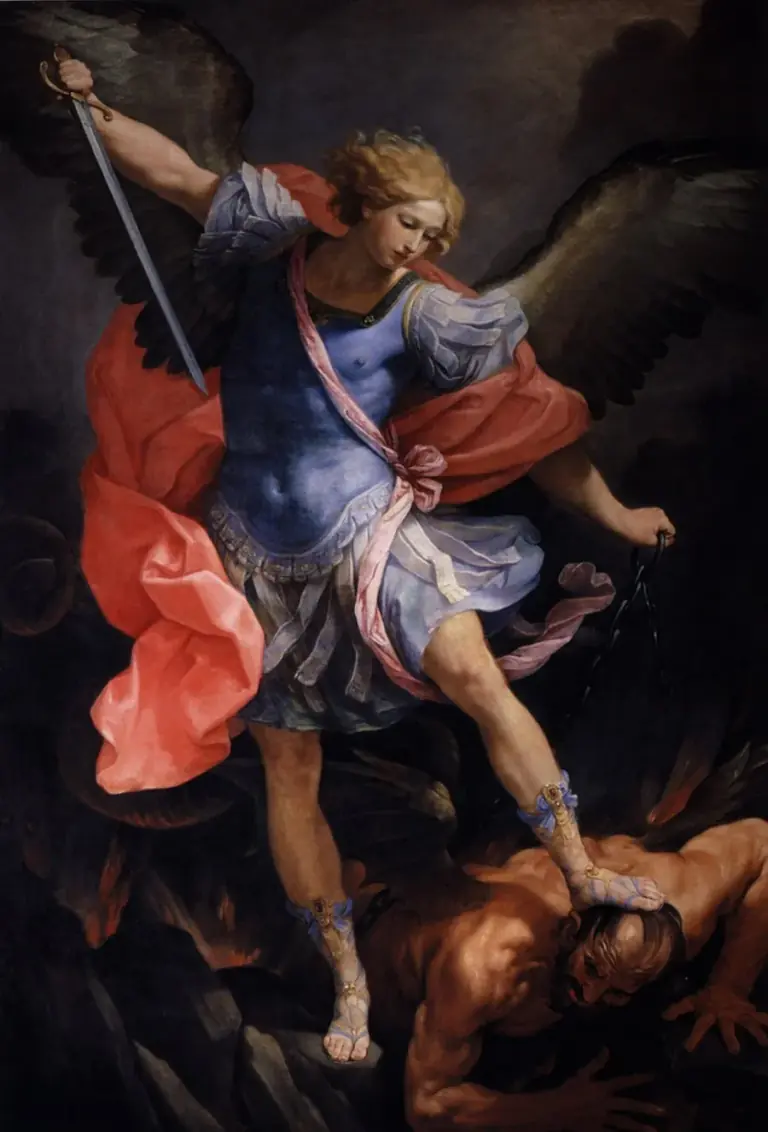
- Name
- Hebrew, meaning "Who is like God?" 1
- Rank
- One of the three archangels named in Scripture 2
- In Scripture
- Daniel 10 and 12, the Letter of Jude, and Revelation 12 1
Saint Michael the Archangel is not a saint in the way the others in this library are. He was never born, never died, and has no biography. What he has is a name that is also a question - "Who is like God?" - and a role: he is the one who asks it, and who fights whatever answers wrongly. He is who Catholics call on when something feels bigger than they are.
A name that is a question
Michael is Hebrew and means "Who is like God?" 1 It is not a description of him. It is what he says. The whole of the tradition about Michael is contained in that: an angel whose entire identity is the refusal to let anything else be treated as God.
He is one of the three archangels named anywhere in Scripture, alongside Gabriel and Raphael. 2
Where he appears in Scripture
There are four references. In Daniel 10, Gabriel tells Daniel that Michael, "one of the chief princes," came to help him. In Daniel 12 he is "the great prince, who standeth for the children of thy people." The Letter of Jude describes him disputing with the devil over the body of Moses. And Revelation 12 gives the scene everyone pictures: "there was a great battle in heaven, Michael and his angels fought with the dragon." 1
That is the entire scriptural record. Everything else said about Michael is the Church reading those four passages carefully over many centuries.
His four offices
Catholic tradition assigns Michael four offices: to fight against Satan; to rescue the souls of the faithful from the enemy, especially at the hour of death; to be the champion of God's people; and to call souls away from earth and bring them to judgment. 1
Franciscan Media puts the three archangels side by side and the distinction is useful: "Michael protects; Gabriel announces; Raphael guides." 2 If you want an angel who explains things, you want Gabriel. Michael is the one you want standing between you and something.
What is Saint Michael the patron saint of?
Saint Michael's feast day
Praying with Saint Michael
Michael is not asked for guidance or comfort. He is asked for defense. 1 Calling on him tends to mean admitting that whatever this is has gotten larger than you are.
His name is a question rather than a description: who is like God. 1 He is the one who asks it. A surprising amount of what goes wrong in a spiritual life is some version of answering that question badly, about money or a person or a reputation or yourself.
One of his four offices is to meet the faithful at the hour of death. 1 The Church has thought for a very long time that nobody makes that crossing alone, and people sitting with the dying have leaned on it heavily.
Michael protects, Gabriel announces, Raphael guides. 2 If your work is to stand between other people and something dangerous, he is the one the Church put in that place.
Saint Michael the Archangel, pray for us.
Sources
Saints to turn to next
Others in this collection who are turned to for some of the same things.