Saint Erasmus
Died c. 303, or in the late second century by one account
- Patron saint of
- Seafarers and maritime people 1; sailors, mariners and those in danger at sea, abdominal pain and intestinal disorders, childbirth and women in labor, according to Catholic Culture 4; also invoked for domestic animals 6
- Bishop of
- Formia, between Rome and Naples, according to the Holy See and FaithND 17; a bishop of Asia Minor martyred in Campania, according to Catholic Culture 4
- Died
- June 2, 303, according to the Holy See 1; about 303 under Diocletian, according to Catholic Culture 46; FaithND places him in the late second century 7
- Relics
- Transferred from Formia to the cathedral of Gaeta 2
- Emblem
- A windlass or capstan, a ship, ravens bringing bread, and a cauldron 4
Saint Erasmus, also called Saint Elmo, was a bishop and martyr of the early Church, remembered as bishop of Formia on the coast of Italy and venerated as a patron of seafarers. 1 He is one of the Fourteen Holy Helpers, and his relics lie in the cathedral of Gaeta, carried there from Formia. 26 Most of what is told about his life comes from legend, and the best-known part of it, the windlass on which his entrails are said to have been wound, is described by Catholic Culture as what "his legend asserts." 4 The name Elmo, and the blue light sailors see on masts in a storm, both trace back to him. 34
What can be said of him
The Holy See's page on patron saints of the sea lists him in a single line: "St Almo, known also as St Erasmus, Bishop of Formia (died 2/6/303)." 1 Catholic Culture gives the same year and places his death under the persecution of Diocletian and Maximian. 46 FaithND, the University of Notre Dame's devotional site, puts him instead in "the late second century," as bishop of Formia, which "sits between Rome and Naples." 7 The page gives both dates because the sources do.
Catholic Culture also describes him differently. It calls him "a bishop in Asia Minor" who was martyred in Campania "at about the same time" as Marcellinus and Peter, and says he was finally "captured and martyred at Formiae." 46 The two accounts can be read together, a bishop from the East who died at Formia, or apart. None of the sources tries to settle it.
What is solid is the cult. Umberto Benigni, writing on Gaeta for the Catholic Encyclopedia in 1909, records that the cathedral there "contains the relics of St. Erasmus, transferred from Formiæ." 2 FaithND adds that he is still the patron of Gaeta, and that both towns sit on the west coast of Italy, where sailors putting in at their ports invoked him. 7
The legend of his sufferings
FaithND is frank that "a number of unreliable legends fill in Erasmus' story." 7 In them he flees a persecution, lives on a mountain, and is kept alive by food a raven brings him; he is found, arrested and tortured, and survives through a series of miraculous escapes. 7 Catholic Culture names the mountain as Mount Lebanon. 6
The account Abbot Prosper Gueranger gave in The Liturgical Year, which Catholic Culture reprints for June 2, is a catalog of torments survived. Under Diocletian and Maximian, it says, Erasmus was "beaten with clubs and whips loaded with lead, and afterwards plunged into resin, sulphur, melted lead, boiling pitch, wax, and oil." 4 He came out unharmed, and many were converted by it. Imprisoned in iron fetters, he was "wondrously delivered by an angel." 4 At Formia he was clothed in "a coat of red-hot brass," and only after converting many more did he obtain "the palm of a glorious martyrdom." 4 Gueranger does not say how he died.
The windlass is a different story, and the sources treat it with different degrees of caution. Catholic Culture says he is invoked for intestinal diseases "for his legend asserts that he was tortured by winding his entrails round a windlass." 4 FaithND opens its entry by calling him patron of abdominal pain "because he was martyred by being disemboweled," and later puts it more carefully: "It was believed he eventually died by disembowelment." 7 This page reports it as legend, as Catholic Culture does.
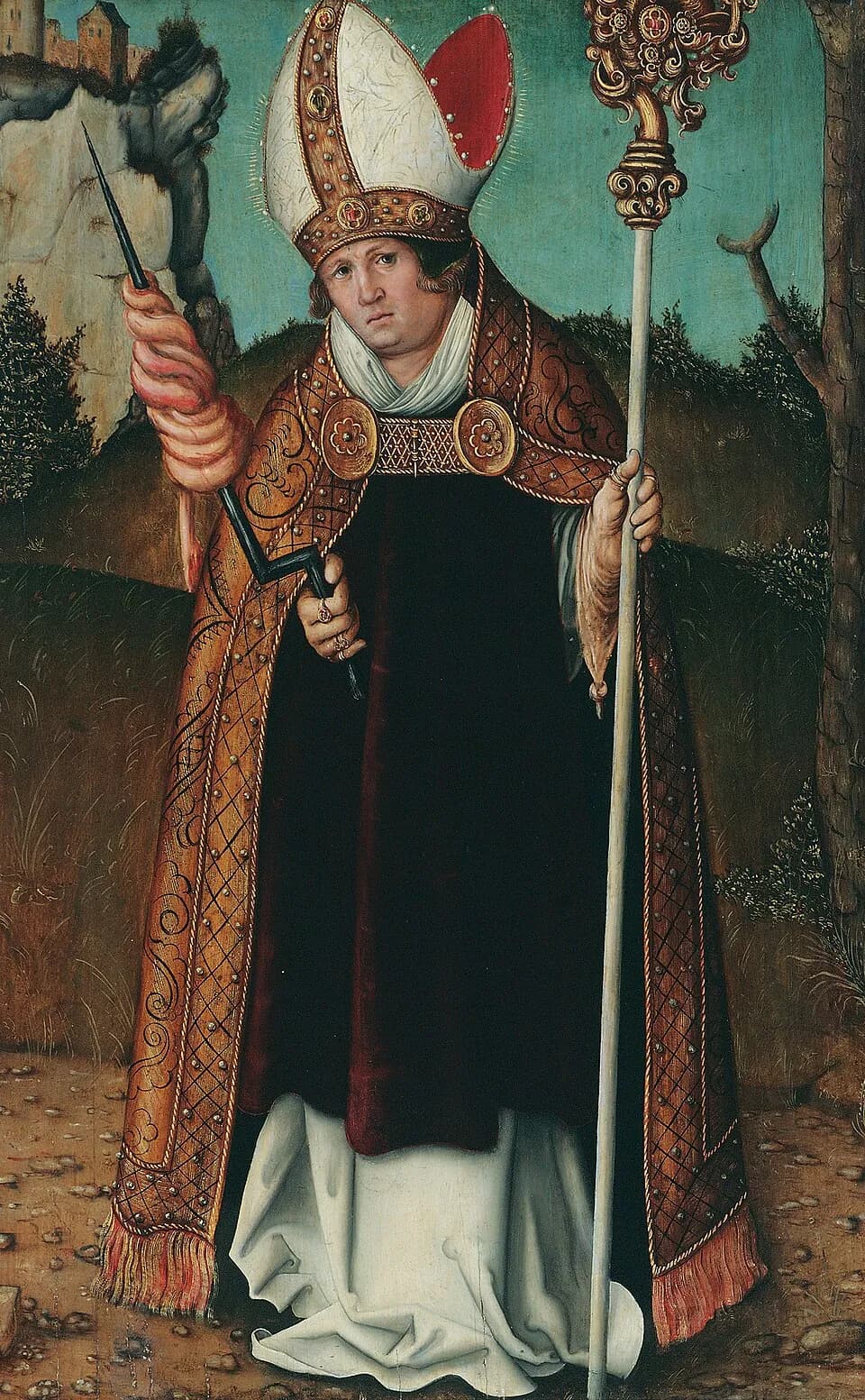
It is also how artists showed him. Catholic Culture lists his emblems as a windlass or capstan wound with his intestines, a ship, ravens with bread, a cauldron of molten lead and red-hot armor. 4 FaithND notes that, as with many martyrs, he is painted holding the instrument of his death. 7 The panel above, from about 1510, shows him in a bishop's cope and miter with the windlass in one hand and his crozier in the other.
Saint Elmo and Saint Elmo's fire
FaithND says his name "morphed into St. Elmo as it was passed along." 7 A note on New Advent's transcription of the Catholic Encyclopedia puts it more precisely: "Elmo" (or "Telmo") "belongs properly to the martyr-bishop St. Erasmus (d. c. 303), one of the Fourteen Holy Helpers, of whose name 'Elmo' is a contraction." 3
The name has a second owner. Peter Gonzalez, a thirteenth-century Dominican who preached to the mariners of Galicia, was also called Saint Elmo, and the Holy See lists "Blessed Pietro Gonzales (died 1246), called St Elmo or Telmo, by the seafarers of Spain and Portugal" directly after Erasmus. 13 The New Advent note explains the overlap: Erasmus is patron of sailors in general and Peter Gonzalez of Spanish and Portuguese sailors, so both "have been popularly invoked as 'St. Elmo.'" 3
Saint Elmo's fire is the light itself. Francis Mershman, writing in 1911, describes it as "a pale electrical discharge sometimes seen on stormy nights on the tips of spires, about the decks and rigging of ships," most often at the mastheads and yardarms, and says sailors took the lights for the souls of the dead. 3 Catholic Culture says the phenomenon is named after Erasmus. 4 FaithND says sailors who saw it dancing in the rigging during a storm took it "as a sign of St. Erasmus' protection." 7
One of the Fourteen Holy Helpers
The Fourteen Holy Helpers are a group of saints invoked together "because they have been efficacious in assisting in trials and sufferings," Catholic Culture explains, and devotion to them as a group grew mainly out of the Black Death of 1346 to 1349. 6 Its victims could die within hours and often without the last sacraments, and people prayed to these saints to be spared or cured. 6 FaithND gives the same origin, calling them a band of saints whose intercession was asked "around the time of the bubonic plague." 7
Erasmus is one of three bishops among them, with Blaise and Denis. 6 Each kept his own feast, and the group as a whole was kept on August 8 until the 1969 reform of the Roman calendar, when that feast was dropped. 6 All of the fourteen except Giles were martyrs. 6
There is an American thread to this. FaithND records that relics of Saint Erasmus rest in the reliquary chapel of the basilica at Notre Dame. 7
What is Saint Erasmus the patron saint of?
Above all, the sea. The Holy See counts him among the saints "widely recognised as Patron saints of maritime people." 1 Catholic Culture lists boatmen, mariners, navigators, sailors and watermen, along with danger at sea, seasickness and storms. 4 FaithND calls him patron of "those who make their living at sea." 7
He is also invoked for illness of the stomach and bowel: abdominal pain, appendicitis, colic and intestinal disorders in Catholic Culture's list, and intestinal disorders in FaithND's. 47 Both add women in labor, and Catholic Culture adds childbirth and birth pains. 47 Catholic Culture's list also includes ammunition, explosives and ordnance workers, and its article on the Holy Helpers adds protection for domestic animals. 46 Both sources connect the bodily patronages to the legend of the windlass. 47
Saint Erasmus's feast day
His feast is June 2. 46 Catholic Culture says the Roman Martyrology commemorates him on that day, and its article on the Holy Helpers gives June 2 as his traditional feast. 46 For 2014 the same site noted that, according to the 1962 Missal, June 2 is the feast of Saint Erasmus. 5 The Holy See page dates his death to the same day, June 2, 303. 1
He shares the day with Saints Marcellinus and Peter, Roman martyrs whose optional memorial is the one kept on June 2 in the current calendar. 4 Vatican News gives its Saint of the Day for June 2 to Marcellinus and Peter and does not list Erasmus. 8
Praying with Saint Erasmus
Very little of this life can be checked. A bishop of Formia died a martyr, in 303 by most of the sources' reckoning, and his relics were later carried from Formia to Gaeta. 124 The rest, the raven, the angel, the cauldrons and the windlass, comes from legend, and the sources that tell it say so. 47
What can be checked is how people have used his name. Sailors who used the ports of Formia and Gaeta called on him, and the light that plays on a ship's masts in a storm came to carry his name. 47 During the Black Death people prayed to him and thirteen other saints when there was nothing else to do. 6 The devotion is old, and it was a devotion of people in danger.
The windlass deserves to be faced as well. Whatever happened at Formia, the image the Church's artists settled on was a man holding the tool of his own suffering. 47 People with pain in their bodies, and women in labor, have prayed to him because of it. 47 The sources do not turn that into a promise, and neither does this page.
Saint Erasmus, pray for us.
Sources
- 1."Patron Saints of the Sea," People of the Sea, Pontifical Council for the Pastoral Care of Migrants and Itinerant People, Holy See.
- 2.Umberto Benigni, "Gaeta," The Catholic Encyclopedia, Vol. 6 (New York: Robert Appleton Company, 1909).
- 3.Francis Mershman, "St. Peter Gonzalez," The Catholic Encyclopedia, Vol. 11 (New York: Robert Appleton Company, 1911), with the editorial note added on New Advent.
- 4."Monday of the Seventh Week of Easter; Opt. Mem. of Sts. Marcellinus and Peter, Martyrs - June 02, 2025," Liturgical Year, Catholic Culture.
- 5."Optional Memorial of Sts. Marcellinus and Peter, martyrs - June 02, 2014," Liturgical Year, Catholic Culture.
- 6.Jennifer Gregory Miller, "Fourteen Holy Helpers," Liturgical Year: Activities, Catholic Culture.
- 7."St. Erasmus," Explore the Saints, FaithND, University of Notre Dame.
- 8."02 June," Saint of the Day, Vatican News.
Saints to turn to next
Others in this collection who are turned to for some of the same things.