Saint James the Greater
First century - A.D. 44
- Patron saint of
- Chile, laborers, Nicaragua, rheumatism sufferers, and Spain 3
- Feast day
- July 25 3
- Family
- Son of Zebedee and Salome; brother of Saint John the Evangelist 2
- Called "the Greater"
- To distinguish him from the apostle James "the Less", "who was probably shorter of stature" 2
Saint James was the first of the apostles to be killed, beheaded at Jerusalem around the year 44 on the orders of Herod Agrippa I. 123 Acts gives the death a single clause and no details, which Benedict XVI reads as a sign of how ordinary it had already become for Christians to witness with their lives. 1 He is also the reason for the pilgrimage to Santiago de Compostela - and the tradition that put him in Spain is one his own encyclopedia treats with open doubt. 2
A son of thunder
James was the son of Zebedee and Salome and the elder brother of John - elder because his name almost always comes first. 2 The family was not poor: Zebedee had hired men working the boats on the Lake of Galilee, and Salome was among the women who later followed Jesus and supported the work out of their own means. 2 Franciscan Media quotes the call itself from Mark: "He walked along a little farther and saw James, the son of Zebedee, and his brother John. They too were in a boat mending their nets. Then he called them. So they left their father Zebedee in the boat along with the hired men and followed him." 3
Jesus nicknamed the two brothers Boanerges, sons of thunder, and the encyclopedia connects it to a temper it calls Galilean - "burning and impetuous in their evangelical zeal and severe in temper." 2 The evidence is in the Gospels. When a Samaritan village would not receive Jesus, the two of them asked whether they should call down fire from heaven and consume it. 23 They also tried to stop a man casting out devils in Jesus' name on the grounds that he was not one of the group. 2
The two mountains
James belonged with Peter and John to the three disciples taken along to the things nobody else saw: the raising of Jairus' daughter, the Transfiguration, and the agony in Gethsemane. 123
Benedict XVI made the last two into the shape of James' whole life. They are, he said, "situations very different from each other." On the mountain James "experiences the Lord's glory and sees him talking to Moses and Elijah"; in the garden "he finds himself face to face with suffering and humiliation, he sees with his own eyes how the Son of God humbles himself, making himself obedient unto death." The second was the education. It forced him "to adjust the unilateral, triumphalist interpretation of the former experience," and to discern that the Messiah his people were waiting for as a victor "was in fact not only surrounded by honour and glory, but also by suffering and weakness." 1
The request, and the answer
On the last journey to Jerusalem their mother came to Jesus and asked that her two sons might sit at his right and his left in the kingdom. Matthew gives the request to Salome; Mark has the brothers ask it themselves; and by either account the two of them wanted it. 23 Jesus answered with a question: could they drink the cup he was about to drink? They said they could. 3
They were told they would indeed drink it, and that the seats were not his to hand out. 3 The other ten were furious, and Franciscan Media notes what Jesus did with their anger - he taught the whole group that authority exists to serve, and that they were not to lord it over anyone. 3
Benedict put the outcome in a single sentence: the man "who initially had requested, through his mother, to be seated with his brother next to the Master in his Kingdom, was precisely the first to drink the chalice of the passion and to share martyrdom with the Apostles." 1 The ambition was answered literally and not at all in the way it was meant.
The first apostle to be killed
Herod Agrippa I, grandson of Herod the Great, ruled a wider territory than his grandfather had and wanted very much to please his Jewish subjects. At the Passover of A.D. 44 he moved against the Church, and the zeal and prominence of James probably made him the obvious first choice. 2 Luke reports it in one line: "He killed James, the brother of John, with the sword." 12
Benedict draws attention to the brevity itself. The notice is "devoid of any narrative detail," which shows "how normal it was for Christians to witness to the Lord with their own lives" and, at the same time, that James held a position of real weight in the church at Jerusalem. 1
One further tradition the encyclopedia is willing to credit comes through Eusebius from Clement of Alexandria: the man who informed on James was so moved by his confession that he became a Christian himself, and the two were beheaded together. Because Clement says he had it "by those who were before him," the article rates this "a better foundation than many other traditions and legends" about James. 2
Spain, and what is doubted about it
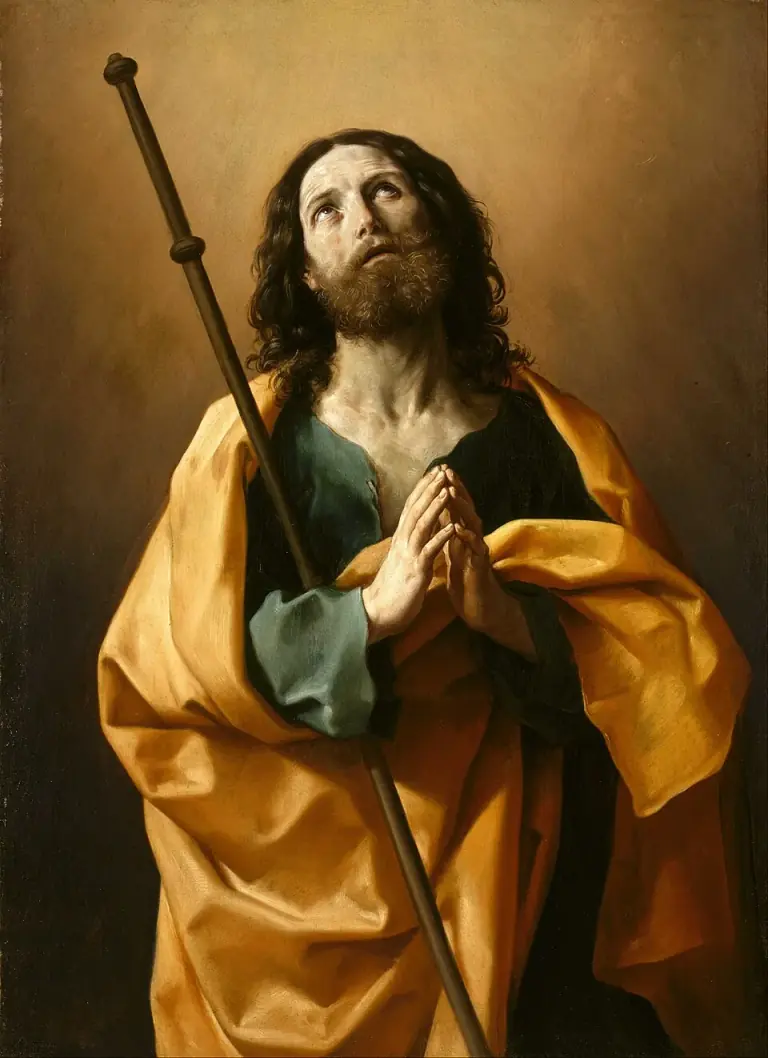
Two traditions carry James to Spain. Benedict names both: one, "dating back at least to Isidore of Seville," that he went there himself to evangelize; the other that it was his body which was taken there, to Santiago de Compostela. 1 Compostela "became the object of great veneration and is still the destination of numerous pilgrimages, not only from Europe but from the whole world," and it is why James is painted with a pilgrim's staff and a scroll of the Gospel, "typical features of the travelling Apostle." 1
The encyclopedia takes the preaching claim seriously enough to examine it, and finds against it. James was martyred in 44, and by the testimony of the early Church he had not yet left Jerusalem. Paul, writing to the Romans in about 58, planned to visit Spain and had just said he did not build on another man's foundation. And there is the silence: although the tradition was current by the year 700, "no certain mention of such tradition is to be found in the genuine writings of early writers nor in the early councils," the first firm mentions coming in the ninth century. "The tradition was not unanimously admitted afterwards, while numerous scholars reject it." 2
On the relics the article is equally direct: "The authenticity of the sacred relic of Compostela has been questioned and is still doubted." It notes that even if he never preached in Spain his body might still have been brought there, that another tradition puts his relics at Toulouse instead, and that a strong argument on the Compostela side is the bull "Omnipotens Deus" of Leo XIII, dated 1 November 1884. 2 The vow of pilgrimage to Compostela is reserved to the pope, who alone can dispense anyone from it by ordinary right. 2
None of that has ever emptied the road. What the encyclopedia doubts is a chain of custody; what the pilgrimage rests on is a shrine that has drawn people across a continent for more than a thousand years. 12
What is Saint James the Greater the patron saint of?
Franciscan Media lists Saint James the Greater as the patron saint of Chile, laborers, Nicaragua, rheumatism sufferers, and Spain. 3 Spain is Compostela. Laborers is the boat, the nets and the hired men he walked away from, which is a working man's biography before it is anything else. 23 The rheumatism patronage is stated without an explanation, and none is invented here.
Saint James the Greater's feast day
Praying with Saint James
James asked for a throne and got a sword, fourteen years later. 2 Benedict does not soften that; he presents it as the answer arriving in full, in a form the man who asked would not have recognized. 1 Prayers are sometimes granted along their own logic rather than ours, and the gap between the two is where most of the spiritual life actually happens.
He is one of the apostles we know least about and one of the most traveled to. There is no writing, no long ministry, no deathbed scene - a temper, a mountain, a garden, and a clause in Acts. 12 Compostela has drawn pilgrims from the whole world regardless, and still does. 1 Nobody seems to have needed a detailed biography in order to set out.
His mother asked for the seats on his behalf, which is worth noticing if you have ever wanted something for your children and asked God for it in those terms. Salome was not rebuked. She was told she did not know what she was asking, and she stayed with the group; the encyclopedia has her among the women at the cross and at the tomb. 23
Benedict's summary of what to learn from him is unusually concrete: "promptness in accepting the Lord's call even when he asks us to leave the 'boat' of our human securities," and "readiness to witness to him with courage, if necessary to the point of making the supreme sacrifice of life." 1 The boat had hired men in it and a father sitting in the stern, and James left it in the middle of a working day. 23
Saint James the Greater, pray for us.
Sources
Saints to turn to next
Others in this collection who are turned to for some of the same things.