Saint Amos the Prophet
Eighth century BC; date of death unknown
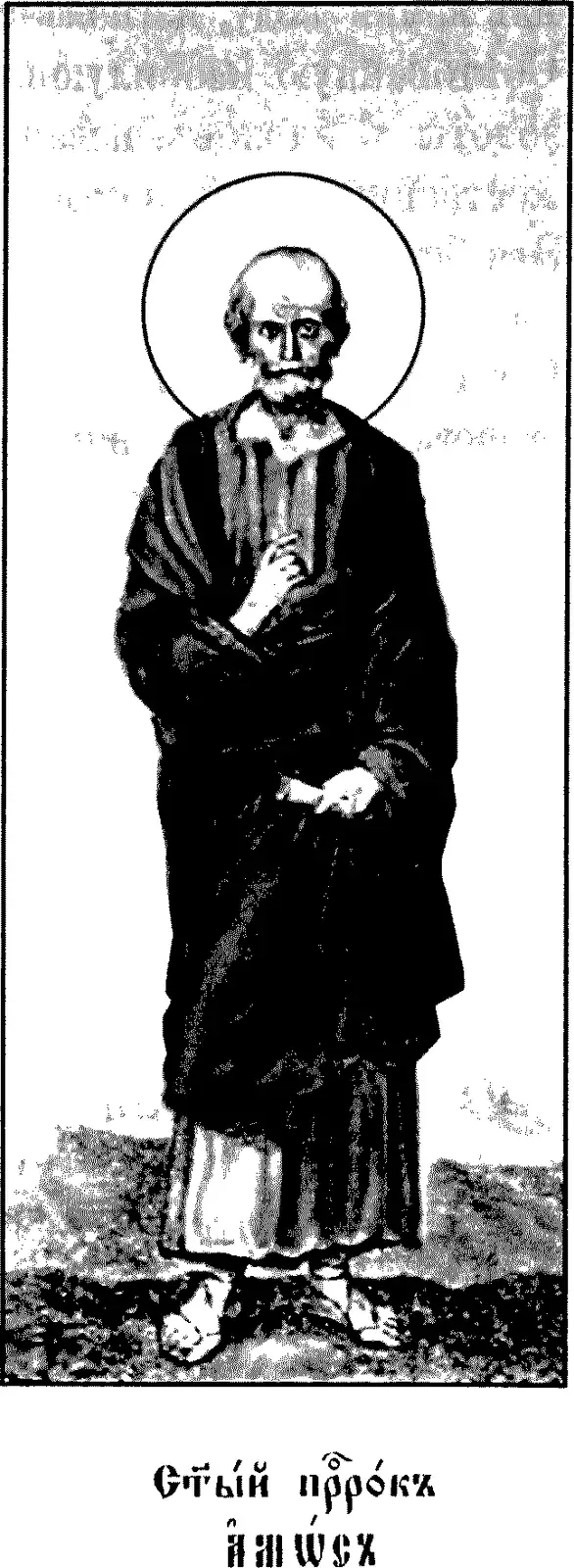
- Not to be confused with
- Amoz, the father of Isaiah, whose name is spelled differently in Hebrew 1
- Prophesied
- At Bethel, in the northern kingdom of Israel, under Uzziah of Judah and Jeroboam II of Israel; Jeroboam reigned about 781-741 BC (Gigot) or 786-746 BC (the New American Bible) 123
Saint Amos was a herdsman from the village of Tekoa in Judah, called away from his flock in the eighth century before Christ to preach in the rich northern kingdom of Israel. 129 He told a nation that believed God was pleased with it that its feasts were hateful to the Lord while it sold "the just man for silver, and the poor man for a pair of shoes." 147 His book is probably the oldest prophetic writing to survive. 1 The Roman Martyrology commemorates him on June 15. 13
Who was the prophet Amos?
His book opens with "the words of Amos, who was among herdsmen of Thecua," the village the New American Bible calls Tekoa. 23 Francis Gigot, writing in the Catholic Encyclopedia in 1907, places it in the southern kingdom of Judah, twelve miles south of Jerusalem, and calls it a shepherds' town. 1 Amos also describes himself as a dresser of sycamore trees, and the current Roman Martyrology remembers him by both trades. 113 Most Jewish interpreters, Gigot notes, thought him a wealthy man; he sees no sufficient ground for it. 1
He is easily confused with Amoz, the father of Isaiah, since the two names look alike in English. In Hebrew they are spelled differently, and Gigot says Christian tradition has "for the most part, rightly distinguished between the two." 1
"I am not a prophet"
Amos tells the story of his call in a few words, spoken under pressure: "I am not a prophet, nor am I the son of a prophet: but I am a herdsman plucking wild figs. And the Lord took me when I followed the flock, and the Lord said to me: Go, prophesy to my people Israel." 9 Challoner's note explains that he meant he was not a prophet by education or by profession. 9 Gigot reads it the same way: Amos had never attended the schools where young men trained for the prophetic office were called "the sons of a prophet." 1
He was also a southerner, sent across the border with a message of judgment, and Gigot thinks the humble shepherd must have found it "a most difficult mission." 1
Israel under Jeroboam II
The kingdom he was sent to had seldom done better. Jeroboam II, who reigned about 781 to 741 BC by Gigot's reckoning and 786 to 746 by the New American Bible's, had conquered Syria, Moab and Ammon and restored nearly all of Solomon's northern empire. 12 Samaria, the capital, was full of fine buildings, and comfort and luxury reached a height not seen since the kingdom divided. 1
Religion looked healthy too. Sacrifices were offered with great pomp, and the long prosperity was taken as a sure sign of God's pleasure. 1 Under it, Gigot says, lay the oppression of the poor and helpless, sacrifice offered with no thought for the heart, and pagan cults mixed into the worship of the Lord. 1 To that people, "thoroughly convinced that God was well-pleased with them," Amos was sent with "a stern rebuke for all their misdeeds," and with the news of coming ruin and captivity. 1
"For three crimes, and for four"
The book opens with a series of oracles against Israel's neighbors, each beginning with the same formula. "For three crimes of Damascus, and for four I will not convert it," and so on through Gaza, Tyre, Edom, Ammon and Moab. 34 Gigot points out that the nations are condemned for breaking "the elementary and unwritten laws of natural humanity and good faith," such as ripping open pregnant women to enlarge a border. 13
An Israelite audience would have agreed with every word. Then the formula turns on Judah, and finally on Israel itself, the target of what the New American Bible calls the herdsman's "climactic denunciation." 24 Israel's crime: "he hath sold the just man for silver, and the poor man for a pair of shoes. They bruise the heads of the poor upon the dust of the earth, and turn aside the way of the humble." 4
Beds of ivory and hollow feasts
The middle of the book, Gigot says, presses the charge against the upper classes, against "the heartless luxury and self-indulgence of the wealthy ladies of Samaria," and against confidence in religious duties done only outwardly. 1 Amos addresses the women as "ye fat kine that are in the mountains of Samaria: you that oppress the needy, and crush the poor." 6 He warns those "that sleep upon beds of ivory" and drink wine in bowls but "are not concerned for the affliction of Joseph." 8
The best-known words in the book are about worship. "I hate, and have rejected your festivities: and I will not receive the odour of your assemblies." 7 "But judgment shall be revealed as water, and justice as a mighty torrent." 7 Gigot is careful about what this means: Amos does not deny that sacrifice should be offered, but insists that the merely outward offering of it cannot please God. 1
Leo XIV, in his 2025 exhortation on love for the poor, names Amos and Isaiah as the prophets through whom God denounced the injustices done to the weakest, calling Israel to renew its worship from within, "because one cannot pray and offer sacrifice while oppressing the weakest and poorest." 16
Amasias at Bethel
The last part of the book is mostly visions. In the first two, of locusts and of fire, Amos pleads, "O Lord God, be merciful, I beseech thee: who shall raise up Jacob, for he is very little?" and the Lord relents. 9 In the third there is no reprieve. The Douay-Rheims reads a mason's trowel in the Lord's hand; Gigot, following the Hebrew, a plumb-line. 19 The fourth is a hook for drawing down fruit in the Douay, a basket of summer fruit in Gigot, and its meaning is the same in both: "The end is come upon my people Israel." 110
Between the visions stands the one story told about him. Amasias, the priest of the royal sanctuary at Bethel, sent word to King Jeroboam that "Amos hath rebelled against thee in the midst of the house of Israel: the land is not able to bear all his words." 9 Then he told the prophet to go home: "Thou seer, go, flee away into the land of Juda: and eat bread there, and prophesy there. But prophesy not again any more in Bethel: because it is the king's sanctuary." 9 Amos answered with the account of his call. 9 The New American Bible says the priest drove him from the shrine. 2
What happened next is not known. The 1897 English Martyrology says that Amasias had him beaten many times and that the priest's son drove an iron spike through his temples, and that he was carried half dead to Tekoa, where he died and was buried with his fathers. 14 Gigot calls the stories of his martyrdom "late and untrustworthy legends," and thinks it more probable that Amos obeyed the order, went back to Judah, and there put his oracles into the careful order they have now. 1 The current Martyrology says nothing of his death. 13
The tabernacle of David
Amos foresaw a worse hunger than the one that follows a failed harvest: "not a famine of bread, nor a thirst of water, but of hearing the word of the Lord." 10 Yet the book does not end in ruin. Its last verses promise, "In that day I will raise up the tabernacle of David, that is fallen: and I will close up the breaches of the walls thereof." 11 The New American Bible calls the passage a perspective of restoration under a Davidic king, and Gigot says its Messianic bearing "will be readily admitted by all who believe in the existence of the supernatural." 12
The apostles read it that way. At the Council of Jerusalem, when the question was whether Gentile converts had to keep the Law of Moses, James answered by quoting this prophecy: "After these things I will return, and will rebuild the tabernacle of David, which is fallen down," so "that the residue of men may seek after the Lord, and all nations upon whom my name is invoked." 12
A herdsman's book
Gigot says the book is universally admitted to be written in a style of "high literary merit," and he does not think that strange for a shepherd. 1 He also notes how much of the imagery comes from country life: the loaded wagon, the lion growling over its prey, the bird and the snare, the shepherd who pulls two legs or the tip of an ear out of the lion's mouth. 15
"The lion shall roar, who will not fear? The Lord God hath spoken, who shall not prophesy?" 5 For Gigot, the teaching beneath the images is a pure monotheism: the Lord of hosts rules the nations and the stars, and punishes the crimes of all people, the chosen people included. 1
What is Saint Amos the patron saint of?
Saint Amos's feast day
Saint Amos's feast day is June 15. The Roman Martyrology, in the text published by the Italian bishops, commemorates him that day as the herdsman of Tekoa whom the Lord sent to Israel to uphold his justice and holiness. 13 The Byzantine Catholic Menaion of the Archeparchy of Pittsburgh keeps him on June 15 too, and its kontakion has him stand up and cry out, "This is our God, and you shall have none before him." 15
The older Roman Martyrology kept him on March 31. The 1897 English edition has him on that day, with the account of his death at Tekoa. 14
Praying with Saint Amos
Amos had no training for what he was asked to do. He was following his flock when the Lord took him, and when a priest told him to go home he answered simply that he was a herdsman who had been sent. 9 Nothing in the book suggests he sought the work.
He was sent to people who were doing well and believed it proved God's favor. 1 The worship was splendid and the poor were being sold for the price of a pair of shoes, and Amos said the Lord would not hear the songs while that went on. 47
He also prayed for the people he was condemning. Twice in his visions he asked the Lord to spare Jacob because he was so small, and twice the Lord relented. 9 The third time there was no reprieve, and Amos did not hide that either. 9
He was expelled from Bethel, and how he died is not known. 12 The promise at the end of his book, a fallen house of David raised up again, was the text James chose when the Church first opened its doors to the nations. 1112
Saint Amos the Prophet, pray for us.
Sources
- 1.Francis E. Gigot, "Amos," The Catholic Encyclopedia, vol. 1 (New York: Robert Appleton Company, 1907).
- 2.Introduction to the Book of Amos, The New American Bible, as hosted by the Holy See.
- 3.Amos 1, Douay-Rheims Bible, Challoner revision, as hosted by drbo.org.
- 4.Amos 2, with Challoner's notes, Douay-Rheims Bible, as hosted by drbo.org.
- 5.Amos 3, Douay-Rheims Bible, Challoner revision, as hosted by drbo.org.
- 6.Amos 4, Douay-Rheims Bible, Challoner revision, as hosted by drbo.org.
- 7.Amos 5, Douay-Rheims Bible, Challoner revision, as hosted by drbo.org.
- 8.Amos 6, Douay-Rheims Bible, Challoner revision, as hosted by drbo.org.
- 9.Amos 7, with Challoner's notes, Douay-Rheims Bible, as hosted by drbo.org.
- 10.Amos 8, Douay-Rheims Bible, Challoner revision, as hosted by drbo.org.
- 11.Amos 9, Douay-Rheims Bible, Challoner revision, as hosted by drbo.org.
- 12.Acts of the Apostles 15, Douay-Rheims Bible, Challoner revision, as hosted by drbo.org.
- 13.Roman Martyrology, entry for June 15, "Sant'Amos, profeta," Santo del giorno, Conferenza Episcopale Italiana (in Italian).
- 14.The Roman Martyrology, March 31 (Baltimore: John Murphy Company, 1897).
- 15."Menaion - June 15," Metropolitan Cantor Institute, Byzantine Catholic Archeparchy of Pittsburgh.
- 16.Leo XIV, Apostolic Exhortation Dilexi te, on love for the poor, no. 17, October 4, 2025, Libreria Editrice Vaticana.
Saints to turn to next
Others in this collection who are turned to for some of the same things.
- Saint BarnabasFirst centuryCourageWork and vocationPoverty and simplicity
- Saint Clement Mary HofbauerDecember 26, 1751 - March 15, 1820Work and vocationCouragePoverty and simplicity
- Saint Frances Xavier CabriniJuly 15, 1850 - December 22, 1917CouragePoverty and simplicityWork and vocation
- Saint François de LavalApril 30, 1623 - May 6, 1708CourageWork and vocationPoverty and simplicity