Saint Frances Xavier Cabrini
July 15, 1850 - December 22, 1917
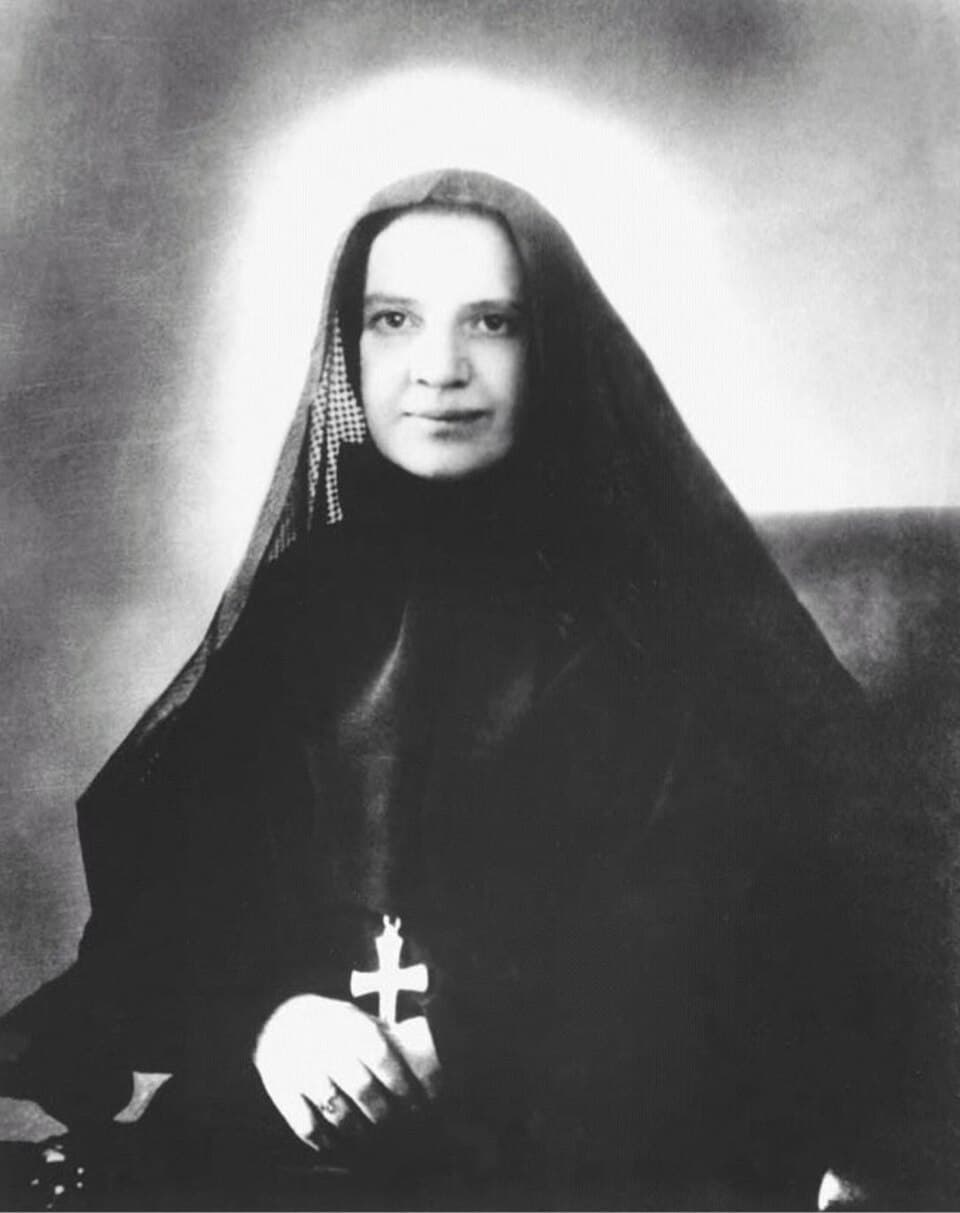
- Patron saint of
- Hospital administrators, immigrants, and impossible causes 2; proclaimed patroness of emigrants by Pius XII in 1950 13
Saint Frances Xavier Cabrini wanted to be a missionary in China, and Pope Leo XIII sent her to New York instead, to the Italian immigrants crowding into American cities. 23 She was afraid of water all her life and crossed the Atlantic dozens of times anyway, founding 67 institutions for the poor, the sick and the abandoned before she died in Chicago in 1917. 2 She was the first citizen of the United States to be canonized, and the Church has named her patroness of immigrants. 12
An orphan from Lombardy
She was born Maria Francesca Cabrini on July 15, 1850, in Sant'Angelo Lodigiano in Lombardy, and was baptized the same day into what John Paul II called a family rich in faith and piety. 13 She was left an orphan young. 1
She wanted to enter a convent and was turned away because of her poor health. 1 Franciscan Media adds that the refusal came from the very order that had trained her as a teacher. 2 She qualified as a teacher anyway and went to work at the House of Providence, an orphanage in Codogno. 123 John Paul II calls that house the turning point of her life, a place where "tribulations and difficulties" strengthened her missionary fervor and her resolve to give herself entirely to God. 3 She made her vows there in September 1877 and took the religious habit. 2
Francis Xavier, the Jesuit who carried the Gospel to Asia, had been her model since childhood, and when she made her vows she added his name to her own. 135
Founding the Missionary Sisters of the Sacred Heart
In 1880 the bishop closed the orphanage and named Frances prioress of a new community, the Missionary Sisters of the Sacred Heart. Seven young women from the orphanage went with her. 2 John Paul II names the bishop as Domenico Maria Gelmini of Lodi and says the sisters began in an old Franciscan monastery, first under the name "Salesian Missionaries of the Sacred Heart", with diocesan approval in 1881. 3 The 1912 Catholic Encyclopedia gives the aim of the institute as spreading devotion to the Heart of Jesus through the spiritual and corporal works of mercy. 7
The community grew quickly. It opened a house in Rome and received papal approval as the Missionaries of the Sacred Heart of Jesus on March 12, 1888, scarcely eight years after its founding. 3 Pope Francis saw something unusual in it for its time: she meant to train women and send them anywhere in the world, "not just as auxiliaries of religious institutes or male missionaries but with their own charism as consecrated women religious." 4
"Not to the East, but to the West"
Her heart was set on China. 25 Leo XIII changed her direction with one sentence, which Pope Francis quotes in the form "Not to the East, Cabrini, but to the West!" 5 The West meant the United States, where Italians were arriving by the thousands, often in extreme poverty and without the language. 3 Francis calls the redirection "the example of a true vocation": she went where God had prepared the way, which was not where she had wanted to go. 5
She sailed for New York with six sisters. 2 The house that was supposed to become her first American orphanage turned out not to be available, and the archbishop advised her to go back to Italy. Franciscan Media records that she left his residence more determined than when she arrived, and opened the orphanage. 2
Thirty-five years on the move
Over the next thirty-five years she founded 67 institutions for the poor, the abandoned, the uneducated and the sick. 2 Pope Francis lists them as shelters, schools, colleges, hospitals, orphanages and workshops, made "out of nothing", and describes a "whirlwind life" of journeys on foot, by train, ship, boat and horse. 5 John Paul II traces her across the United States from New York to New Jersey, Pennsylvania, Illinois, California, Louisiana and Colorado, and abroad to Nicaragua, Brazil and Argentina as well as France, Spain and England. 3 Francis adds that she pushed as far as the Andes. 5
She had been frightened of water since childhood and never got over her fear of drowning. 2 Franciscan Media counts more than 30 Atlantic crossings; Pope Francis, in his centenary address, says she crossed the ocean "some 24 times". 25
She went where Italians were least welcome. One year after the lynching of Italians accused of murdering the chief of police in New Orleans, she opened a house in the city's most notorious Italian quarter. 4 John Paul II says she reached immigrants everywhere, "in hovels, prisons and mines". 3 Pope Francis names the needs of orphans and miners as examples of the poverty and fragility she gave her attention to. 4
She also had a clear idea of what she was doing for them. Francis writes that she tried to keep alive the faith the immigrants had brought from home while helping them settle into their new country, so that her sisters accompanied them "in becoming fully Italian and fully American." 4 She took American citizenship herself. 23
The 1912 encyclopedia, written while she was still alive, gives a snapshot of the work at the start of 1911: in the United States alone, 253 sisters, eleven schools with 4,850 pupils, six orphanages with 713 orphans, and two hospitals treating about 3,520 patients a year. 7
Her motto and her hurry
She took her motto from Saint Paul: "I can do all things in him who strengthens me" (Philippians 4:13). 35 John Paul II quotes a line of hers that explains the pace: "The Heart of Jesus does things in such a hurry that I can barely keep up with him". 3 He adds that her activity drew its strength from prayer, especially long periods before the tabernacle. 3
The devotion at the root of it was to the Sacred Heart, the name she gave her congregation. Pope Francis describes a missionary consecration born from her union with the Heart of Christ, "whose compassion surpasses all limits", and says she passed on to her sisters a desire to make reparation for the ills of the world that carried them through tasks beyond human strength. 4 In his address a few months later he put it more simply: hers was a life offered entirely to make the Sacred Heart known and loved, and that is what let her look into the hearts of the people she helped. 5
He also named what that looked like in practice. "Mother Cabrini had the courage to look into the eyes of the orphaned children who were entrusted to her care, the unemployed young people who were tempted to commit crimes, the men and women exploited through the most humble labour," he said, and in each of them she recognized the face of Christ. 5
Death in Chicago
She died in Chicago on December 22, 1917, in Columbus Hospital, one of the hospitals she had built for immigrants. 123 Franciscan Media gives the cause as malaria. 2 Pope Francis says she died suddenly, and the English text of his 2017 address dates her death to December 17. 5 Her remains were later moved to Mother Cabrini High School in New York. 1
Pius XI beatified her in 1938, twenty-one years after her death, and Pius XII canonized her on July 7, 1946. 13 In the Holy Year of 1950 he proclaimed her patroness of emigrants. 13
What is Saint Frances Xavier Cabrini the patron saint of?
Saint Frances Xavier Cabrini is the patron saint of immigrants. Pius XII named her "Celestial Patroness of all Emigrants" in 1950, and popes since have called her by that title: Benedict XVI asked for her intercession as "Patroness of migrants" on the World Day of Migrants and Refugees in 2007, and Pope Francis calls her "Patron Saint of Immigrants". 1346 Franciscan Media also lists her as patron of hospital administrators and of impossible causes. 2
John Paul II, marking the fiftieth anniversary of the 1950 proclamation, called her a "little woman" who, by defending the dignity of those forced to live far from their own country, had become "an indomitable peacemaker". 3
Saint Frances Xavier Cabrini's feast day
Praying with Saint Frances Cabrini
She did not get the mission she asked for. She had wanted China since she was a girl, and the Pope sent her the other way. 25 Pope Francis treats that as the center of her vocation: she had to open her eyes to where God was sending her, which was somewhere she had not planned to go. 5 Her life is a fair answer for anyone whose plans have been overruled, and it does not suggest the disappointment was small.
She was afraid of the sea and crossed it again and again. 2 Courage in her case looks less like the absence of fear than like booking the next passage regardless. The archbishop in New York told her to go home, and she opened the orphanage. 2
The people she served were the ones nobody wanted: orphans, miners, prisoners, Italians in a city that had just lynched Italians. 34 Pope Francis, speaking to her sisters a century after her death, said migrants need good laws and programs, and "also need, always and first and foremost, love, friendship, human closeness; they need to be listened to, looked in the eye, accompanied". 5
Everything she built rested on prayer before the tabernacle and a line from Saint Paul she made her own. 3 Pope Francis writes that "I can do all things in Him Who strengthens me" was borne out by the number and importance of her works. 4 Sixty-seven foundations in thirty-five years, from a woman whose health had once kept her out of a convent, is what that verse looked like in one life. 12
Saint Frances Xavier Cabrini, pray for us.
Sources
- 1."St. Francesca Saverio Cabrini, Virgin, Foundress of the Missionaries of the Sacred Heart of Jesus," Saint of the Day, Vatican News.
- 2."Saint Frances Xavier Cabrini," Saint of the Day, Franciscan Media.
- 3.John Paul II, Message to the Congregation of the Missionaries of the Sacred Heart, 31 May 2000.
- 4.Francis, Letter to the participants in the General Assembly of the Missionaries of the Sacred Heart of Jesus on the centenary of the death of Saint Frances Xavier Cabrini, 29 August 2017.
- 5.Francis, Address to the Missionary Sisters of the Sacred Heart of Jesus on the 100th anniversary of the death of Saint Frances Xavier Cabrini, 9 December 2017.
- 6.Benedict XVI, Angelus, 14 January 2007 (World Day of Migrants and Refugees).
- 7.Andrew MacErlean, "Missionary Sisters of the Sacred Heart of Jesus," The Catholic Encyclopedia, Vol. 13 (New York: Robert Appleton Company, 1912).
Saints to turn to next
Others in this collection who are turned to for some of the same things.
- Saint BarnabasFirst centuryCourageWork and vocationPoverty and simplicity
- Saint Katharine DrexelNovember 26, 1858 - March 3, 1955Poverty and simplicityWork and vocationCourage
- Saint Mary MacKillopJanuary 15, 1842 - August 8, 1909CouragePoverty and simplicityWork and vocation
- Saint LukeFirst centuryWork and vocationPoverty and simplicity