Saint Katharine Drexel
November 26, 1858 - March 3, 1955
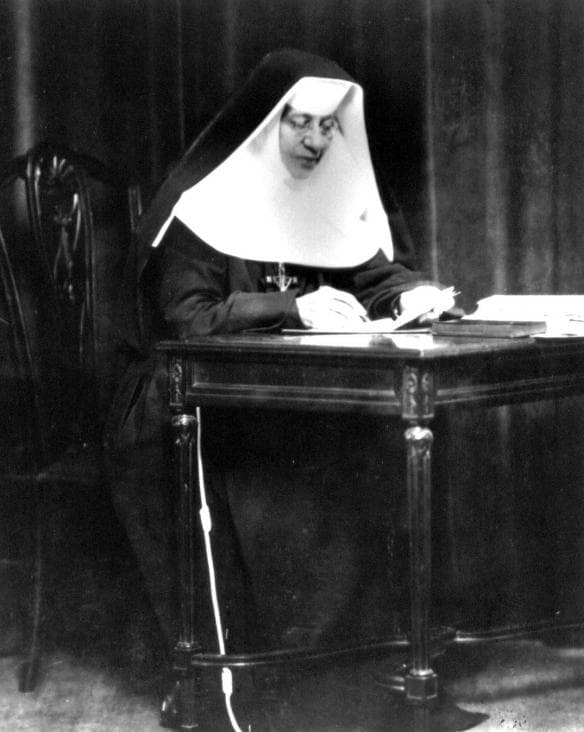
- Feast day
- March 3 3
- Parents
- Francis Anthony Drexel, a banker and philanthropist, and Hannah Langstroth 2
- Canonized
- October 1, 2000, by Pope John Paul II 1
Saint Katharine Drexel was a Philadelphia banker's daughter who gave away an inheritance in the millions and spent it on schools and missions for Native Americans and Black Americans. 23 She founded the Sisters of the Blessed Sacrament for that work, opened Xavier University in New Orleans, and spent nearly two decades at the end of her life almost entirely in prayer. 23 John Paul II canonized her on October 1, 2000, calling her an example of "practical charity and generous solidarity with the less fortunate." 1
A rich girl in Philadelphia
Katharine Drexel was born in Philadelphia on November 26, 1858, the second daughter of Francis Anthony Drexel and Hannah Langstroth. 2 Her father was a well-known banker and philanthropist; Franciscan Media calls him an international banker and notes that the family traveled in a private railroad car. 23 She had an excellent education, traveled widely, and made a grand debut into society. 3
The money came with a way of looking at it. The Vatican biography says both parents taught their daughters that their wealth "was simply loaned to them and was to be shared with others." 2 Franciscan Media fills in what that looked like in the house: her mother opened the home to the poor three days a week, and her father spent half an hour in prayer every evening. 3 John Paul II made the same point at her canonization. From her parents, he said, she learned that her family's possessions "were not for them alone but were meant to be shared with the less fortunate." 1
The turn in her own life came at a sickbed. She nursed her stepmother through a terminal illness that lasted three years, and Franciscan Media says she saw then that all the Drexel money could not buy safety from pain or death. 3
"Why don't you become a missionary?"
She had been troubled for some time about the treatment of Native Americans; Franciscan Media says she was appalled by Helen Hunt Jackson's book A Century of Dishonor. 3 The Vatican biography traces it to a family trip to the American West, where as a young woman she saw the destitution of the Indian peoples and wanted to do something specific about it. 2 That was the start of her personal and financial support for missions across the country, and in 1887 she established her first school, St. Catherine Indian School in Santa Fe, New Mexico. 2
She was still a laywoman paying for other people's missions when she went to Rome. In an audience with Pope Leo XIII she asked him to send missionaries to staff the Indian missions she was funding; Franciscan Media says she wanted them for Wyoming, for her friend Bishop James O'Connor. 23 The pope answered with a question: "Why don't you become a missionary?" 3 The Vatican biography says she was surprised. 2 Franciscan Media says the answer shocked her. 3
Back home she visited the Dakotas and met the Sioux leader Red Cloud. 3 After long discussion with Bishop O'Connor, her spiritual director, she decided to give herself to God along with her inheritance. 23 In 1889 she wrote: "The feast of Saint Joseph brought me the grace to give the remainder of my life to the Indians and the Colored." 3 The newspapers ran the headline "Gives Up Seven Million!" 3
The Sisters of the Blessed Sacrament
On February 12, 1891, she made her first vows as a religious and founded the Sisters of the Blessed Sacrament, a congregation dedicated to bringing the Gospel and the life of the Eucharist to Native Americans and Black Americans. 2 Franciscan Media gives the founding name in full, the Sisters of the Blessed Sacrament for Indians and Colored, and says that after three and a half years of training she and her first sisters opened a boarding school in Santa Fe. 3 The Vatican biography describes the change in her own circumstances: a fortune turned into a life supported only by the bare necessities. 2
The Eucharist was the center of it. The Vatican biography says she found in it "the source of her love for the poor and oppressed and of her concern to reach out to combat the effects of racism." 2 John Paul II described the spirituality she gave her sisters as "prayerful union with the Eucharistic Lord and zealous service of the poor and the victims of racial discrimination." 1
Schools in a segregated country
She knew, the Vatican biography says, that many Black Americans were still living as sharecroppers or underpaid laborers, denied education and the constitutional rights others enjoyed, and that in the rural South the law itself kept them from basic schooling. 2 Founding and staffing schools became the priority of her congregation. 2
The sources count the result differently. The Vatican biography says that in her lifetime she opened, staffed and directly supported nearly 60 schools and missions, especially in the West and Southwest. 2 Franciscan Media says that by 1942 she had a system of Black Catholic schools in 13 states, along with 40 mission centers and 23 rural schools, and that she established 50 missions for Indians in 16 states. 3 Her sisters also taught religion, did social work, and visited homes, hospitals and prisons. 2
It was not quiet work. Franciscan Media records that segregationists harassed it and burned one of her schools in Pennsylvania. 3 The Vatican biography says she did not hesitate to speak out and took a public stance when racial discrimination was in evidence. 2 Franciscan Media also notes that Mother Cabrini, another future saint, advised her on the politics of getting her congregation's rule approved in Rome. 3
In 1925 she founded Xavier University of Louisiana in New Orleans. 2 The Vatican biography calls it "the only predominantly Afro-American Catholic institution of higher learning in the United States"; Franciscan Media calls it the first Catholic university in the United States for African Americans, and her crowning achievement. 23
Twenty years in a small room
At 77 she had a heart attack and was forced to retire. 3 The Vatican biography says that for the last 18 years of her life a serious illness left her almost completely immobile; Franciscan Media speaks of almost 20 years. 23 She spent them in adoration and contemplation, the life the Vatican biography says she had wanted since early childhood, praying from a small room that looked onto the sanctuary. 23 Small notebooks and slips of paper survive with her prayers and meditations. 3
She died on March 3, 1955, at the age of 96. 23 She was beatified by John Paul II, and he canonized her in Rome on October 1, 2000, together with Josephine Bakhita, María Josefa Sancho de Guerra, and Augustine Zhao Rong and his companions, the martyrs of China. 12
What is Saint Katharine Drexel the patron saint of?
None of the sources consulted for this profile names a patronage for Saint Katharine Drexel, so this page does not claim one. 123 What they agree on is the work: missions and schools for Native Americans and Black Americans, paid for with her own inheritance, and a congregation founded to carry it on. 23 The Vatican biography sums up her legacy as her love of the Eucharist, her courage in addressing injustice toward minorities long before it became a public concern, her belief in quality education for all, and the total gift of herself and her inheritance. 2
Saint Katharine Drexel's feast day
Praying with Saint Katharine Drexel
John Paul II chose the reading from the Letter of James for her: "See what you have stored up for yourselves against the last days!" 1 It is a hard verse about the rich, and he set it beside a rich woman who had answered it. She did not stop at writing checks. The Vatican biography says the decision she reached with Bishop O'Connor was to give herself to God along with the inheritance, and John Paul II said she understood that "more was needed." 12
Her charity was practical down to the plumbing. Franciscan Media notes, with some affection, that she wore a watch, gave interviews to the press, traveled by train, and could concern herself with the right size of pipe for a new mission. 3 A saint who worried about pipe sizes is a reminder that the work of justice is mostly logistics, done by somebody who keeps showing up.
The work was opposed, and some of it was burned. 3 She kept going, and the Vatican biography credits her with helping the Church in the United States see a need it had not seen. 2
Then, at 77, it was taken away from her. 3 She spent nearly two decades unable to do what she had done all her life, and prayed instead, in the life of adoration the Vatican biography says she had wanted from childhood. 2 The sources do not present those years as a lesser chapter, and there is no reason to.
Saint Katharine Drexel, pray for us.
Sources
- 1.John Paul II, Homily at the Canonization of Augustine Zhao Rong and 119 Companions, María Josefa of the Heart of Jesus Sancho de Guerra, Katharine Mary Drexel and Josephine Bakhita, October 1, 2000.
- 2."Katharine Drexel (1858-1955)," biography published by the Holy See for the canonization of October 1, 2000.
- 3."Saint Katharine Drexel," Saint of the Day, Franciscan Media.
Saints to turn to next
Others in this collection who are turned to for some of the same things.
- Saint BarnabasFirst centuryCourageWork and vocationPoverty and simplicity
- Saint Frances Xavier CabriniJuly 15, 1850 - December 22, 1917CouragePoverty and simplicityWork and vocation
- Saint Isidore the Farmerc. 1070 - May 15, 1130Work and vocationPrayerPoverty and simplicity
- Saint James the LessFirst centuryPrayerPoverty and simplicityCourage