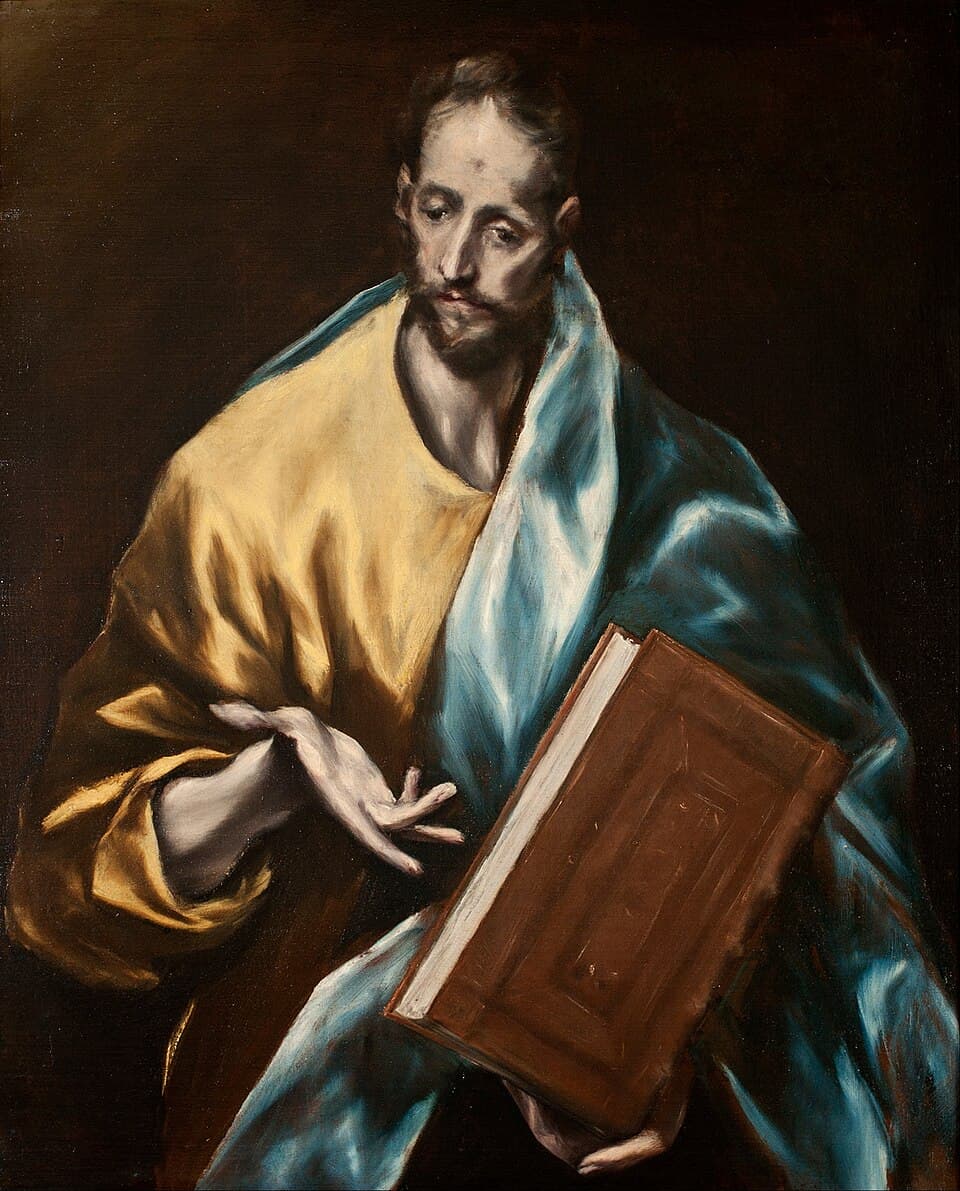
Saint James the Less
First century
- Feast day
- May 3, kept with Saint Philip 56. Kirsch in 1911 gives 1 May for the two Apostles together 7
- Patron saint of
- Uruguay, listed jointly with Saint Philip 5
Saint James the Less is one of the Twelve Apostles, always named in the lists as "the son of Alphaeus," and the Gospels record nothing he said or did. 12 He is often identified with James "the brother of the Lord," the bishop of Jerusalem who spoke at the Council of Jerusalem and who is traditionally credited with the Letter of James, but the sources do not agree on that, and this page sets out where each one stands. 1235
Three men called James, or one
Benedict XVI began his 2006 catechesis on him by placing him beside James the Greater, the son of Zebedee: "another James appears in the Gospels, known as 'the Lesser'." 1 The nickname is smaller than it sounds. Mark, naming the James whose mother stood at the cross, calls him ho mikros, and the 1910 Catholic Encyclopedia points out that this means "the little," not "the less" or "the lesser." 2
The trouble is that the New Testament has several men named James, and the encyclopedia counts five. 2 The ones that matter here are three: James son of Alphaeus, the Apostle; James the brother of the Lord, who led the church in Jerusalem; and James the son of a Mary who stood at the cross, the Mary whom John calls the wife of Clopas. 12
Achille Camerlynck, who wrote the encyclopedia article, thinks they are the same man. The identity of the Apostle with the bishop of Jerusalem, he writes, "although contested by many critics and, perhaps, not quite beyond doubt, is at least most highly probable." 2 Joining in the son of Mary of Clopas needs Alphaeus and Clopas to be two names for one man, which he grants "offers some difficulty" but is "by no means improbable," given doubles like Simon and Peter, Saul and Paul. 2
Benedict is more reserved. "Among experts, the question of the identity of these two figures with the same name, James son of Alphaeus and James 'the brother of the Lord', is disputed." 1 Franciscan Media goes furthest the other way. "We know nothing of this man except his name," its entry says of the son of Alphaeus, and "he is not the James of Acts, son of Clopas, 'brother' of Jesus and later bishop of Jerusalem." 5
The rest of this page follows the brother of the Lord, because he is the one the sources have something to say about. Camerlynck states the stakes himself: without the identification, "we should only know his name and his Apostleship." 2
A pillar of the church in Jerusalem
On the identification, James was a relative of Jesus from Nazareth, called his "brother" according to Semitic custom. 1 Camerlynck adds that he was called to the Apostolate with his own brother Jude and stands at the head of the third group in all four lists of the Twelve. 2 Nothing more is heard of him individually until after the Resurrection. Paul lists him among those to whom the risen Lord appeared. 12
From there he is unmistakably prominent. When Paul came up to Jerusalem three years after his conversion, about the year 37, the only Apostles he saw were Peter and James. 2 When Peter escaped from prison in 44, he asked that the news be taken to James, who by then held what Camerlynck calls "a marked preeminence in the Church of Jerusalem." 2 Paul names him with Peter and John as the "pillars" of that church, and Benedict notes that Paul even names James before Peter. 12
His decisive act came at the Council of Jerusalem, which the encyclopedia dates to 51. The question was whether converts from paganism had to be circumcised and keep the whole Mosaic Law. James spoke after Peter and agreed with him that they did not. 12 The compromise he proposed asked of Gentile believers only a few things: to keep away from meat offered to idols and from what Benedict translates as "impropriety," which "probably alluded to irregular matrimonial unions." 1
Benedict called this James's most important act, and said its two results are "still valid today." It recognized "the inseparable relationship that binds Christianity to the Jewish religion," and at the same time let Christians of pagan origin keep their own identity rather than lose it under the ceremonial precepts. 1 James himself went on keeping the Law, Camerlynck says, as "an ancient, most venerable and national custom." 2 When Paul visited in about 58, James and the elders advised him to join in the rites of a Nazarite vow, to answer the charge that he had abandoned the Law, and Paul agreed. 2
James the Just
Hegesippus, a Jewish Christian of the second century, is the source for most of what was remembered about the man himself, and the encyclopedia judges his narrative "highly probable." 2 Eusebius preserves it. James was called "the Just" by everyone, Hegesippus says. He drank no wine or strong drink and ate no meat, no razor touched his head, and he did not anoint himself or use the bath. 24 He was often found in the Temple on his knees "begging forgiveness for the people, so that his knees became hard like those of a camel." 4
How he died
There are two accounts, and the sources do not merge them.
Benedict gives the older one, from the Jewish historian Josephus, writing in Rome toward the end of the first century. In the year 62, in the interval between one Roman procurator, Festus, and the arrival of his successor, Albinus, the high priest Ananus took advantage of the gap to have James handed over to be stoned, an act Benedict calls "an illegal initiative." 1 Eusebius quotes the passage in full, and it goes on to say that the more moderate men of the city protested and that Ananus was deprived of the high priesthood after three months. 4
Hegesippus tells it at more length. Asked to stand on the pinnacle of the Temple at Passover and turn the crowds away from Jesus, James instead declared that the Son of Man "sits in heaven at the right hand of the great Power." 4 He was thrown down, survived the fall, and was stoned. Kneeling, he prayed, "I entreat you, Lord God our Father, forgive them, for they know not what they do." A man who was a fuller then struck him on the head with the club he used to beat out cloth, "and thus he suffered martyrdom." 4
Camerlynck accepts that James was put to death by the Jews, observes that Josephus's account "is somewhat different," and adds that "later traditions deserve less attention." 2
The Letter of James
The Letter of James stands first among the so-called Catholic Letters, written not to one church but to many. 1 Benedict says it "is also attributed to him," and notes that its author calls himself a "servant of God and of the Lord Jesus Christ" and not a brother of the Lord. 1 The encyclopedia's article on the Epistle says the author "is commonly identified with the Lord's brother," dates it to about the year 47, and places it in Jerusalem. 3 Eusebius himself recorded that its authorship was disputed and that not many of the ancients mentioned it, and the Council of Trent later defined it as canonical. 34
Its best-known sentence, "faith apart from works is dead," was famously set against Paul, and Luther called the whole letter "a letter of straw." 13 Benedict reads the two as completing each other. Paul opposes the pride of self-justification without grace; James "talks about works as the normal fruit of faith." 1
Camerlynck reads the man from the letter: "a grave, meek, and calm mind, nourished with the Scriptures of the Old Testament, given to prayer, devoted to the poor, resigned in persecution, the type of a just and apostolic man." 2
What is Saint James the Less the patron saint of?
Franciscan Media lists Saints Philip and James together as patron saints of Uruguay. 5 It is a shared patronage on a shared feast, given without explanation, and none of the sources used here gives James a patronage of his own.
Saint James the Less's feast day
The feast of Saint James the Less is May 3, kept together with Saint Philip the Apostle. 56 The pairing is older than the date. Kirsch, writing in 1911, gives the feast of Philip in the Roman Church as 1 May "together with that of James the Younger," and New Advent's editors have since noted that it is now celebrated on 3 May. 7
Praying with Saint James the Less
The Gospels never quote him. 1 Franciscan Media says we know nothing of him but his name and the fact that Jesus chose him. 5 For most people who have ever followed Christ, that is the whole of their record too.
If he is the bishop of Jerusalem, the knees tell you most of what Hegesippus thought worth remembering: years spent in the Temple asking forgiveness for the people, until they were as hard as a camel's. 4 His death, in that account, ends the same way, kneeling under the stones and asking forgiveness for the men throwing them. 4
The Council of Jerusalem shows a different kind of holiness. James kept the Law in his own life and was respected for it, and he still argued that new converts should not be made to carry it. 124 Later he advised Paul to make a public gesture toward the Law, to answer a charge that had been spread against him. 2 Benedict credits the settlement with producing "a practice of reciprocal esteem and respect" between two communities that could easily have split. 1
The letter asks for faith that shows up in what a person does, especially for the poor, and for plans made with "If the Lord wills" in front of them. 1 Benedict ended his catechesis by calling James "an ever up-to-date teacher of life for each one of us." 1
Saint James the Less, pray for us.
Sources
- 1.Benedict XVI, General Audience of 28 June 2006, "James, the Lesser" (Libreria Editrice Vaticana).
- 2.Achille Camerlynck, "St. James the Less," The Catholic Encyclopedia, Vol. 8 (New York: Robert Appleton Company, 1910).
- 3.Achille Camerlynck, "Epistle of St. James," The Catholic Encyclopedia, Vol. 8 (New York: Robert Appleton Company, 1910).
- 4.Eusebius of Caesarea, Church History, Book II, Chapter 23, quoting Hegesippus and Josephus, trans. Arthur Cushman McGiffert, Nicene and Post-Nicene Fathers, Second Series, Vol. 1 (1890).
- 5."Saints Philip and James," Saint of the Day, Franciscan Media.
- 6."Sts. Philip and James the Less, Apostles," Saint of the Day for 3 May, Vatican News.
- 7.Johann Peter Kirsch, "St. Philip the Apostle," The Catholic Encyclopedia, Vol. 11 (New York: Robert Appleton Company, 1911).
Saints to turn to next
Others in this collection who are turned to for some of the same things.