Saint Peter Damian
1007 - February 21, 1072
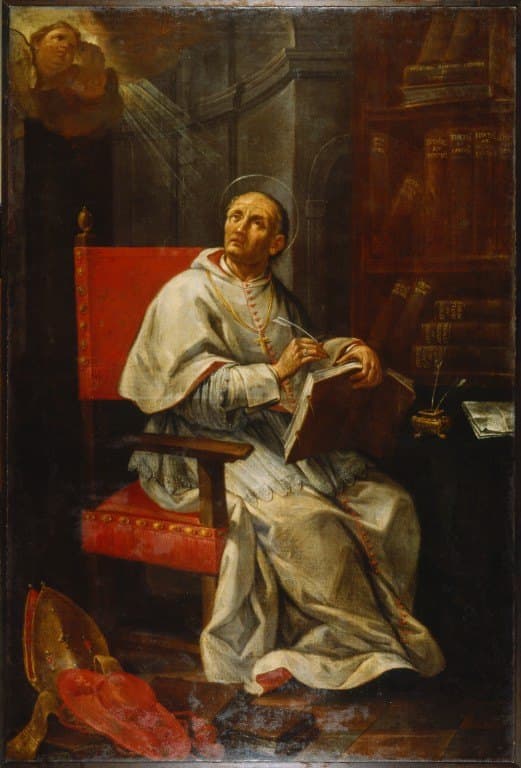
- Born
- Ravenna, 1007 - "five years after the death of the Emperor Otto III" 1
- Before school
- A swineherd for the brother who took him in, ill-treated and under-fed 1
- The name Damian
- His brother's. He added it in gratitude to the one who finally educated him 1
- Prior
- Of Fonte-Avellana from 1043 until his death, twenty-nine years 1
- Made cardinal
- Under threat of excommunication, after refusing for a long time. Ostia, November 30, 1057 1
Saint Peter Damian was the youngest of too many children, and when he was born a brother complained about the cost of him so effectively that "his mother refused to suckle him and the babe nearly died." 1 A family servant fed him and shamed her into taking him back. 1 He grew up to be a Doctor of the Church who had to be threatened with excommunication before he would accept being made a cardinal. 1
A swineherd with remarkable intellectual gifts
He was born at Ravenna in 1007, dated in the article by the death of an emperor. 1 "He was the youngest of a large family; his parents were noble, but poor." 1 The first thing that happened to him is the protest over the expense, his mother's refusal, and the retainer who "fed the starving child and by example and reproaches recalled his mother to her duty." 1
Orphaned early, he was taken in by an elder brother "who ill-treated and under-fed him while employing him as a swineherd." 1 Kelly puts the two facts side by side without comment: "The child showed signs of great piety and of remarkable intellectual gifts." 1 Nobody was educating him.
Another brother, an archpriest at Ravenna, "had pity on him and took him away to be educated." 1 That brother was named Damian, and it was generally accepted that Peter added the name to his own "in grateful recognition of his brother's kindness." 1 He is known to history by the name of the first person who was decent to him.
He studied at Ravenna, Faenza and Parma, and "when about twenty-five years old was already a famous teacher at Parma and Ravenna." 1 He gave it up around 1035: he "could not endure the scandals and distractions of university life." 1 After meeting two hermits of Fonte-Avellana and making a forty-day retreat in a small cell, "he left his friends secretly" and went to the hermitage. 1
The prior who bought books and invented the nap
His penances were so extreme that "for a time, his health was affected." 1 He spent the convalescence studying Scripture thoroughly, and when he recovered he was set to lecture to the other monks - then to monks of neighboring houses as well, at their superiors' request. 1 Around 1042 he wrote a life of Saint Romuald. 1
He became prior of Fonte-Avellana in 1043 and stayed prior until he died, twenty-nine years later. 1 The article records two changes he made, and the second is unexpected from a man of extreme penances: he had "later to moderate the imprudent zeal of some of his own hermits", and "another innovation was that of the daily siesta, to make up for the fatigue of the night office." 1
He also built a cloister, bought silver chalices and a processional cross, and "many books added to the library." 1 A man who had been kept from school as a boy spent his priorate buying books.
Writing at popes
"Although living in the seclusion of the cloister, Peter Damian watched closely the fortunes of the Church, and like his friend Hildebrand, the future Gregory VII, he strove for her purification in those deplorable times." 1 What that meant in practice was letters.
When Gregory VI took office in 1045, Peter "hailed the change with joy and wrote to the pope, urging him to deal with the scandals of the church in Italy, especially with the evil bishops of Pesaro, of Citta di Castello, and of Fano." 1 He named them. He attended the Lateran synod of early 1047 that passed decrees against simony, and the synod at Florence in June 1055 "where simony and clerical incontinence were once more condemned." 1
Around 1053 he wrote the "Liber Gratissimus", arguing for the validity of ordinations conferred by simoniacs - a position "much combatted at the time" that nevertheless "was potent in deciding the question in their favour before the end of the twelfth century." 1 He argued the unpopular side of a question about other people's validity, and the Church came round a century later.
In 1057 Stephen X decided to make him a cardinal. "For a long time he resisted the offer, but was finally forced, under threat of excommunication, to accept." 1 He was consecrated Cardinal-Bishop of Ostia on November 30, 1057, and his first act was "a stirring letter to his brother-cardinals, exhorting them to shine by their example before all." 1 He died at Faenza on February 21, 1072. 1
What is Saint Peter Damian the patron saint of
He is a Doctor of the Church and belongs to theologians and to writers, having spent his life arguing in letters with men more powerful than he was. 1 The encyclopedia gives no formal patronage list. 1
He also belongs, more quietly, to children who were not wanted and were fed anyway. The first paragraph of his life is about that and about the servant who would not let it happen. 1
Saint Peter Damian's feast day
Praying with Saint Peter Damian
Read the first paragraph of his life again. An infant whose family debated whether he was worth the food, and a servant who fed him and then told his mother what she was doing. 1 Everything Peter Damian became - the fasting, the letters naming bad bishops, the refusal of promotion - is downstream of somebody with no standing deciding that a starving child was not going to die that day.
The swineherd years are given one sentence. 1 So is the fact that he was brilliant. The two sat together for years and nobody did anything about it, and the person who finally did was a brother with a job and a conscience, and Peter carried his name for the rest of his life and into the calendar.
The siesta is the detail that saves him from being a fanatic. 1 He mortified himself until his health broke, and then, as a superior, he made his monks take an afternoon nap because the night office was wearing them out, and he had to restrain their zeal rather than encourage it. He knew what excess cost because he had paid it, and he did not require it of anybody else.
And the cardinalate, which he took only when refusing became disobedience. 1 The man who wrote to popes about scandals did not want office and accepted it under threat, and then immediately wrote to his fellow cardinals telling them to be examples. He was not comfortable with power and he used it the day he got it.
Saint Peter Damian, pray for us.
Sources
Saints to turn to next
Others in this collection who are turned to for some of the same things.