Saint Cyril of Jerusalem
c. 315 - March 18, 386 or 387
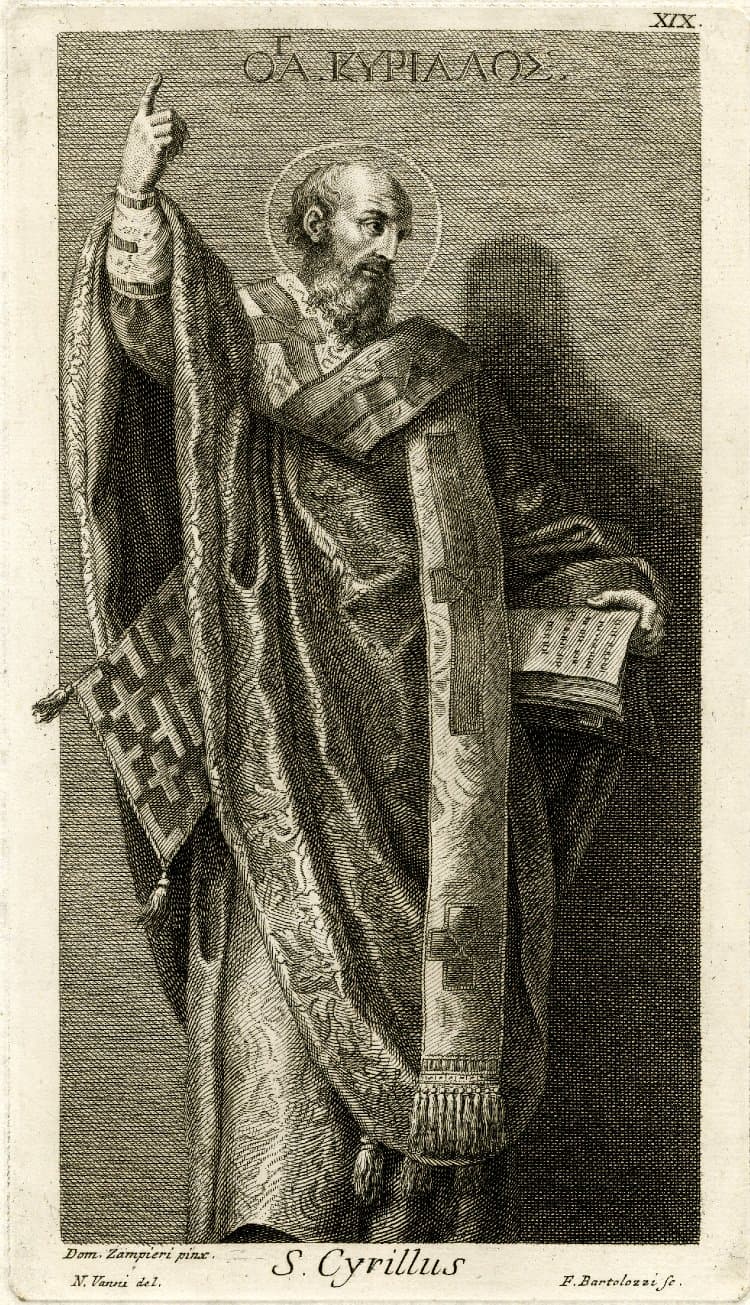
- Feast day
- March 18. Chapman: observed on the 18th in the East, "in the West on the 18th or 20th" 1
- Bishop of Jerusalem
- From 348, ordained by Acacius of Caesarea, with whom he was soon in open conflict 2
- Exiled
- Three times in about twenty years - 357, 360 and 367; the last lasted eleven years 2
- Wrote
- Twenty-four catecheses, delivered around 350, eighteen of them in the Basilica of the Holy Sepulchre 2
Saint Cyril of Jerusalem taught the faith to adult converts in the church built over the tomb of Christ, and twenty-four of those talks survive. 2 He was also accused by Saint Jerome of having obtained his bishopric by disowning his own ordination, spent eleven straight years in exile, and was formally cleared of everything by the Eastern bishops in a letter to Rome. 12 The catecheses are why he is a Doctor of the Church. 1
How he got the see, and what Jerome said about it
Cyril was born at or near Jerusalem about 315 and ordained priest by Bishop Maximus. 12 When Maximus died or was deposed in 348, Cyril was ordained bishop by Acacius, the influential Metropolitan of Caesarea. 2 Acacius was a philo-Arian, and Benedict XVI gives the obvious inference: he "must have been under the impression that in Cyril he had an ally," and Cyril was therefore "suspected of having obtained his episcopal appointment by making concessions to Arianism." 2
Chapman prints something much worse, and attributes it. Jerome relates that the episcopate was promised to Cyril by Acacius and the other Arian bishops "on condition that he should repudiate the ordination he had received from Maximus"; that Cyril "consented to minister as deacon only, and was rewarded for this impiety with the see"; and that when Maximus had already consecrated a successor named Heraclius, Cyril "by various frauds, degraded Heraclius to the priesthood." 1
Chapman does not leave it there. "So says St. Jerome; but Socrates relates that Acacius drove out St. Maximus and substituted St. Cyril." 1 He then offers a reading in which the real quarrel was never about Arianism at all - Nicaea had guarded the metropolitan rights of Caesarea while granting Jerusalem a special dignity, and Maximus had held a synod and ordained bishops anyway, so the fight may have been jurisdictional. 1 Or, Chapman allows, "Cyril's correct Christology may have been the real though veiled ground of the hostility of Acacius to him." 1
Two fourth-century witnesses, flatly opposed, and an encyclopedia article declining to choose. This page does the same.
Three exiles
The conflict with Acacius broke out quickly, and Benedict says it ran in two directions at once: doctrine, and jurisdiction, because Cyril claimed his see was autonomous of Caesarea. 2
Chapman supplies the charge on which the first exile hung, and it is not a doctrinal one. In 357 Acacius had Cyril banished "on the charge of selling church furniture during a famine." 1 Cyril took refuge with the Bishop of Tarsus, appeared at the Council of Seleucia in 359 where the Semi-Arian party came out on top, and seems to have got his see back when Acacius was deposed. 1 The emperor was displeased, and in 360 Cyril and other moderates were driven out again; they returned when Julian came to the throne in 361. 1
In 367 Valens banished every bishop Julian had restored, and Cyril stayed out for eleven years. 12 Benedict counts three exiles across roughly twenty years of episcopate. 2 Only after the emperor's death in 378 could he take possession of his see for good "and restore unity and peace to his faithful." 2
The vindication came formally and from his peers. Benedict cites the Synodal Letter of 382, following the Second Ecumenical Council of Constantinople in which Cyril had played an important part: addressed to the Roman Pontiff, it recognized "Cyril's flawless orthodoxy, the legitimacy of his episcopal ordination and the merits of his pastoral service." 2 The legitimacy of his ordination. The charge Jerome made was answered by name.
Teaching people who were about to be baptized
The twenty-four catecheses date from about 350 and were mostly delivered in the Basilica of the Holy Sepulchre. 12 Eighteen are addressed to catechumens preparing for baptism; the last five, the "mystagogical" ones, were for the newly baptized during Easter week. 2
Benedict describes the structure, and it is a curriculum rather than a set of sermons. The first five treat the prerequisites for baptism, conversion from pagan morals, the sacrament itself and the truths of the Creed; numbers six to eighteen work through the Jerusalem Creed in anti-Arian tones; the mystagogical five cover the rites of baptism, then the Chrism, the Body and Blood of Christ, the Eucharistic Liturgy and the Our Father. 2
Benedict describes the effect he was after with the newly baptized, and it is a teacher's observation rather than a theologian's. With neophytes of Greek origin especially, Cyril "made use of the faculty of sight which they found congenial," and the passage from the rite to the mystery "made the most of the psychological effect of amazement, as well as the experience of Easter night." 2 He knew that people who had just been through something at night in a church were in an unusual condition to be taught.
What is distinctive is the order. Benedict notes that the mystagogical catechesis came after the rites rather than before them: Cyril led the neophytes "to discover the mysteries still hidden in the baptismal rites of the Easter Vigil," which they were able to understand better "having celebrated their rites." 2 Explain it afterward, when they have been through it.
Chapman adds a detail about the dating that shows how thin the ground is even for the basic facts. Cyril himself dates the catecheses as "fully seventy years after the Emperor Probus," which puts them at about 347 if he was being exact; Constans was then still alive. 1 Whether he was already a bishop when he delivered them is disputed - Mader thought so, Chapman notes, "but it is usually held that he was at this date only as a priest." 1 The most famous thing the man produced may have been produced before he held the office he is remembered for.
Beyond the catecheses, Chapman says plainly that "little is known of his life," and lists where the little comes from: his younger contemporaries Epiphanius, Jerome and Rufinus, and the fifth-century historians Socrates, Sozomen and Theodoret. 1 Two of those, Jerome and Socrates, are the pair who contradict each other about how he became bishop.
The passage Benedict quotes shows the method working. "You descended three times into the water, and ascended again, suggesting by a symbol the three days burial of Christ... And at the self-same moment you were both dying and being born; and that water of salvation was at once your grave and your mother." 2 And the opening address to catechumens, which is not the language of a man softening the thing: "You have been caught in the nets of the Church. Be taken alive, therefore; do not escape for it is Jesus who is fishing for you, not in order to kill you but to resurrect you after death." 2
What is Saint Cyril of Jerusalem the patron saint of?
Saint Cyril of Jerusalem's feast day
The feast of Saint Cyril of Jerusalem is March 18. 1 Chapman records the position as of 1908 with a precision worth preserving: "In the East his feast is observed on the 18th of March, in the West on the 18th or 20th." 1 The eighteenth is also the day he probably died, though the sources differ on the year - Chapman gives 386, Benedict XVI 387. 12
Praying with Saint Cyril
Cyril is useful mainly for what he did with a room full of people who did not yet believe anything in particular. He did not begin with mystery. He began with the prerequisites, moved through conversion of behavior, went line by line through a creed, and saved the explanation of the sacraments until after his hearers had received them. 2 Anyone who has tried to explain the faith to an adult will recognize the problem he was solving.
The accusation is the harder thing to sit with, and it is better faced than skipped. One saint accused another of simony and fraud, in writing, and the encyclopedia prints it. 1 What answered it was not a denial but thirty years: three exiles, eleven of them consecutive, and a council at which he was influential enough that the bishops wrote to Rome to say his ordination had been legitimate all along. 2
He is also evidence against the idea that a serious churchman gets a quiet life. Benedict opens by saying Cyril's life was woven of pastoral care on one side and, on the other, involvement "in spite of himself, in the heated controversies that were then tormenting the Church of the East." 2 In spite of himself. He wanted to teach catechumens, and spent two decades being expelled from the city where he taught them.
The line to take away is the one he gave people on the edge of baptism, because it assumes nothing about how they were feeling: die to your sins and live to righteousness from this very day. 2 Not when the doubts clear. From this day.
Saint Cyril of Jerusalem, pray for us.
Sources
Saints to turn to next
Others in this collection who are turned to for some of the same things.