Saint John Damascene
c. 676 - between 754 and 787
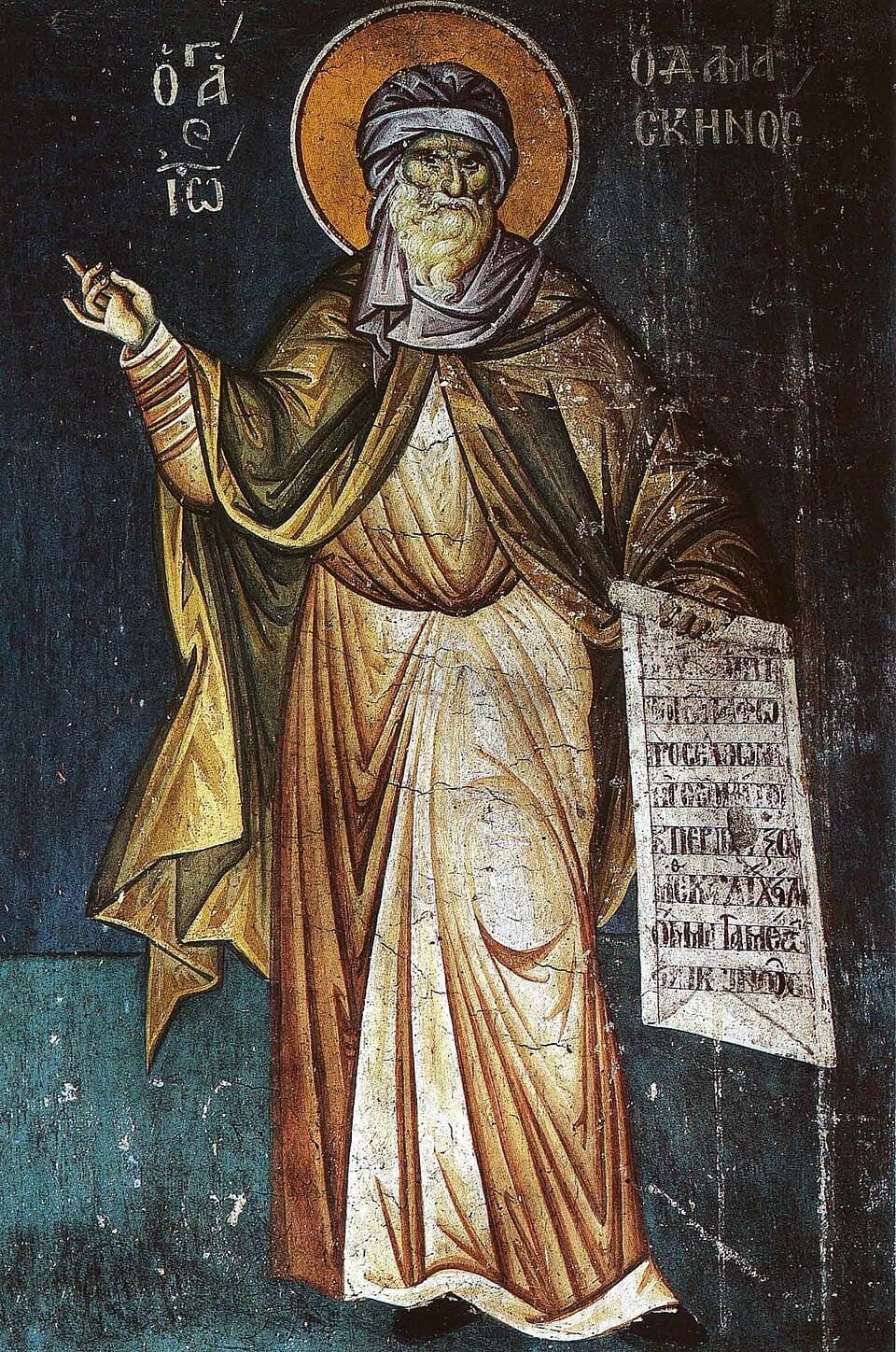
- Feast day
- December 4 23. The 1910 encyclopedia gives 27 March, which was the date when it was written 1
- Died
- At the monastery of Mar Saba, some time between 754 and 787 1
- Before the monastery
- Chief councillor of Damascus, in the service of the caliph, as his father had been 12
- Known as
- Chrysorrhoas, "golden stream," a name Theophanes records his friends giving him 1
Saint John Damascene defended the veneration of images from inside the court of a Muslim caliph, which put him beyond the reach of the Christian emperor who was destroying them. 12 He argued that since God had taken flesh, matter could be painted without insult - and the council that condemned him for it was itself overturned. 2 He is the last of the Greek Fathers, and almost everything told about his life comes from one document the encyclopedia calls legendary. 1
One unreliable source
O'Connor opens the encyclopedia article with a warning that shapes everything after it. The only surviving life is by John, Patriarch of Jerusalem, and it dates from the tenth century - some two hundred years after its subject. 1 "This life is the single source from which have been drawn the materials of all his biographical notices. It is extremely unsatisfactory from the standpoint of historical criticism. An exasperating lack of detail, a pronounced legendary tendency, and a turgid style are its chief characteristics." 1
What both sources agree on is the situation rather than the incidents. He was born at Damascus about 676 into a wealthy Christian family, and his father - probably named Mansur - held the post of chief financial officer for the caliph. 12 Benedict XVI notes that John took on the role of Treasurer of the Caliphate, "perhaps already held by his father." 2 O'Connor gives his title as protosymbulus, chief councillor of Damascus. 1
The detail from the legendary life that is too good to leave out, and is here as the life tells it: standing in the market-place, Mansur found among captives taken in a raid on the coast of Italy a Sicilian monk named Cosmas, discovered he was a man of deep learning, had the caliph free him, and made him tutor to his sons. 1 Under Cosmas, the biographer says with evident enthusiasm, John "soon equalled Diophantus in algebra and Euclid in geometry." 1 O'Connor reports the claim in the biographer's own register, which is the right way to handle it.
The famous episode belongs to the same document. When Leo the Isaurian could not silence John, the life says, he forged a letter in John's hand offering to betray Damascus, and sent it to the caliph; the caliph believed it and ordered the hand that wrote it struck off at the wrist. 1 The story continues with the hand restored. It rests entirely on the tenth-century life, and O'Connor has already said what that is worth.
Why a monk in Palestine could say what a patriarch could not
In 726 Leo the Isaurian issued his first edict against the veneration of images, over the protests of Germanus, Patriarch of Constantinople. 1 O'Connor puts John's position exactly: he entered the fight "from his secure refuge in the caliph's court." 1
That is the political fact underneath the theology. A bishop inside the empire could be deposed; a Christian official in Damascus, under a caliph who valued him, could not. The most effective defense of Christian images in the eighth century was written by a man living outside Christendom.
Around the year 700 he had left the court for the monastery of Mar Saba, near Jerusalem, dissatisfied with life at court. 2 Benedict says he never left it again, giving his energy to asceticism and writing, "not disdaining a certain amount of pastoral activity, as is shown by his numerous homilies." 2
His three Discourses against those who calumniate the Holy Images were condemned after his death by the iconoclastic Council of Hieria in 754. 2 They were then the grounds of his rehabilitation and canonization by the Fathers at the Second Council of Nicaea in 787, the Seventh Ecumenical Council. 12 O'Connor notes what the intervening years were like, recording the insults of his enemies, and that Theophanes, writing in 813, says his friends called him Chrysorrhoas, golden stream, for his oratory. 1
The argument about matter
The distinction John drew is the one that made the argument answerable. Benedict credits him with being among the first to separate, in Christian worship, latreia from proskynesis - adoration, which may be offered to God alone, from veneration, which "can make use of an image to address the one whom the image represents." 2 The saint is in no way to be identified with the material the icon is made of. 2
Benedict notes why that mattered so much just then, and it is not only an internal Christian question. The Old Testament prohibition of cult images was being pressed as universal and eternal, and the Islamic world around John accepted the Jewish tradition of excluding them entirely. 2 He was answering neighbors as well as emperors.
The passage Benedict quotes is the heart of it, and it turns on the Incarnation. "In other ages God had not been represented in images, being incorporate and faceless. But since God has now been seen in the flesh, and lived among men, I represent that part of God which is visible. I do not venerate matter, but the Creator of matter, who became matter for my sake." 2
Then he presses the point to where it is hardest to refuse. "Is not the wood of the Cross, three times blessed, matter?... And the ink, and the most Holy Book of the Gospels, are they not matter? The redeeming altar which dispenses the Bread of life, is it not matter?... And, before all else, are not the flesh and blood of Our Lord matter?" 2 The conclusion is a single sentence: "Do not, therefore, offend matter: it is not contemptible, because nothing that God has made is contemptible." 2
Benedict draws out the consequence: after the Incarnation "matter is seen to have become divine, is seen as the habitation of God. It is a new vision of the world and of material reality." 2 O'Connor places him at the end of a line - "the last of the Greek Fathers." 1
What is Saint John Damascene the patron saint of?
Neither source used here states a patronage for Saint John Damascene, and this profile does not supply one. 12 He is commonly named for icon painters, which follows obviously from the Discourses, and neither O'Connor nor Benedict XVI says it. What both give him is the doctorate: Leo XIII enrolled him among the Doctors of the Church in 1890. 12
Saint John Damascene's feast day
The feast of Saint John Damascene is December 4. 23 Benedict XVI states it outright - "his liturgical commemoration is on the 4 December" - and Franciscan Media gives the same date. 23 The encyclopedia says something different and was right when it said it: writing in 1910, O'Connor records that "his feast is celebrated on 27 March." 1 The calendar was reformed in 1969, and an article older than the reform reports the day it knew. Both dates are printed here for that reason.
Praying with Saint John Damascene
The argument he won is one most people now inherit without noticing they hold it. A crucifix on a wall, a photograph of the dead kept on a shelf, a statue in a side chapel - the instinct that these are neither idols nor nothing is his instinct, worked out under pressure and against a serious objection. He did not dismiss the objection. He answered it by pointing at the Incarnation and asking what else, then, would have to be thrown out.
His list is the part worth sitting with, because it refuses a tidy line. The wood of the Cross, the ink of the Gospel book, the altar, and finally the flesh and blood of Christ. 2 Either all of that is suppressed as merely material, or matter can carry grace. He was unwilling to keep the sacraments and lose the images, and he noticed that the same argument covered both.
The circumstances are their own lesson. He was a Christian civil servant in a Muslim administration, writing to defend a Christian practice from a Christian emperor, and the reason he could do it was that the emperor could not reach him. 1 He was condemned by a council twenty-odd years after his death and vindicated by another thirty-three years after that. 2 Neither the condemnation nor the vindication arrived in his lifetime.
The biography is thin and partly legendary, and O'Connor says so before saying anything else. 1 What is not thin is the writing, which is why he is a Doctor of the Church and why the sentence that ends his argument still does work: nothing that God has made is contemptible. 2
Saint John Damascene, pray for us.
Sources
Saints to turn to next
Others in this collection who are turned to for some of the same things.