Saint Anselm of Canterbury
1033 or 1034 - April 21, 1109
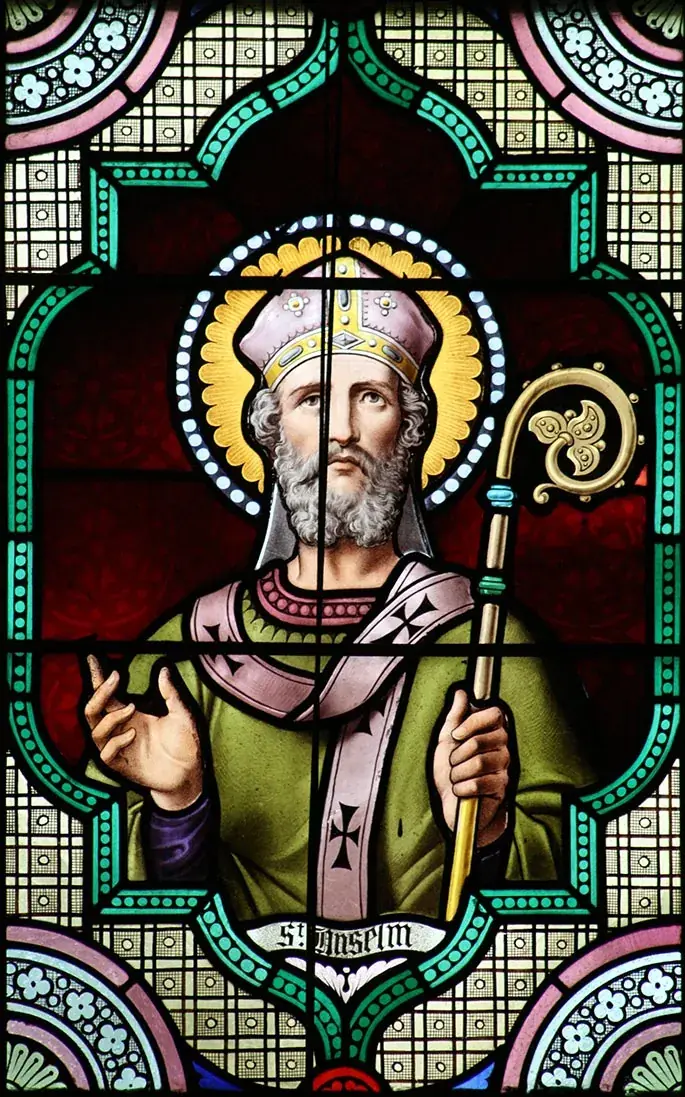
- Feast day
- April 21, the day he died in 1109 2
- Abbot of Bec
- From February 1079; Archbishop of Canterbury from 1093 1
- Exiled
- From his see in 1103; able to return only in 1106 1
Saint Anselm asked to enter a monastery at fifteen and his father refused, so hard that he would not relent even when the boy fell seriously ill and begged for the habit as a dying comfort. 1 Anselm recovered, his mother died, and he spent the next several years neglecting his studies and wandering through France. 1 He became abbot, archbishop, exile, and the founder of scholastic theology, and what he wanted was for the mind to be raised to the contemplation of God. 1
The mountain and the white bread
Anselm was born at Aosta - "a Burgundian town on the confines of Lombardy" - in 1033 or the beginning of 1034, the first child of a noble family. 12 His father, Benedict XVI says frankly, was "a coarse man dedicated to the pleasures of life who squandered his possessions"; his mother was "a profoundly religious woman of high moral standing," and it was she who saw to his first formation before entrusting him to the Benedictines at a priory in Aosta. 1
His biographer Eadmer preserved a story from those years, which Kent gives at length and Benedict summarizes. Living in the mountains, the child had heard his mother say that God dwelt on high, and concluded that heaven must be at the top of the Alps. One night he dreamed he was invited up to that kingdom, spoke with God at length, and was given "a very white bread roll" to eat by the cupbearer. Waking, "as a simpler and innocent child he believed that he had truly been fed in heaven with the bread of the Lord, and this he publicly affirmed in the presence of others." 12
At fifteen he asked to be admitted to the Benedictines and his father brought "the full force of his authority" against it, refusing even when Anselm, seriously ill, begged for the habit. 1
The years he lost
Benedict XVI does not tidy up what happened next, and this page follows him. After Anselm recovered and his mother died young, he "went through a period of moral dissipation. He neglected his studies and, consumed by earthly passions, grew deaf to God's call." He left home and wandered through France "in search of new experiences." 1
Three years later he reached Normandy and went to the Benedictine abbey of Bec because of the reputation of its prior, Lanfranc of Pavia. Benedict calls the meeting "providential, crucial to the rest of his life." Under Lanfranc, Anselm took up his studies again in earnest and became not only the favorite pupil but the teacher's confidant. 1 The vocation came back, and at twenty-seven he entered the monastery and was ordained.
A teacher who would not force anybody
Three years after entering, when Lanfranc went to Caen, Anselm was made prior of Bec and master of the cloister school. Benedict singles out how he taught: "He was not keen on authoritarian methods; he compared young people to small plants that develop better if they are not enclosed in greenhouses and granted them a 'healthy' freedom." 1
He was demanding about monastic observance, with himself first, "but rather than imposing his discipline he strove to have it followed by persuasion." 1 On the death of Bec's founding abbot he was elected unanimously to succeed him, in February 1079. 1
Canterbury, and exile
Made Archbishop of Canterbury in 1093, he spent much of the rest of his life defending the liberty of the Church against two English kings, William Rufus and Henry I, with the support of the pope. 1 In 1103 that loyalty cost him "the bitterness of exile from his See of Canterbury." 1
He could return only in 1106, when Henry I gave up his claim to confer ecclesiastical offices and to collect taxes and confiscate Church property. Anselm came back to England and "was festively welcomed by the clergy and the people." Benedict describes the whole struggle as one "he had fought with the weapons of perseverance, pride and goodness." 1 He died on 21 April 1109. 2
Faith that wants to understand
Christian tradition calls him the Magnificent Doctor, and Benedict XVI explains why in terms of appetite rather than achievement: he "fostered an intense desire to deepen his knowledge of the divine Mysteries but in the full awareness that the quest for God is never ending, at least on this earth." 1 The clarity and logical rigor were always aimed, in Anselm's own words, at "raising the mind to contemplation of God." 1
The condition he attached to theology is the part worth carrying: "whoever intends to study theology cannot rely on his intelligence alone but must cultivate at the same time a profound experience of faith." 1 He is called the founder of scholastic theology by the same pope who insists that his method begins on the knees.
The prayer Benedict quotes from the Proslogion is the shape of the whole man: "I pray, O God, to know you, to love you, that I may rejoice in you. And if I cannot attain to full joy in this life may I at least advance from day to day, until that joy shall come to the full." 1
Kent records the official recognition: Clement XI declared him a Doctor of the Church in 1720, and the office read on his feast says his works "are a pattern for all theologians." Kent then adds, drily, that "it may be doubted whether his position is generally appreciated by students of divinity," because "in some degree his work has been hidden by the fabric reared on his foundations." 2 He was outbuilt by the people who came after him, which is a real kind of obscurity.
What is Saint Anselm the patron saint of?
Nothing that either source cited here will state. 12 Neither Benedict XVI's catechesis nor the encyclopedia article gives him an individual patronage, and this page leaves the question open rather than filling it in.
What he is for is not in doubt: theologians, students, teachers who would rather persuade than compel, and anyone whose faith has questions in it.
Saint Anselm's feast day
The feast of Saint Anselm is April 21, the day he died in 1109. 2 The encyclopedia mentions the date only in passing - "in the office read on his feast day (21 April)" - which is the sort of sentence that is easy to walk past and is the only statement of it either source makes. 2
He is called Anselm of Aosta, of Bec and of Canterbury, after the three places that claim him, in three different countries. 1
Praying with Saint Anselm
His vocation was refused by his own father, and then he lost it himself. Benedict XVI says plainly that after his mother died Anselm neglected his studies, was consumed by earthly passions and grew deaf to God's call, and went wandering. 1 That is a pope describing a Doctor of the Church, and it is more use to most people than the version where the saint proceeds smoothly from a pious childhood.
What brought him back was not a crisis but a teacher. He went to Bec because Lanfranc was there, started studying again, and the vocation restarted with the work. 1 Sometimes the way back is a person who is good at what you used to love.
He taught by persuasion and thought young people were like plants that do badly in greenhouses. 1 For a man remembered as the founder of scholastic theology, the most quoted thing about his practice is that he refused to force anyone.
His prayer asks for something modest, which is why it is usable: to know God, to love him, to rejoice in him - and, if the full joy is not available in this life, to advance from one day to the next until it comes. 1 That is a request for slow progress made by a man who was exiled from his own cathedral for three years and did get back.
Saint Anselm of Canterbury, pray for us.
Sources
Saints to turn to next
Others in this collection who are turned to for some of the same things.
- Saint Abercius of HieropolisSecond century; died at seventy-two or laterPrayerStudy and teaching
- Saint Aelred of Rievaulx1109 - January 12, 1166 (or 1167)PrayerStudy and teaching
- Saint Ambrosec. 340 - April 4, 397PrayerStudy and teaching
- Saint Bede the Venerable672 or 673 - 735 or 737Study and teachingPrayer