Saint Bede the Venerable
672 or 673 - 735 or 737
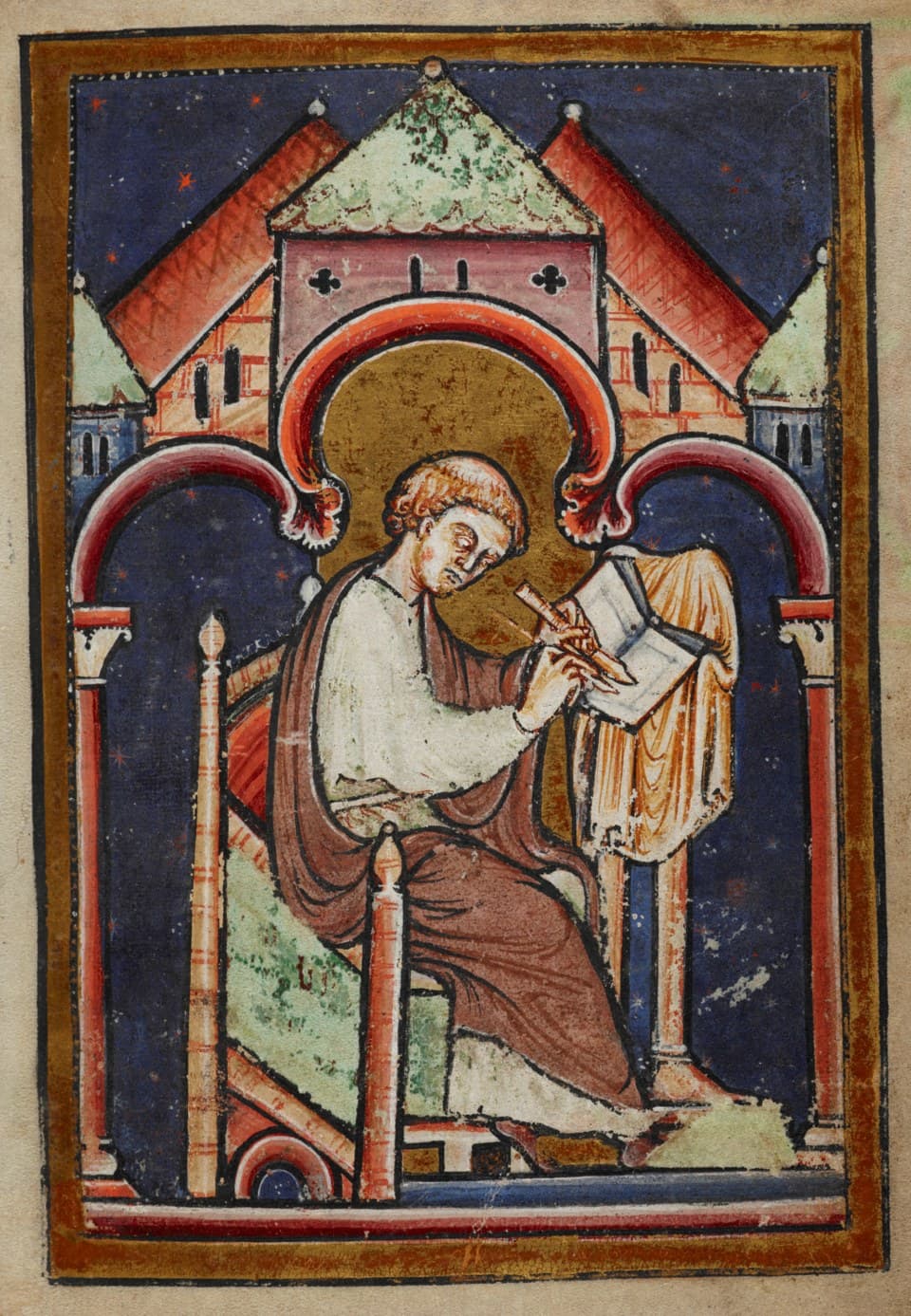
- Feast day
- May 27, decreed for the whole Church by Leo XIII on 13 November 1899, with the title Doctor Ecclesiae 1
- Known for
- The Ecclesiastical History of the English People, which earned him the name of father of English historiography 2
- The title Venerable
- Attached to his name within two generations; used by Alcuin, and by the Council of Aachen in 835 1
Saint Bede was handed over to a monastery at seven years old and stayed there until he died, roughly sixty years later, and from that one place he worked out the dating system that put the birth of Christ at the center of the calendar. 12 Every time a document is dated A.D., it is using the convention his Chronica Maiora established. 2 He wrote the first history of the English, and he did it without going anywhere.
One monastery, one life
Bede described his own life in a single paragraph at the end of the Ecclesiastical History, and Thurston says it is "practically speaking, all that we know." 1 He was born on land belonging to the monastery of Wearmouth and Jarrow, given at seven by his relations to Abbot Benedict Biscop and afterward to Ceolfrid, and from that time spent the whole of his life inside it. 12 His own summary of the arrangement: "amid the observance of monastic discipline and the daily charge of singing in the Church, it has been ever my delight to learn or teach or write." 12
This sounds like a small life and was not. Benedict XVI points out the resource that made the difference: Bede had the use of a remarkable collection of manuscripts, brought back by his abbots from repeated journeys to the continent and to Rome. 2 A monastery in Northumbria with a serious library turned out to be enough. Benedict calls him one of the most learned figures of the early Middle Ages, and notes that the fame of his writing brought him friendships with the important people of his time, who encouraged him to keep at it. 2
Thurston records the exceptions to the routine as exceptions - a few days away with friends, away from Jarrow - and says that otherwise the life "seems to have been one peaceful round of study and prayer passed in the midst of his own community." 1 Benedict adds that when Bede fell ill he did not stop working, and kept "an inner joy that he expressed in prayer and song." 2
What he actually did to the calendar
The contribution most people use daily without knowing whose it is sits in the Chronica Maiora. In Bede's day, time was counted from the foundation of the city of Rome. 2 He worked out a chronology reckoned "ab incarnatione Domini," from the Incarnation of the Lord, and Benedict states the reasoning: Bede realized "that the true reference point, the centre of history, is the Birth of Christ." 2 That calendar is the one the world still keeps.
The related labor was the Computo, his scientific reckoning of the exact date of Easter and therefore of the whole liturgical year, which Benedict says "became the reference text for the whole Catholic Church." 2 It had a practical purpose behind the mathematics. Bede thought it mattered a great deal to convince the Irish, Celtic and Pict Churches to keep Easter on the same day as Rome. 2 A shared date is a visible unity, and he was prepared to do a lot of arithmetic to get one.
He was a serious student of the text of Scripture as well as of the calendar - Thurston notes that a copy of the monumental Codex Amiatinus of the Vulgate on which Bede worked has survived. 1 Benedict describes his method of commentary as holding two things together: listening to exactly what the text says, and reading it in the conviction that the key to the whole is Christ. 2
The history of the English
The Ecclesiastical History of the English People is the book that earned him, in Benedict's phrase, "recognition as 'the father of English historiography.'" 2 Benedict credits it with documentary rigor and literary skill, and notes what Bede thought he was doing: tracking the work of the Holy Spirit as it continued in history, through the Fathers, the councils, and the conversion of peoples. 2
The Church Bede describes has two features he cared about. One is catholicity, which he understood as faithfulness to tradition combined with openness to historical development, and as unity held across real cultural difference - following the instructions Gregory the Great had given Augustine of Canterbury. 2 The other is the link to Rome. 2
Benedict brings out an image from Bede's commentary on the temple that shows how he thought about this. Pagan peoples contributed valuable materials and the skill of their master builders to the ancient temple; in the same way, apostles and teachers from the new peoples build the Church - and Bede was pleased to list the Irish Celts and the Anglo-Saxons among them. 2 A man on the northern edge of the known world, writing himself and his neighbors into the structure.
He wrote for particular kinds of people, too. Scholars were to examine the marvels of the word of God and present them attractively, and to explain dogma while keeping to "Catholic simplicity." 2 Pastors were to put preaching first. 2 Parents were told that within the small circle of a household they exercise "the priestly office as pastors and guides." 2 And Benedict quotes him as knowing many of the faithful, married and single, "capable of irreproachable conduct who, if appropriately guided, will be able every day to receive Eucharistic communion." 2
The last day
The account of his death comes from Cuthbert, one of his disciples, and Thurston quotes it at length because it is worth quoting. 1 Bede's community kept reading aloud at his bedside through the final illness, and the reading kept being interrupted by their crying. 1 Cuthbert: "I can with truth declare that I never saw with my eyes or heard with my ears anyone return thanks so unceasingly to the living God." 1
On the last day he was still dictating a translation of the Gospel of John. 1 In the evening the boy Wilbert, who was taking it down, told him there was one sentence left unwritten. It was supplied, and the boy said it was finished. "Thou hast spoken truth," Bede answered, "it is finished." 1 He asked to be held facing the place where he used to pray, and died on the floor of his cell singing the Gloria Patri. 1
Thurston dates that to the vigil of the Ascension, 735. 1 Benedict XVI says "death took him on 26 May 737: it was the Ascension." 2 The disagreement is left standing here, because two careful sources disagree and this page has no way to settle it.
The title came fast and the honors came slowly. Venerabilis was attached to his name within two generations, used by Alcuin and Amalarius and apparently Paul the Deacon, and the Council of Aachen in 835 called him venerabilis et modernis temporibus doctor admirabilis Beda. 1 That decree was cited in the petition Cardinal Wiseman and the English bishops sent to Rome in 1859 asking that Bede be made a Doctor of the Church. 1 They got their answer forty years later. 1
What is Saint Bede the Venerable the patron saint of?
Neither source used here states a patronage for Saint Bede, so this profile claims none. 12 He is often named for historians, scholars and writers, which suits him, but the encyclopedia article and Benedict XVI's catechesis are both silent on it. What the sources do give is the title Doctor of the Church, decreed with his feast in 1899. 1
Saint Bede the Venerable's feast day
The feast of Saint Bede is May 27. 1 Thurston gives the decree behind it precisely: on 13 November 1899, Leo XIII ordered that the feast of Venerable Bede, with the title Doctor Ecclesiae, be celebrated throughout the Church each year on 27 May. 1 Before that there had been a local observance at York and in the north of England through the Middle Ages, though his feast was not widely kept in the south, where the Sarum Rite was followed. 1
Praying with Saint Bede
Bede is the patron saint of nobody in these sources and the obvious model for anyone whose life happens in one building. He did not travel, did not found an order, did not govern anything, and was not martyred. He read, taught and wrote in the same set of rooms for about sixty years, and the result reorganized how the West counts time and gave the English their history. 12
The prayer he put at the end of that history says what he wanted, and it is not a small request from a man who had spent his life on books: that the one to whom God had "graciously granted sweetly to drink in the words of your knowledge" might also come at last to God himself, "the Fountain of all wisdom," and appear forever before his face. 2 He knew the difference between the words about the thing and the thing.
What Cuthbert noticed about him, watching him die, was the thanking. Not the learning, which was obvious to everybody, and not the patience. Somebody who had never heard anyone return thanks so unceasingly to the living God. 1 It is an odd detail to be the one his disciple chose to record, and it is probably the most informative thing in the article.
The last hour is the part that stays. An old man on the floor of a cell, finishing a translation of John because there was one sentence left, telling the boy with the pen that he had spoken truly, and then singing the Gloria Patri until he stopped. 1 Nobody arranged that as a scene. It is what somebody does at the end of a life spent that way.
Saint Bede the Venerable, pray for us.
Sources
Saints to turn to next
Others in this collection who are turned to for some of the same things.