Saint Bonaventure
1217 or 1221 - July 15, 1274
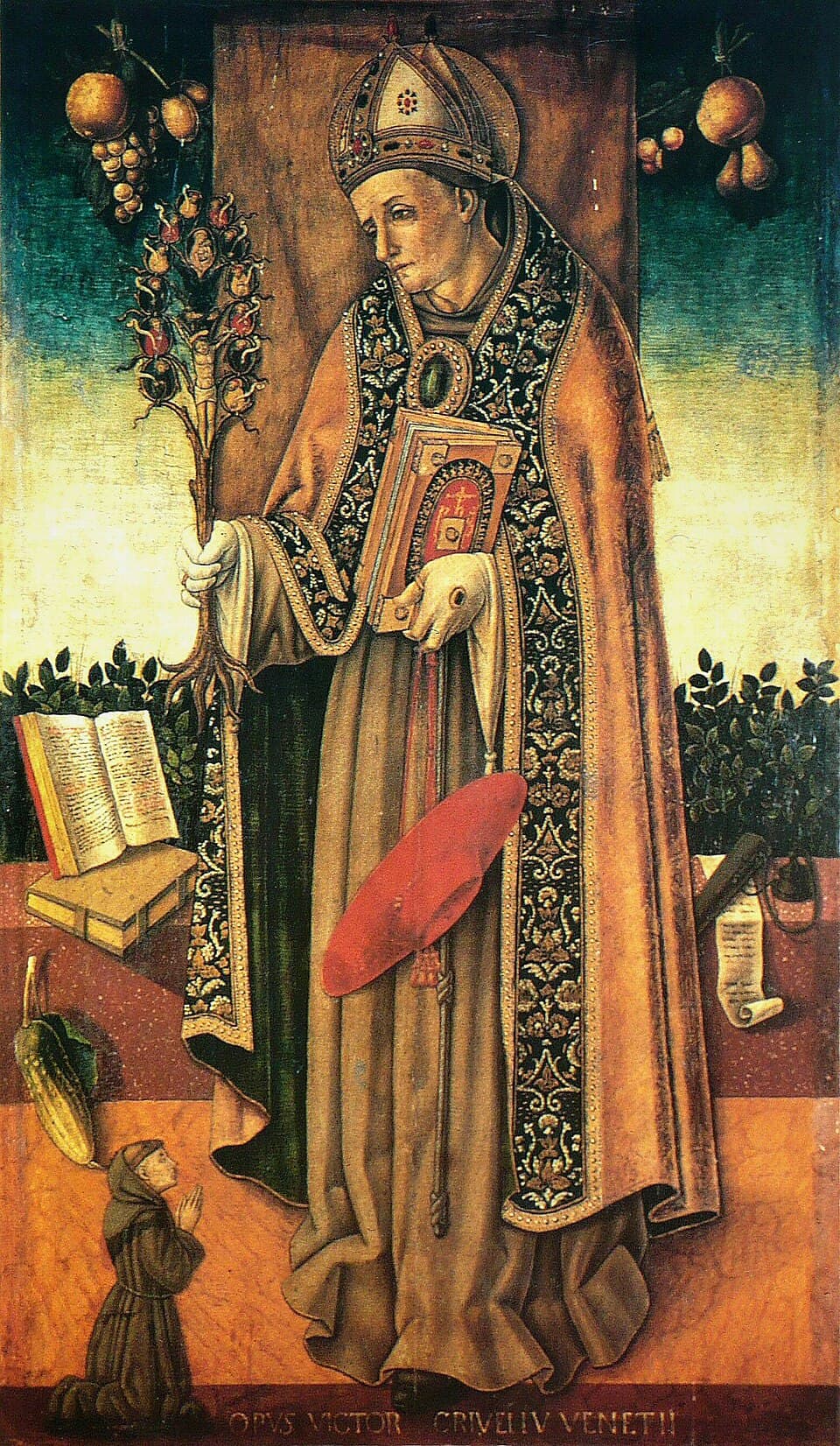
- Feast day
- July 14, though he died on July 15 1
- Born
- Bagnoregio, near Viterbo. Robinson gives 1221; Benedict XVI says "in all likelihood born in 1217" 12
- Declined
- The Archbishopric of York, offered by Clement IV in a Bull of 23 November 1265 1
- Doctor of the Church
- Inscribed among the principal Doctors by Sixtus V in 1557 1
Saint Bonaventure ran the Franciscans for seventeen years while they were coming apart, and the most criticized thing he ever did was order the destruction of the older biographies of Saint Francis. 1 He was also the theologian who wrote the "Itinerarium Mentis in Deum," turned down an archbishopric, and was the reason the Church got Pope Gregory X. 1 Benedict XVI, who wrote his doctoral research on him, admitted to a certain nostalgia at having to introduce him in a half-hour talk. 2
A boy who was not expected to live
He was born Giovanni di Fidanza at Bagnoregio, near Viterbo, and Robinson says nothing is known of his parents beyond their names. 1 The one event from childhood both sources report is an illness. He fell seriously ill, and his father, who was a doctor, gave up hope of saving him; his mother appealed to the intercession of Francis of Assisi, recently canonized, and the boy recovered. 2
Robinson is careful about what follows from that, because a tidy story is available and he will not tell it. The attempt to derive the name Bonaventure from Francis exclaiming "O buona ventura" over the sick child is, he says, "highly improbable" and rests on a late fifteenth-century legend. 1 Bonaventure himself says only that as a child he was preserved from death through the intercession of Francis, with no evidence that the cure happened during the saint's lifetime. 1 Other people had borne the name before him. 1
He went to Paris, took a Master of Arts, and asked himself what Benedict calls the crucial question - "What should I do with my life?" 2 The Friars Minor had arrived in the city in 1219, and their fervor and evangelical radicalism decided him. 2 Years later he explained why, in a letter Benedict quotes: what made him love the life of blessed Francis most "is that it resembled the birth and early development of the Church. The Church began with simple fishermen, and was subsequently enriched by very distinguished and wise teachers; the religion of Blessed Francis was not established by the prudence of men but by Christ." 2 He entered in 1238 or 1243; Robinson says the exact year is uncertain and lays out who argues for which. 1
The fight over the friars
Paris in those years was not hospitable to the new orders. A violent dispute was running against the Friars Minor and the Friars Preachers together: their right to teach at the university was contested, and the authenticity of their consecrated life was being questioned outright. 2 Benedict is unusually frank about the mixture of motives, saying that alongside genuine incomprehension of what the mendicants were doing, "human weakness, such as envy and jealousy, came into play." 2
Bonaventure answered with a book, "Evangelical Perfection," arguing that in practicing poverty, chastity and obedience the mendicants were following the recommendations of the Gospel itself. 2 The storm passed for a while, and in 1257 Alexander IV intervened personally to have him recognized as doctor and master of the University of Paris. 2 He held the post almost no time at all. In the same year the general chapter elected him Minister General, and he had to give it up. 2
The order he inherited had grown past anyone's ability to supervise it: more than 30,000 friars across the West, with missionaries in North Africa, the Middle East and as far as Peking. 2 Benedict identifies the danger precisely. Different readings of Francis had arisen among his followers, and "they ran a real risk of an internal split." 2
The decree about the legends
His response had two parts. The first was legislative: the chapter at Narbonne in 1260 adopted a text he proposed which collected and unified the norms of daily life for the friars. 2 But Bonaventure saw that rules would not be enough to hold hearts together, and that what was needed was a shared account of what Francis had actually been. 2 So he gathered documents, listened to people who had known Francis personally, and wrote the "Legenda Maior." 2 Benedict points out that the Latin word does not mean an invention: a legenda is an authoritative text, one "to be read" officially. 2 The chapter at Pisa in 1263 recognized it as the most faithful portrait of the founder and it became the official biography. 2
The second part is the part that gets him criticized. In 1266 the general chapter at Paris decreed that all the "legends" of Saint Francis written before his own should be destroyed. 1
Robinson does not soften it. "This decree has excited much hostile criticism," he writes, and he states the harshest reading in full: that some "would fain see in it a deliberate attempt on Bonaventure's part to close the primitive sources of Franciscan history, to suppress the real Francis, and substitute a counterfeit in his stead." 1 Others read it as a purely liturgical ordinance to secure uniformity in the choir legends. 1 Robinson's own verdict sits between: "this edict was nothing more than another heroic attempt to wipe out the old quarrels and start afresh," and he notes that both factions had been arguing by appeal to the words and actions of Francis as recorded in the earlier lives, so proscribing them is not simply literary vandalism. 1 Then he says the thing worth keeping: "One cannot but regret the circumstances of this decree." 1
A modern reader is entitled to find this troubling, and the encyclopedia evidently did too. It is left here as Robinson left it, with the accusation, the defense, and the regret all on the page.
What he would not take, and what he could not finish
In 1265 Clement IV nominated him to the vacant Archbishopric of York by a Bull of 23 November. Robinson records that Bonaventure "steadfastly refused this honour and the pope yielded." 1 Some years later he was the man the cardinals listened to. Assembled at Viterbo and deadlocked for nearly three years over a successor to Clement IV, they chose Theobald Visconti of Piacenza unanimously on 1 September 1271, on Bonaventure's advice; the new pope took the name Gregory X. 1 Robinson pauses to knock down two stories that have grown up around this: that the cardinals seriously authorized Bonaventure to nominate himself is "most improbable," and there is "no truth in the popular story" that he told the citizens to lock the cardinals up to hurry things along. 1
In 1273 Gregory X made him a bishop and a cardinal, and asked him to prepare the Second Council of Lyons, which was meant to restore communion between the Latin and Greek Churches. 2 He worked at it and did not see the end of it; he died on 15 July 1274, while the council was still sitting. 12 The people of Lyons chose him as their special patron. 1
His writings run across nearly every subject the Schoolmen touched. Robinson singles out four - the "Commentary on the Sentences," the "Breviloquium," the "Itinerarium Mentis in Deum," and the "De reductione Artium ad Theologiam" - which taken together contain the elements of a complete philosophy, and which show the interpenetration of philosophy and theology that marks the period. 1 The title of the thesis he defended to qualify as a teacher was "Questions on the knowledge of Christ," and Benedict reads that as the key to everything after it: his thinking was "profoundly Christocentric." 2
What is Saint Bonaventure the patron saint of?
Neither source used here states a general patronage for Saint Bonaventure, and none is claimed. 12 Robinson does record a local one: when his body was found in a remarkable state of preservation, it "moved the people of Lyons to choose Bonaventure as their special patron." 1 What he is universally titled is the Seraphic Doctor, and he was inscribed among the principal Doctors of the Church by Sixtus V in 1557. 1
Saint Bonaventure's feast day
Praying with Saint Bonaventure
Benedict XVI calls him "a man of action and contemplation, of profound piety and prudent government," and the interesting thing is how much the two halves cost each other. 2 He was recognized as a master of the University of Paris and had to resign it within the year because the order needed a superior. 2 He wrote one of the great books of Christian mysticism while visiting provinces, writing to friars, and intervening "at times with some severity to eliminate abuses." 2
The decree of 1266 is where a reader has to decide what to do with a saint. He was holding together thirty thousand men who were quoting rival lives of their founder at each other, and his solution was to write a better one and suppress the others. 12 Robinson, who admired him, still wrote that one cannot but regret the circumstances. 1 Both of those things are allowed to be true, and a page that only reported the admiration would be less useful to anybody actually facing a decision of that kind.
What he declined is as informative as what he did. An archbishopric, refused outright. 1 A papal election in which, whatever the later stories claim, he was the man everyone trusted to advise and not the man who took it. 1 Robinson attributes the York refusal to "his singular humility," which is the sort of phrase that usually means nothing and here has a Bull with a date attached to it. 1
The eulogy an anonymous papal notary wrote for him is the portrait Benedict chose to end on: "A good, affable, devout and compassionate man, full of virtue, beloved of God and human beings alike... God in fact had bestowed upon him such grace that all who saw him were pervaded by a love that their hearts could not conceal." 2 That was written about the administrator who ordered the books burned. People are not usually one thing.
Saint Bonaventure, pray for us.
Sources
Saints to turn to next
Others in this collection who are turned to for some of the same things.
- Saint Robert BellarmineOctober 4, 1542 - September 17, 1621Study and teachingPrayerDiscernment
- Saint Thomas Aquinasc. 1225 - March 7, 1274Study and teachingPrayerDiscernment
- Saint Ambrosec. 340 - April 4, 397PrayerStudy and teaching
- Saint Anselm of Canterbury1033 or 1034 - April 21, 1109Study and teachingPrayer