Saint Robert Bellarmine
October 4, 1542 - September 17, 1621
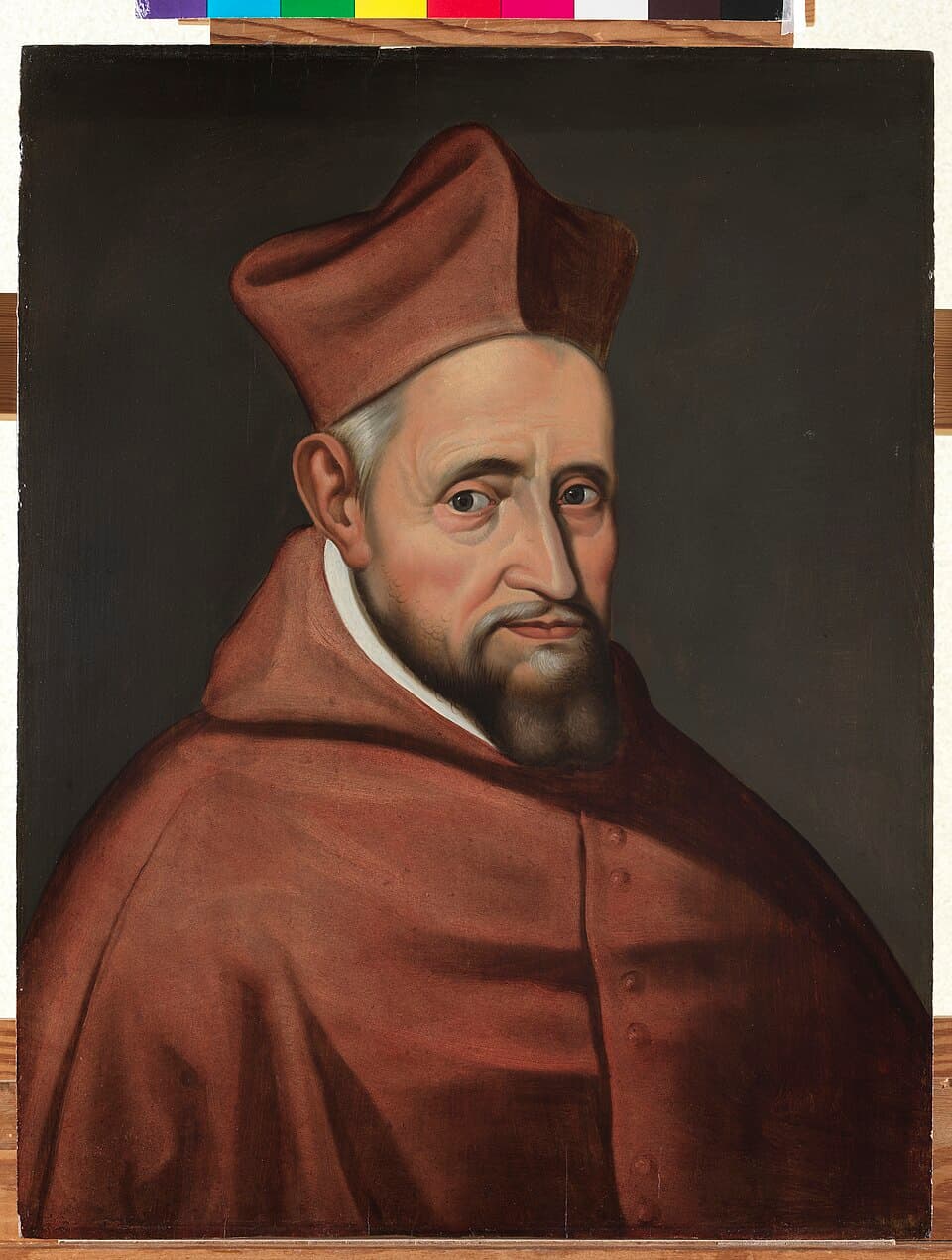
- Born
- Montepulciano, October 4, 1542; his mother was sister to the cardinal who became Pope Marcellus II 12
- Wrote
- De Controversiis, out of his Roman College lectures - Smith calls it "the earliest attempt to systematize the various controversies of the time" 12
- Galileo
- Corresponded with him as a friend, then had to deliver the Holy Office's condemnation in 1616 1
Saint Robert Bellarmine wrote the book that systematized every argument between Catholics and Protestants, and was condemned from both directions for the position he took on papal power - "in 1590 as too much of a Regalist and in 1605 as too much of a Papalist." 1 He was also Galileo's friend and correspondent, held what the encyclopedia calls exactly the right view of how science and Scripture should be reconciled, and had to deliver the condemnation anyway. 1
The chair of Controversies
He was born at Montepulciano in 1542, nephew on his mother's side of the cardinal who became Pope Marcellus II. 12 He entered the Society of Jesus in 1560, studied philosophy at the Roman College, taught the humanities at Florence and Mondovi, began theology at Padua, and was sent in 1569 to finish it at Louvain - where, Smith notes, "he could obtain a fuller acquaintance with the prevailing heresies." 1 Benedict XVI records that his studies there centered on Thomas and the Fathers, and were "crucial to his theological orientation." 2
Ordained at Louvain, he built a reputation as professor and as preacher, "in the latter capacity drawing to his pulpit both Catholics and Protestants, even from distant parts." 1 In 1576 he was recalled to Rome for the newly founded chair of Controversies at the Roman College, and held it for a decade. 12
The lectures became De Controversiis. Smith's verdict: "This monumental work was the earliest attempt to systematize the various controversies of the time, and made an immense impression throughout Europe." 1 Benedict praises the method rather than the impact, and the praise is more interesting. In a work organizing every theological dispute of the age, Bellarmine "avoids any polemical and aggressive approach in speaking of the ideas of the Reformation," and instead "using the arguments of reason and the Tradition of the Church, he illustrates the Catholic doctrine clearly and effectively." 2
Benedict also notes what the book is still used for. The Controversiae remain "a reference point, still valid, for Catholic ecclesiology," and while the institutional side of the Church is emphasized because of the errors then circulating, Bellarmine also set out the invisible side - the Mystical Body, explained through the analogy of body and soul. 2
Condemned from both sides
The sentence in Smith's article that says most about him in fewest words concerns his doctrine of the indirect power of the papacy in temporal affairs. For holding that middle position, Smith writes, "he was condemned in 1590 as too much of a Regalist and in 1605 as too much of a Papalist." 1
The same instinct shows in the Oath of Allegiance controversy in England. Smith describes an oath "craftily worded in such wise that a Catholic in refusing to take it might appear to be disavowing an undoubted civil obligation," while taking it would mean condemning as "impious and heretical" a doctrine the Holy See had claimed for centuries "and which even in that age the mass of the theologians of Europe defended." 1 When the oath was forbidden, King James came forward himself to argue the case, and Bellarmine answered him. 1
Benedict lists the offices without dwelling on them: Papal Theologian, consultor to the Holy Office, rector of the College of Confessors at St Peter's, cardinal in 1599, Archbishop of Capua in 1602, then member of the Congregations of the Holy Office, of the Index, for Rites, for Bishops and for the Propagation of the Faith, with diplomatic work in Venice and England. 2 The three years at Capua are the ones Benedict singles out for praise - preaching in his own cathedral, weekly parish visits, three diocesan synods and a provincial council. 2
Galileo
Benedict XVI's catechesis passes over this entirely. Smith gives it four sentences, and they are careful ones.
Bellarmine "had always shown great interest in the discoveries of that investigator, and was on terms of friendly correspondence with him." 1 On the general question he held, in Smith's judgment, "exactly the right attitude towards scientific theories in seeming contradiction with Scripture." 1 Smith sets out what that attitude was: a theory insufficiently proved "should be advanced only as an hypothesis; but if, as is the case with this theory now, it is solidly demonstrated, care must be taken to interpret Scripture only in accordance with it." 1 The evidence is Bellarmine's letter to Galileo's friend Foscarini.
Then the institution moved. "When the Holy Office condemned the heliocentric theory, by an excess in the opposite direction, it became Bellarmine's official duty to signify the condemnation to Galileo, and receive his submission." 1 Smith - a Jesuit writing in 1907 - calls the condemnation an excess, and records that the man who thought so had to deliver it. He notes too that Bellarmine "did not live to deal with the later and more serious stage of the Galileo case." 1
A catechism, and three hundred years
Among all the controversial literature, the work that reached most people was the smallest. Benedict notes the short catechism, Dottrina cristiana, written in 1597-98, as "one of his most popular works." 2 The patronage he now holds comes from that side of his life rather than from the Controversiae.
Benedict is insistent that the offices did not displace the pastor. "The burdensome offices of governance did not prevent him from striving daily for holiness," and because he was first of all a pastor of souls "he felt it was his duty to preach diligently" - hundreds of sermons in Flanders, Rome, Naples and Capua, and expositions of Scripture, especially Paul, to parish priests, women religious and students. 2
He was also the spiritual director of Aloysius Gonzaga at the Roman College and guided the last years of that young man's life; Smith records that many years later he had "the further consolation of successfully promoting the beatification of the saintly youth." 1 He sat on the final commission for the revision of the Vulgate. 1
His own cause took three centuries, and Smith explains why with a quotation that is unusually frank for an encyclopedia. Bellarmine's name was "closely associated with a doctrine of papal authority most obnoxious to the Regalist politicians of the French Court," and Benedict XIV wrote privately to Cardinal de Tencin: "We have said, in confidence to the General of the Jesuits, that the delay of the Cause has come not from the petty matters laid to his charge by Cardinal Passionei, but from the sad circumstances of the times." 1 He was beatified in 1923, canonized in 1930 and made a Doctor in 1931. 12
What is Saint Robert Bellarmine the patron saint of?
Saint Robert Bellarmine is the patron saint of catechists. New Advent's editorial note states it plainly: "He is the patron saint of catechists." 1 Franciscan Media lists catechists and catechumens together. 3 It is a fitting result for a man whose vast controversial literature is read now mostly by specialists, while the little Dottrina cristiana he wrote for ordinary people is the reason he is invoked. 2
Saint Robert Bellarmine's feast day
The feast of Saint Robert Bellarmine is September 17, the day he died in Rome in 1621. 123 The 1907 encyclopedia article could not print a feast day, because he had not yet been beatified - that came in 1923, sixteen years after Smith wrote. 1 Franciscan Media supplies the current date, and both sources agree on the death. 13
Praying with Saint Robert Bellarmine
The Galileo episode is the reason to read about him, and it is uncomfortable in a useful way. He was right about the principle, friendly with the man, and obliged to carry the decision he thought excessive. 1 Smith does not pretend otherwise and does not defend the Holy Office. Most people who work inside an institution will at some point have to deliver something they argued against, and it is worth knowing that a Doctor of the Church has been there.
Being condemned from both directions in fifteen years is the other thing. 1 The via media was not a way of avoiding trouble; it doubled it. He held a position that satisfied neither the king's party nor the pope's, and was punished by each in turn for not being the other.
Benedict's portrait is of a man who kept preaching through all of it, and he treats that as the inheritance rather than the books: the offices "did not prevent him from striving daily for holiness." 2 Hundreds of sermons, weekly parish visits as archbishop, Scripture expounded to parish priests and students. The Controversiae made his name; the catechism is why he is patron of catechists. 12
Benedict ends on the interior life and says something specific about its tone. The hallmark of Bellarmine's spirituality is "his vivid personal perception of God's immense goodness," which is why he "truly felt he was a beloved son of God," and why it was a source of great joy to him "to pause in recollection, with serenity and simplicity, in prayer and in contemplation of God." 2 That is an unexpected description of the most formidable controversialist of his age, and it comes from a man who had read him closely.
Saint Robert Bellarmine, pray for us.
Sources
Saints to turn to next
Others in this collection who are turned to for some of the same things.
- Saint Thomas Aquinasc. 1225 - March 7, 1274Study and teachingPrayerDiscernment
- Saint Bonaventure1217 or 1221 - July 15, 1274Study and teachingPrayerDiscernment
- Saint Augustine of HippoNovember 13, 354 - August 28, 430Study and teachingDiscernment
- Saint Gregory the Greatc. 540 - March 12, 604DiscernmentStudy and teaching